
The Stone That Became a Civilization
In the West, diamonds hold the top position in the hierarchy of precious stones. In China, for more than 5,000 years, that position has belonged to jade — specifically, to the stone that Chinese people call yu, written as 玉.
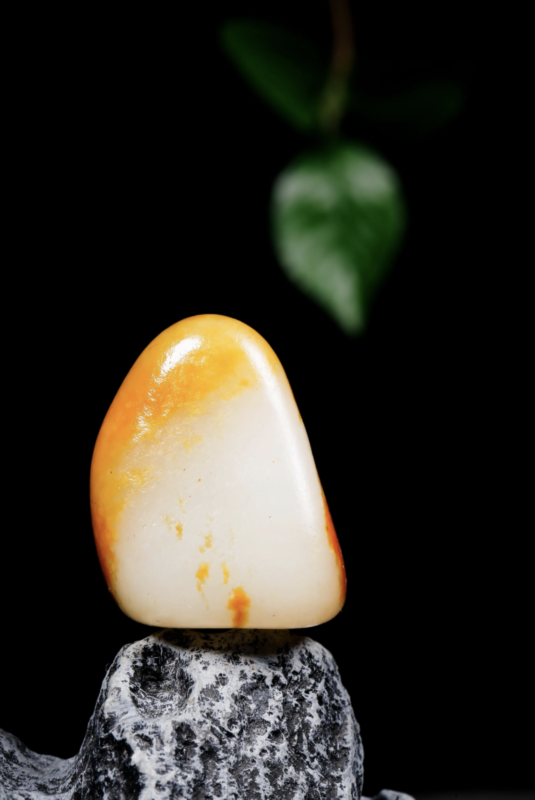
White jade refers to jadeite or nephrite in its light-colored, translucent white or near-white form. In China, the finest white jade — known as Hetian jade, named after the Hetian region of Xinjiang — was historically the most prized variety. Hetian jade forms in metamorphic rocks deep in the mountains of western China, and its milky white translucency comes from fine fibrous tremolite actinolite intergrown within the stone. Unlike crystals that form in visible geometric shapes, jade’s structure is interlocking microscopic fibers — which is why jadeite and nephrite are technically metamorphic rocks rather than minerals. That interlocking fiber structure is what gives jade its remarkable toughness: it is harder to break than steel in certain directions, and has outlasted empires.
Archaeological excavations at the Dadiwan and Xinglongwa sites in northern China have uncovered jade artifacts dating back to 6000 BCE — making jade one of the earliest worked stones in human history. These were not merely decorative objects: the earliest jade artifacts were ritual implements — bi discs, cong tubes, and axe heads — found in graves, placed there as symbols of status, spiritual connection, and cosmic order. The Chinese word for jade, yu, also forms part of the word for emperor (huang, 黄) and appears in words meaning virtue, beauty, and excellence — a linguistic heritage that reflects how deeply jade embedded itself in Chinese culture.
A Stone That Became a Civilization’s Soul
No other stone has shaped a civilization the way jade shaped China.
Ancient China: In classical Chinese civilization, jade was not merely a precious material — it was a philosophical and spiritual ideal. Confucius described jade as possessing all eleven Confucian virtues: humanity, justice, propriety, wisdom, sincerity, harmony, loyalty, Heaven, Earth, morality, and peace. A gentleman wore jade because it reminded him of virtue. A ruler held jade because it symbolized Heaven’s mandate. Jade burial suits — sewn with thousands of jade pieces connected by gold, silver, or copper thread — appeared in the Han dynasty (206 BCE–220 CE), designed to preserve the bodies of emperors for eternity. The famous jade bianzhong — a large musical instrument carved entirely from white and pale green jade — is one of the most extraordinary surviving artifacts of ancient Chinese craftsmanship, demonstrating the depth of skill that jade work had reached by 300 BCE.
Myanmar (Burma): The finest white jade in the modern market comes not from China but from Myanmar — specifically from theHpakan-Tawmaw jade field in Kachin State, where jadeite of exceptional translucency and color quality forms in serpentine rocks. The trade in Burmese jade has shaped Myanmar’s economy for centuries, and the material — traded into China through Yunnan — represents a major conduit of cultural exchange between Southeast Asia and the Chinese heartland.
Mesoamerica: Jade held a position of similar sacred importance in Maya and Olmec civilizations, though the specific stones used — jadeite from Guatemala — were geologically distinct from Chinese nephrite. The Maya prized vivid green jade above all other stones, using it for royal tomb offerings, elite jewelry, and as a symbol of the Maize God. The famous jade mask of Pacal the Great, ruler of Palenque, is the most celebrated example of Maya jade craftsmanship — a burial offering that depicts the king’s face reconstructed in jade, meant to give him eternal life. The word for jade in most Maya languages shares roots with words meaning “precious,” “green,” and “life.”
What makes jade extraordinary is not just its beauty, but its endurance. Diamonds fracture; gold bends; silver tarnishes. Jade — when properly worked and cared for — outlasts the civilizations that carved it. A piece of Han dynasty jade can sit in a museum case for two thousand years and emerge looking as fresh as the day a craftsman set down his tools. That quality — permanence in a changing world — is the deeper reason Chinese culture came to associate jade with virtue, longevity, and the continuity of what matters most.
Spiritual Properties & Energetic Qualities
In the modern crystal lexicon, jade — particularly white jade — is described as a stone of serenity, balance, and nurturing protection.
Contemporary energy practitioners describe white jade as one of the most gentle and stabilizing stones available. Unlike crystals described as energizing or clarifying, white jade is characterized as calming and grounding — a stone that supports emotional equilibrium rather than driving transformation. For people who feel anxious, overwhelmed, or emotionally scattered, white jade is frequently described as a stone that brings a quiet sense of stability and ease. It is not dramatic or stimulating; it is steady, reliable, and deeply reassuring.
White jade is also described as a stone that supports healthy boundaries — not aggressive or defensive boundaries, but the kind of quiet, clear boundaries that come from knowing your own center. In this reading, jade acts as a stabilizing presence in difficult environments, helping the wearer remain centered when the surrounding energy is chaotic or draining. This quality connects directly to its ancient Chinese association with virtue: a person of strong character is not easily moved by external circumstances, and white jade is described as supporting that inner steadiness.
Finally, jade — and white jade in particular — is widely described as a stone of longevity and endurance. This is not a medical claim about the stone supporting physical health; it is a description of jade’s energetic qualities as a stone that supports perseverance, patience, and the willingness to persist through long periods of difficulty. Wearing jade during a long project, a difficult transition, or a period of sustained effort is a common practice — described as a way to call on jade’s ancient quality of endurance for your own purposes.
Who Is White Jade For
White jade is one of the most approachable and versatile crystals you can work with. It suits people who feel overwhelmed, overstimulated, or emotionally fragile — providing a sense of stability that is present without being forceful. If you are navigating a difficult period that will require sustained effort — a demanding project, a health challenge, a long transition — white jade is traditionally regarded as a supportive companion for the long haul, not a quick fix.
White jade is also particularly meaningful for people drawn to its historical and cultural depth. Unlike many crystals whose associations come primarily from modern practice, jade carries five thousand years of documented human meaning — making it one of the few stones whose contemporary use is directly continuous with its ancient purpose. If you value heritage, permanence, and the sense of connecting to something very old and very enduring, white jade speaks to that aspiration in a way few other stones can.
When to Wear
- During demanding or high-pressure situations that require sustained focus and emotional stability.
- On days when you feel emotionally fragile, scattered, or overwhelmed — jade’s quiet steadiness is particularly grounding.
- During long projects, transitions, or periods of difficulty that require patience and endurance.
- As a daily companion for anyone drawn to the cultural depth and enduring quality of jade.
Small pauses.Big shifts.Find your piece→
Care Guide
White jade is a dense, durable stone, but it benefits from thoughtful care that protects both its surface luster and its energetic qualities over time.
Avoid impact with hard surfaces. Jade’s interlocking fiber structure makes it remarkably tough overall, but a sharp blow at the right angle can chip or crack the surface. This is particularly important for jade beads and carved pieces, which have thin sections that are more vulnerable than the main body of a solid piece.
Keep jade away from harsh chemicals. Perfume, hairspray, cleaning agents, and cosmetics can gradually erode the surface polish of jade. Apply sprays and creams before putting on jade jewelry, and wipe it gently with a soft cloth after wearing. Warm, soapy water is safe for cleaning jade — use a soft brush to clean around carved details.
Store jade separately from harder stones (diamonds, sapphires, rubies) to prevent scratching. Jade is hard enough to scratch most metals and glass, but it can be scratched by harder gemstones. A soft pouch or lined jewelry box is ideal. For energetic cleansing, smudging with sage or placing jade on a crystal cluster are gentle, effective methods that support the stone’s described stabilizing properties over time.
Further Reading & References
1. The Book of Jade — Der-Chen Holtzman and Susan G. Holtzman, Chronicle Books, 1997.
A beautifully produced illustrated guide to jade — its history, symbolism, and cultural significance in Chinese civilization.
2. Chinese Jades: Collected Writings of Gustav Arlt — Gustav Arlt, University of Washington Press, 1978.
A scholarly collection of writings on Chinese jade — its archaeological history, material properties, and role in Chinese ritual and culture.
3. Jade: Stone of Immortality — S.I. Majumdar, edited, National Book Trust India (various editions).
A comprehensive overview of jade’s role across Asian cultures, including Chinese, Burmese, and Mesoamerican traditions.
4. The Maya Jade — Jeremy A. Sabloff, Harvard University Press, various editions.
A concise, authoritative exploration of jade’s central role in Maya civilization, from royal burials to everyday ritual.
5. The British Museum — Chinese Jade Collection — https://www.britishmuseum.org/collection/search?subject=Jade (accessed 2026)
The British Museum holds one of the world’s most significant collections of Chinese jade artifacts, including Neolithic bi discs, Han dynasty burial objects, and imperial jewelry.