
Chatoyance: The Stone That Moves
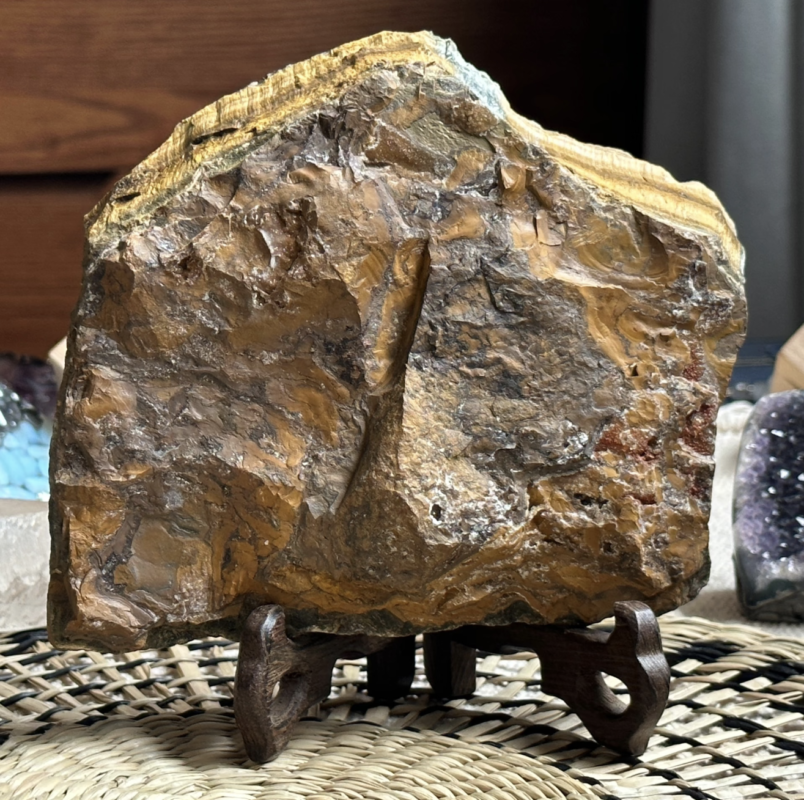
Tiger eye — also spelled tiger’s eye — is one of the most visually striking stones in the quartz family, and its defining characteristic is chatoyancy: a movable band of light that appears to move across the surface of the stone as you rotate it. This effect, sometimes called “the cat’s eye effect,” comes from the parallel alignment of crocidolite fibers within the stone. When light strikes these parallel fibers at different angles, it reflects back at different intensities — creating the appearance of a luminous band moving across the stone’s surface, like a cat’s eye dilating in the dark.
Tiger eye is a pseudomorph: one mineral that has replaced another while retaining the original crystal shape. In this case, quartz has replaced crocidolite — a blue mineral in the riebeckite family — while preserving the original fibrous structure that creates the chatoyant effect. This transformation takes millions of years and produces one of the most distinctive optical effects in the mineral world.
The classic golden-brown tiger eye is the most common variety, but tiger eye also occurs in blue (hawk’s eye), red-brown (ox eye), and green (pietersite) varieties. The warm golden and brown tones that give tiger eye its name come from iron oxidation within the stone during the transformation process. Tiger eye rates 7 on the Mohs scale — hard and durable enough for everyday jewelry wear — and takes a high polish that brings out the chatoyant effect to best advantage.
A Stone for Warriors and Seekers
Tiger eye’s visual drama — the band of light moving across its surface — has captivated human cultures for thousands of years, and its symbolism reflects that hypnotic quality.
Ancient Rome: Roman soldiers particularly valued tiger eye and carried it as a protective talisman in battle. The stone’s movable band of light was associated with the eye of a deity or spirit watching over the wearer — providing protection, vigilance, and clarity in the midst of combat. The Romans called it “the stone of prophecy,” believing it enhanced the wearer’s ability to anticipate danger and respond with clear, decisive action.
Ancient Egypt & North Africa: Some evidence suggests Egyptian cultures used tiger eye as a protective amulet, associating its warm golden color with the sun and with Ra, the god of the sun. In North African traditions, the stone was used by traders and travelers as a talisman for safe passage through dangerous territories. The stone’s chatoyant eye effect was interpreted as an ever-vigilant guardian spirit — always watching, always protecting.
South Africa & Asia: South Africa is one of the world’s primary sources of tiger eye, and the stone features prominently in indigenous Southern African traditions. In Chinese and broader East Asian cultures, tiger eye was associated with the tiger — the animal of courage, power, and territorial confidence. It was carried as a charm for bravery and for maintaining clear boundaries — personal, territorial, and energetic. This association connects directly to modern practitioners’ description of tiger eye as a stone for confidence and clear personal boundaries.
Across cultures, tiger eye’s defining symbolic quality is vigilance without anxiety — the calm watchfulness of a creature that is always alert but never tense. That quality — steady confidence, clear focus, and grounded courage — is what has made tiger eye one of the most consistently valued talismanic stones in human history.
Spiritual Properties & Energetic Qualities
In the modern crystal lexicon, tiger eye is described as one of the most grounding and stabilizing stones available — particularly valued for its ability to promote calm confidence without aggression or tension.
Contemporary energy practitioners describe tiger eye as a stone that brings focus and mental clarity during stressful or high-pressure situations. Unlike stimulants that increase anxiety, tiger eye is characterized as producing a quality of calm alertness — steady, focused attention without the nervous energy that often accompanies it. For people who freeze under pressure or who become scattered when stakes are high, tiger eye is traditionally used as a supportive stone for maintaining grounded, clear-headed action.
Tiger eye is also widely described as a stone that supports personal boundaries and confident self-presentation. This is not aggressive or dominant — it is the quiet confidence of someone who knows their value and does not need to prove it. For people who tend to defer, to diminish themselves in the presence of stronger personalities, or who have difficulty asserting their needs, tiger eye is characterized as a supportive companion — helping to bring a quality of grounded self-assurance to interpersonal situations.
Finally, tiger eye is described as a stone of good fortune and prosperity in many traditions. In feng shui and broader Eastern practices, placing tiger eye in specific areas of a space or wearing it during business negotiations or financial decisions is described as a way to attract the kind of luck that comes from being clear-eyed, focused, and ready when opportunity arrives — rather than any supernatural form of chance.
Who Is Tiger Eye For
Tiger eye is one of the most practical crystals you can work with — it suits people who need calm focus during high-pressure situations, who tend to freeze or scatter when stakes are high, or who need support in maintaining clear personal boundaries.
If you are preparing for a high-stakes situation — a presentation, a negotiation, a performance, an important conversation — tiger eye is traditionally used as a supportive companion for that moment, described as helping to keep attention focused and nerves calm.
If you tend to diminish yourself in group settings or find it hard to assert your needs, tiger eye may serve as a grounding support — helping to bring a quiet, steady quality of self-assurance that doesn’t need to announce itself but simply is. And if you are drawn to the chatoyant beauty of the stone itself — the warm golden light moving across its surface — tiger eye jewelry is among the most visually striking pieces you can wear.
When to Wear
- During high-pressure situations that require clear focus and calm nerves — presentations, negotiations, performances, important conversations.
- On days when you need steady confidence without nervous energy — when calm alertness is more useful than adrenaline.
- During business activities or financial decisions — tiger eye is traditionally used as a prosperity and focus stone.
- As a daily companion during periods when you need to maintain clear boundaries with others — professional, personal, or energetic.
Small pauses.Big shifts.Find your piece→
Care Guide
Tiger eye is one of the more durable options in the quartz family — a Mohs hardness of 7 and its fibrous internal structure make it a practical choice for daily wear. That said, a few simple habits will keep it looking its best and preserve the chatoyant effect.
Clean tiger eye with warm, soapy water and a soft brush. It is safe in water for regular cleaning. Avoid harsh chemicals, which can dull the surface polish over time. A regular wipe with a soft cloth after wearing helps maintain the high luster that makes the chatoyant effect most visible.
Store tiger eye separately from harder gemstones, particularly diamonds and sapphires, which can scratch its surface. A soft pouch or lined jewelry box is ideal. Avoid prolonged exposure to strong direct sunlight, which can cause some tiger eye varieties to fade over very long periods.
For energetic cleansing, sage smudging or placing on a crystal cluster are gentle, effective methods. Tiger eye is described as a grounding, stabilizing stone that tends to require cleansing less frequently than lighter or more porous stones — making it a relatively low-maintenance crystal to work with over time.
Further Reading & References
1. The Crystal Bible — Judy Hall, Godsfield Press, 2003 (first edition); revised and expanded in subsequent editions.
One of the world’s best-selling crystal reference guides, with a detailed entry on tiger eye and its chatoyant varieties.
2. The Book of Stones — Robert Simmons & Naisha Ahsian, North Atlantic Books, multiple editions since 2005.
Widely regarded as one of the most authoritative references in the modern crystal field. The tiger eye entry covers its formation, varieties, and energetic properties in depth.
3. The Encyclopedia of Crystals, Herbs, and New Age Items — Rosemary Gladstar, Storey Publishing, 2012.
A foundational reference in the contemporary crystal and holistic wellness community.
4. GIA — Gemological Institute of America: Tiger Eye — https://www.gia.edu/tigers-eye/ (accessed 2026)
The Gemological Institute of America’s official information on tiger eye — covering its chatoyancy, formation, varieties (including hawk’s eye and ox eye), and care.
5. Mindat.org — Mineral Database — https://www.mindat.org/ (accessed 2026)
One of the world’s largest and most authoritative mineralogy databases, with detailed geological information on tiger eye formation and global sources.
FAQ
Tiger eye is a chatoyant variety of quartz, formed when quartz replaces the mineral crocidolite while preserving its parallel fibrous structure. This structure creates the stone’s characteristic movable band of light — called chatoyancy — that appears to glide across the surface as you rotate the stone. It is found primarily in South Africa and occurs in golden-brown (classic), blue (hawk’s eye), and red-brown (ox eye) varieties.
Tiger eye has been valued as a talismanic stone for thousands of years. Roman soldiers carried it for protection and clear focus in battle; ancient Egyptian and North African traditions associated it with the sun and with vigilance. Today practitioners describe it as a stone of calm confidence, clear focus, and grounded courage — helping the wearer stay alert and centered during high-pressure situations without anxiety or aggression.
Clean tiger eye with warm soapy water and a soft brush — it is safe in water for regular cleaning. Avoid harsh chemicals, which dull the polish. Store separately from harder gemstones to prevent scratching. Avoid prolonged strong sunlight, which can cause fading over time. For energetic cleansing, sage smudging or a crystal cluster work well. Tiger eye is a relatively low-maintenance stone that requires cleansing less frequently than lighter varieties.