Material
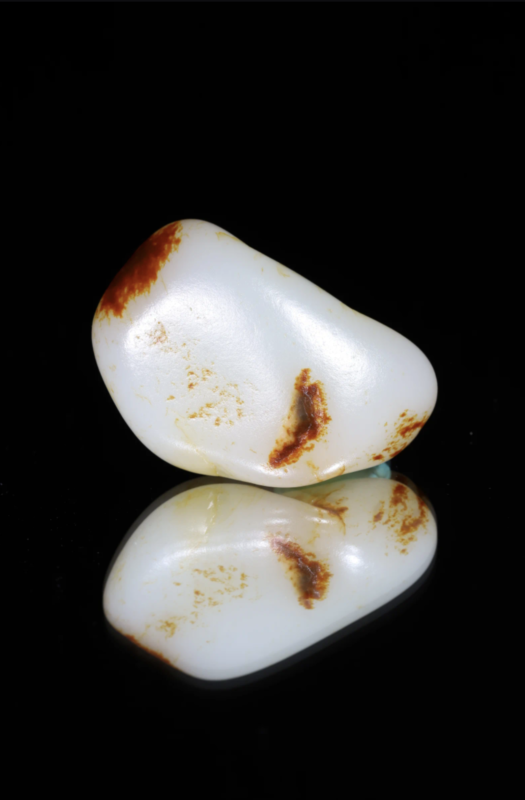
Hetian Jade — known in Chinese as hetian yu (和田玉) — is a variety of nephrite, a calcium-rich magnesium-iron silicate mineral belonging to the tremolite-actinolite series of the amphibole group. Its chemical composition is fundamentally different from jadeite (翡翠, also called “jade” in the West but a completely distinct mineral). Hetian Jade forms through the metamorphism of dolomitic marble in the region’s complex geological environment, and its finest specimens are sourced from the alluvial deposits of the Hotan River and its tributaries in the Xinjiang region of western China. The material is characterized by a dense, fine-grained microstructure that gives it an exceptionally smooth, almost oily luster when polished — a quality known as “warm luster” (和田玉的温润感) that distinguishes it from the harder, more glassy appearance of jadeite. Hetian Jade ranges in color from pure white (called yangzhi baiyu, 羊脂白玉 — “mutton fat white jade” for its creamy, translucent quality) to pale celadon green, pale lavender, and warm yellow. The most prized variety is pure white with a translucent, waxy quality reminiscent of solidified fat — hence the poetic name. Three primary types of Hetian Jade are recognized based on their geological origin: mountain stone (shanliao, 山料), extracted from quarry sites in the Kunlun Mountains; mountain runoff stone (shanliushui, 山流水), partially transported from its source by natural forces; and pebble stone (ziliao, 籽料), river-transported pebbles found in the Hotan River beds — the rarest and most valued of all. The scarcity of high-quality Hetian Jade, particularly top-grade ziliao, has made it one of the most valuable jade materials in the world.
Cultural Significance
Hetian Jade occupies a position in Chinese civilization that no other stone quite matches: it is not merely valued, it is woven into the language, the philosophy, the rituals, and the moral imagination of an entire culture.
Neolithic China: Jade artifacts dating to the Liangzhu culture (c. 3400–2250 BCE) in the Yangtze River Delta represent some of the earliest and most sophisticated jade working in human history. While the Liangzhu culture primarily used nephrite from local sources, the tradition of using nephrite jade in ritual objects was already deeply established. The famous Liangzhu jade cong (cylindrical ritual objects) and bi (circular ritual discs) demonstrate a level of precision and symbolic sophistication that would define Chinese jade culture for the next five millennia.
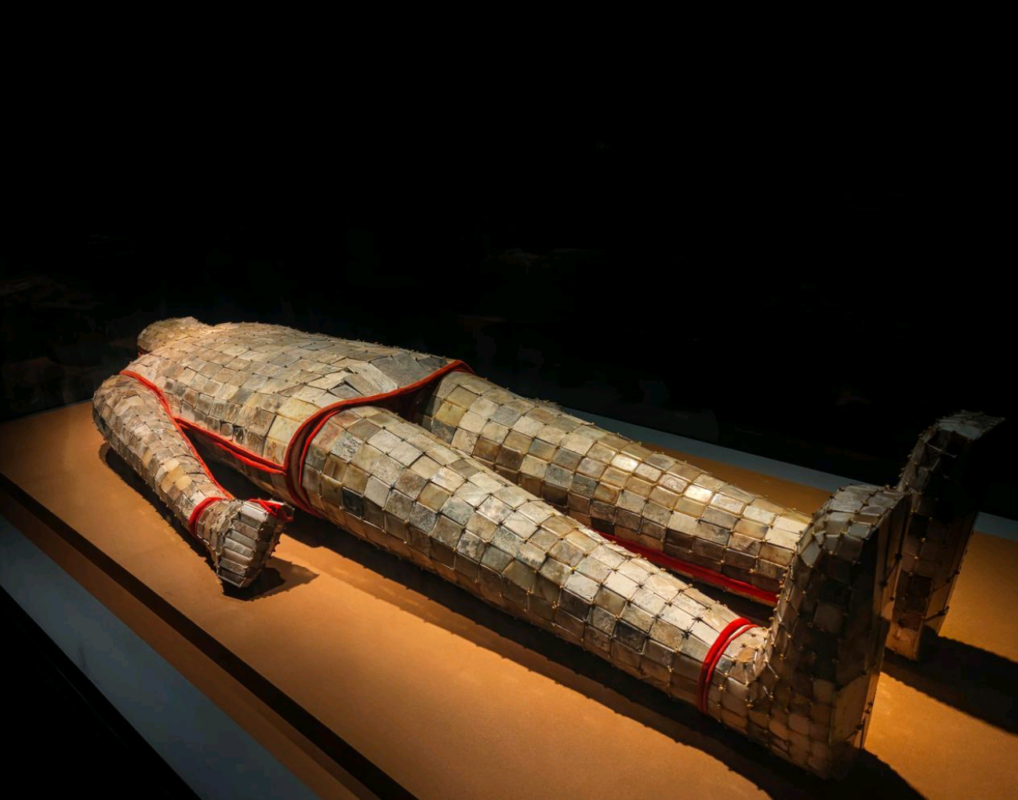
Shang and Zhou Dynasties: By the time of the Shang Dynasty (c. 1600–1046 BCE), Hetian Jade from the Kunlun Mountains had become the material of choice for the most sacred ritual objects. The famous jade burial suits (yuyi, 玉衣) — sewn from thousands of individual jade pieces and placed over the bodies of royalty — were the ultimate expression of wealth, status, and spiritual protection in ancient China. The Zhou Dynasty formalized jade’s place in Confucian ethics, establishing the Five Virtues of jade: benevolence (ren, 仁), righteousness (yi, 义), wisdom (zhi, 知), propriety (li, 礼), and bravery (yu, 勇).
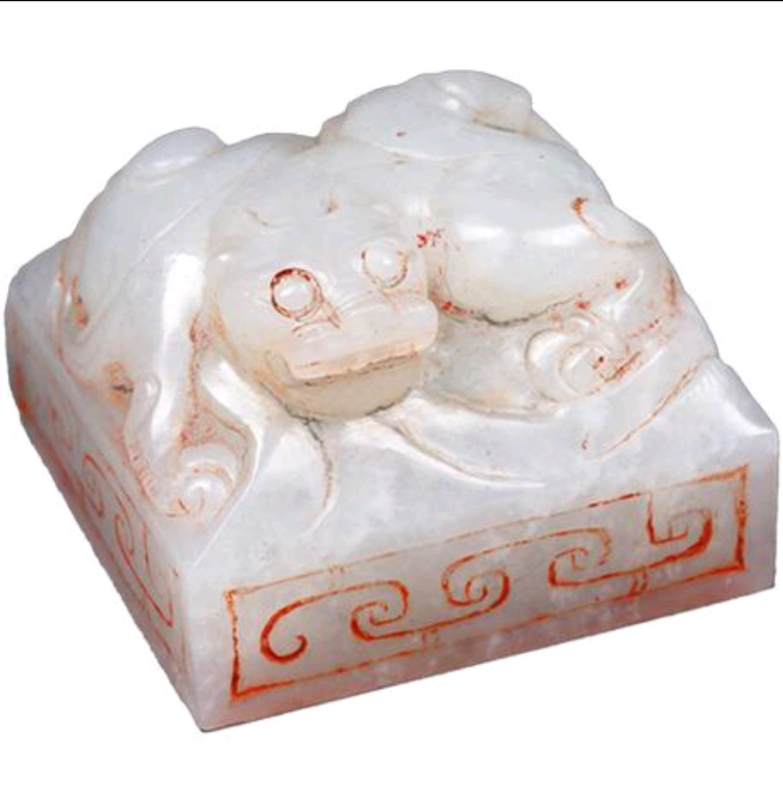
Imperial China: Throughout the Han, Tang, Song, Yuan, Ming, and Qing dynasties, Hetian Jade remained the jade of emperors. The Qing Dynasty Emperor Qianlong is legendary for his obsession with Hetian Jade — his personal collection of jade carvings was among the finest ever assembled, and he was known to compose poetry about his favorite pieces. Imperial seals, ceremonial objects, and personal ornaments in Hetian Jade were reserved exclusively for the emperor’s household.
Tibetan Buddhist Tradition: In Tibet and among Tibetan Buddhist practitioners, Hetian Jade (particularly the green celadon variety) is highly valued as a material for ritual objects, prayer beads, and protective amulets. It is associated with the Green Tara and is considered an auspicious material for devotional purposes.
Modern China: Today, Hetian Jade remains the most prestigious and sought-after jade variety in China, where it is understood not simply as a gemstone but as a cultural artifact — a piece of civilization that you carry. It is gifted at major life events: births, graduations, weddings, and significant birthdays. Its market value, particularly for high-quality ziliao, has risen consistently for decades and continues to command premium prices.
The recurring theme across five thousand years of Chinese culture is this: Hetian Jade is not merely beautiful. It is the material form of something moral and spiritual — a stone that embodies the Confucian ideal of refined virtue expressed through physical beauty.
Energetic Qualities
Hetian Jade is regarded in Chinese and East Asian energy traditions as the supreme embodiment of jade energy — a stone of cultivation, refinement, and the quiet accumulation of virtue over time. Unlike more dramatic crystals whose energy announces itself, Hetian Jade’s power is subtle, persistent, and cumulative — like the slow formation of the stone itself. Its most defining energetic quality is warmth: a stone that seems to carry a temperature slightly warmer than its surroundings, as though it holds something alive inside it. Practitioners value Hetian Jade for its association with the cultivation of the self — a stone that supports patience, gentleness, and the long, unglamorous work of becoming a better person. In Chinese philosophy, jade’s dense, compact structure is the physical counterpart to moral integrity: a person who is whole, undivided, and complete on the inside expresses that quality outwardly, just as jade is whole and undivided within. Hetian Jade is also associated with the heart in traditional Chinese medicine and energy work, where it is valued for supporting emotional balance, compassion, and the ability to act from a place of inner stillness rather than reactive emotion. Many who wear Hetian Jade describe it as a stone that grows more beautiful with time — and this is understood not merely as a matter of polish, but as a genuine reciprocal relationship: the jade absorbs the wearer’s energy and care and reflects it back as beauty, just as a cultivated person reflects the culture they have absorbed. It is a stone for those who are in it for the long run — who understand that the finest things in life are those that develop slowly, over years, with consistent attention and care.
Who It Suits
Those deeply connected to Chinese culture, East Asian heritage, or Tibetan Buddhist tradition and who want a piece of jewelry that carries that civilizational weight with authenticity
Individuals on a path of personal cultivation — whether through meditation, philosophy, the arts, or a deliberate way of living — who want a stone companion for that journey
People who appreciate subtlety and refinement over ostentation, and who recognize that the finest things are often the most understated
Collectors and connoisseurs who understand the difference between common jade and premium Hetian Jade, and who value authenticity and provenance
Anyone looking for a meaningful, enduring gift for a major life milestone — a piece that carries both beauty and significance
When to Wear It
Daily cultivation: A piece worn as a daily reminder of one’s intentions and values — Hetian Jade rewards consistency, and the regular contact of wearing it is part of the practice
Quiet, significant occasions: Appropriate for ceremonies, formal occasions, or any moment where presence and refinement matter — a piece that elevates without announcing itself
Meditation and contemplative practice: A smooth, cool piece of Hetian Jade held in the hand during seated practice creates a natural tactile anchor, supporting stillness and inward attention
Professional and social settings: Its understated elegance makes it appropriate for business and creative environments where personal presence carries weight — Hetian Jade communicates quiet confidence rather than display
Small pauses.Big shifts.Find your piece→
Care Instructions
Clean with lukewarm water and a soft cloth; avoid acidic or alkaline substances (including fruit juices, perfumes, and cleaning agents), which can dull the stone’s surface over time
Remove before activities involving impact, hard surfaces, or abrasive materials — while nephrite is relatively tough, it can be scratched by harder materials including diamond and sapphire
Store in a soft pouch or lined jewelry box away from other gemstones, particularly harder varieties; Hetian Jade scratches more easily than jadeite, though it is less brittle
Handle with clean hands — the oils from frequent handling actually polish the stone naturally over time, which is one reason jade becomes more beautiful with wear
Avoid prolonged exposure to strong heat or sudden temperature changes, which may cause internal stress in the stone over many years; treat it with the same respect you would any heirloom
Further Reading
Rawson, Jessica. Chinese Jade: The Image Refined. British Museum Press, 2016.
Gropp, R. Eric. “Jade: Stone of Immortality.” Arts of Asia, Vol. 34, No. 4, 2004.
Hansford, S. Howard. Chinese Jade Carving. Lund Humphries, 1950.
Palmgren, Nils. Selected Chinese Antiquities from the Collection of Gustav Adolf, Crown Prince of Sweden. Stockholm, 1948.Palace Museum, Beijing — Jade Collection: https://www.dpm.org.cn/
FAQ
Hetian Jade (和田玉, hetian yu) is a variety of nephrite — a calcium-rich magnesium-iron silicate mineral — sourced primarily from the Hotan River region in Xinjiang, western China. It is fundamentally different from jadeite (翡翠), which is a separate mineral entirely. Hetian Jade is characterized by an exceptionally smooth, warm luster when polished and ranges in color from pure white to pale celadon green, lavender, and warm yellow.
The defining quality of Hetian Jade is its “warm luster” (温润感) — a dense, fine-grained microstructure that gives it an almost oily sheen distinctly different from the harder, more glassy appearance of jadeite. The rarest and most valued variety is “ziliao” (籽料) — river pebbles found in the Hotan River beds, characterized by their pure white color and translucent, waxy quality.
Hetian Jade has been revered in Chinese civilization for over 5,000 years. The Confucian tradition established the Five Virtues of jade — benevolence, righteousness, wisdom, propriety, and bravery — and imperial China reserved Hetian Jade exclusively for the emperor’s household. It is understood not as a gemstone but as a cultural artifact — the material form of refined virtue.
Yes — in Tibet and among Tibetan Buddhist practitioners, Hetian Jade (particularly the green celadon variety) is highly valued for ritual objects, prayer beads, and protective amulets. It is associated with the Green Tara and considered an auspicious material for devotional purposes.
Clean with lukewarm water and a soft cloth. Avoid acidic or alkaline substances including perfumes and cleaning agents. Handle with clean hands — the natural oils from handling actually polish the stone over time, which is why jade becomes more beautiful with wear. Store in a soft pouch away from harder gemstones.
Yes, Hetian Jade is well-suited for daily wear. However, remove it before activities involving impact or contact with abrasive materials, as nephrite can be scratched by harder stones including diamond and sapphire.
In Chinese tradition, this is understood as a genuine reciprocal relationship — jade absorbs the wearer’s energy and care over years of contact and reflects it back as beauty. Physically, the natural oils from handling gradually polish the surface to a higher luster.
High-quality Hetian Jade — particularly top-grade ziliao (river pebble) — has shown consistent value appreciation over decades and continues to command premium prices, especially in the Chinese market. For collectors and connoisseurs who understand authenticity and provenance, it is regarded as both a cultural artifact and a meaningful investment.