
The Stone
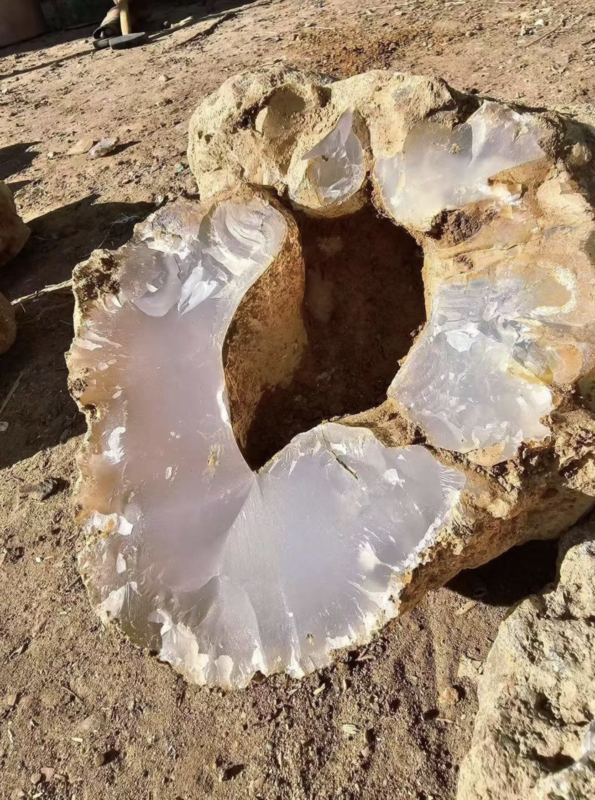
White agate is a rare variety of the chalcedony family, a microcrystalline form of quartz composed primarily of silicon dioxide (SiO₂). It presents as a translucent to semi-translucent stone in shades of pure white, soft grey, and cream — with a texture often described as resembling frozen morning light. Unlike its more visibly crystalline counterparts, white agate has a dense, fine-grained structure that gives it a smooth, waxy-to-vitreous luster and a distinctly cool, pleasing touch against the skin.
White agate forms through the slow deposition of silica-rich solutions in cavities within volcanic rock, typically at relatively low temperatures. This process often results in the banded or layered patterns characteristic of agate varieties, though premium white agate — prized for its even, luminous tone — forms under conditions that minimize these inclusions.
Cultural Significance
Ancient Egypt associated white agate with Thoth, the god of wisdom and writing. It was commonly carved into amulets and seals believed to confer divine protection and mental clarity upon the wearer.
Ancient Rome valued white agate for cameos, signet rings, and fine carvings presented as gifts of distinction. Its use among the educated classes carried associations with purity, loyalty, and refined taste.
Traditional Chinese culture has long placed white stones at the pinnacle of jade appreciation. While white nephrite (hetian yu) commands the highest prestige, white agate — known as bai yu sui — has long been valued in its own right. Within Confucian and Taoist frameworks, jade in any fine form represents the five virtues: benevolence, righteousness, wisdom, courage, and temperance. A pure white stone, luminous as moonlight, symbolizes a clarity of mind and a purity of intent that transcends worldly distraction.
Japanese lapidary traditions similarly connect fine white stones to shrine ritual and spiritual practice, viewing them as vehicles for connecting earthly and celestial realms.
Across cultures, the through-line is consistent: white agate speaks to clarity of mind, purity of intent, and a stillness that endures.
Energetic Qualities
White agate is often described as a stone of quiet stability. Its presence is unobtrusive — it does not demand attention, but it holds its ground. Where other stones are energetic or activating, white agate tends toward equilibrium: a steady, grounded calm that many find grounding in daily life.
It is commonly associated with:
- Encouraging emotional equilibrium and a settled state of mind
- Supporting mental clarity and focus, especially during periods of transition or noise
- Symbolizing the quality of “letting go” — releasing what no longer serves, reducing unnecessary weight
Core energetic signature: quiet, stable, self-contained.
Who It’s For
- People who experience restless thinking or scattered focus and are looking for a quiet anchor in their daily routine
- Those who work in creative or high-stimulation environments and want a piece that carries meaning without announcing it
- Anyone drawn to minimalist jewelry with depth — pieces that are understated yet intentional
- Those who value their inner life and seek objects that feel like companions rather than accessories
When to Wear It
- Morning ritual: As a first gesture of the day — something you put on with intention before the world begins
- Before important conversations: Meetings, negotiations, or difficult calls where calm clarity matters
- During moments of transition: Commutes, solo meals, the quiet hours between tasks
- Everyday wear: It asks for very little and gives back in return — a piece that becomes part of your routine without becoming part of your noise
Care Guide
- Avoid contact with perfumes, lotions, and cleaning products, which can dull the surface over time
- Keep away from sudden temperature changes and prolonged direct sunlight to prevent thermal stress
- Clean gently with a soft, dry cloth after wearing
- Store separately from harder stones to prevent surface scratching
Further Reading
- The Crystal Bible, Judy Hall, Godsfield Press, 2003 — A comprehensive reference guide to agate and the quartz family
- The Book of Stones, Robert Simmons & Naisha Ahsian, North Atlantic Books, 2007 — Authoritative work on crystal energetic qualities, with detailed agate entries
- Gemological Institute of America (GIA): gia.edu/agate — Official gemological reference on agate mineralogy
FAQ
No. White agate belongs to the quartz family (chalcedony/agate), primarily composed of silicon dioxide (SiO₂). White jade (hetian yu / nephrite) is a variety of jadeite, composed mainly of tremolite-actinolite. They are entirely different minerals.
Primarily white, with variations ranging from soft grey and cream white to blush pink. The highest-quality specimens feature even color distribution, a smooth waxy luster, and translucent clarity.
Yes. With a hardness of 6.5–7 on the Mohs scale, white agate is durable enough for regular use. Avoid hard impacts and prolonged exposure to chemicals.
Keep it away from perfumes, lotions, and cleaning products. Clean gently with a soft, dry cloth after wearing. Store separately in a soft pouch or jewelry bag to prevent scratching from harder stones.
The Crown Chakra (Sahasrara), located at the top of the head. It is traditionally associated with intuition, higher wisdom, and a sense of inner clarity.
White agate is a microcrystalline quartz with a cool, smooth touch and a waxy-to-vitreous luster. Pearl has a soft, iridescent glow from organic nacre. Diamond is the hardest mineral and creates brilliant light refraction. Moonstone displays a signature blue schiller called adularescence. Each stone has its own distinct beauty — white agate’s advantage lies in its warm translucency and accessible price point.