
The Mantra
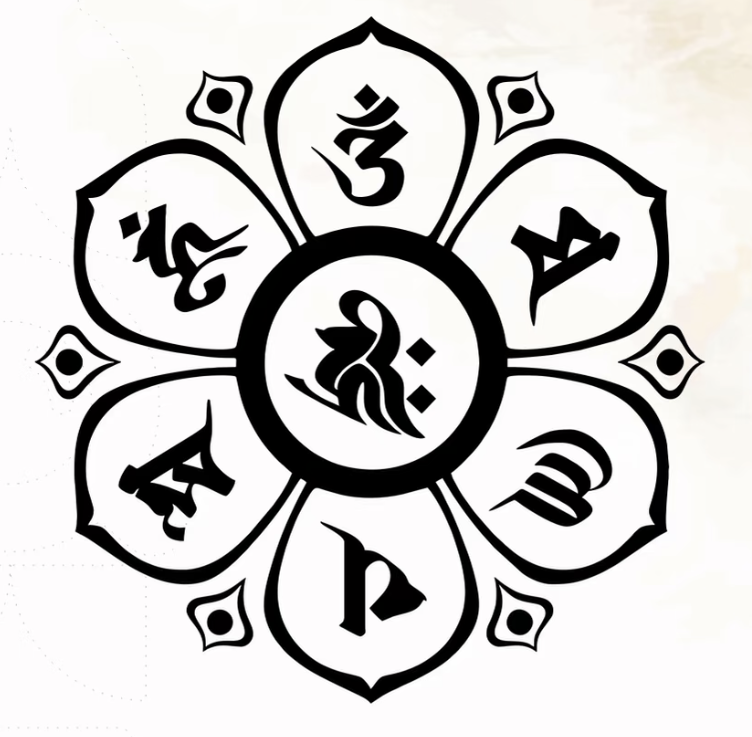
Om Mani Pad Me Hum (唵嘛呢叭咪吽) is one of the most widely recited mantras in human history. Its earliest textual record appears in the Lotus Sutra (妙法莲华经) — one of the central scriptures of Mahayana Buddhism — where it is closely associated with Avalokiteshvara, the Bodhisattva of Compassion. The mantra is understood as an embodiment of the Buddha’s compassion and wisdom in sound form.
As Mahayana Buddhism spread across East Asia and the Himalayan region, this mantra took root in diverse cultural contexts. Its most intensive daily practice developed within Tibetan Buddhist traditions, where it moved far beyond temple walls into the rhythms of ordinary life — carved into mountainside stones, printed on prayer flags, spun through prayer wheels, repeated by millions as they walked through their days.
Cultural Significance
In Mahayana Buddhist tradition, Om Mani Pad Me Hum is the heart of Avalokiteshvara practice — a sound-form of compassion that practitioners turn to for protection, clarity, and guidance through the cycle of life.
In Tibetan Buddhist culture specifically, it became inseparable from daily life itself. Mountain stones inscribed with the six syllables, cloth flags spinning in the wind carrying the mantra across valleys, prayer wheels turned by hand — these are not merely religious acts but living cultural practices, passed from one generation to the next through every walk of life.
In the modern world, the mantra has attracted practitioners from far beyond Buddhist traditions — not for its religious framing, but for what it actually is at its core: repetition, return, continuity. This is why it resonates so strongly with contemporary mindfulness and meditation practice.
Six syllables, crossing one thousand five hundred years of history to arrive here. Its essence: return, continue, stay present — the same quiet point, over and over.
Energetic Qualities
The energetic qualities of Om Mani Pad Me Hum cannot be fully separated from its Buddhist and cultural context, but in modern daily practice it is most commonly experienced as a form of continuous attention training — not seeking anything extraordinary, but repeatedly returning to the same anchor.
It is commonly associated with:
- A built-in mental anchor — something you can return to without thinking, in any moment
- Finding a still point between inner noise and outer chaos
- The subtle power of repeated sound — the act of reciting itself is the practice; meaning is not required for it to work
Core energetic signature: return, persist, stay close.
Who It’s For
- Practitioners of Mahayana Buddhist tradition who use Om Mani Pad Me Hum as a core daily recitation
- Those drawn to Buddhist culture — Mahayana, Tibetan, or otherwise — and seeking a genuine cultural connection through a physical object
- Meditators and mindfulness practitioners who use mantra recitation or breath work as a daily support
- Anyone seeking a personal “return point” — whether the framing is spiritual, philosophical, or simply practical
When to Wear
- During meditation or mantra practice: As a tactile and visual reminder of the syllable being recited
- During circumambulation or walking meditation: As a companion during movement-based stillness practice
- During daily commutes or walks: As a form of mobile meditation — silently repeating while moving through the world
- As a transitional object: Placing it on before sleep or upon waking, marking the threshold between states of consciousness
Small pauses.Big shifts.Find your piece→
Care Guide
- S925 silver Om Mani bead: Polish regularly with a silver cleaning cloth to maintain brightness; avoid exposure to moisture and body products which accelerate tarnishing
- Stone beads: Avoid contact with perfumes and lotions; wipe clean and store separately after wearing
- Braided cord: Avoid prolonged soaking or high-intensity activity while wearing; this extends the cord’s lifespan significantly
- General storage: Keep in a dry, soft pouch away from strong magnetic fields and direct heat
Further Reading
- The Lotus Sutra (妙法莲华经) — The earliest textual source of the Six Syllable Mantra in Mahayana Buddhism
- The Tibetan Book of the Living and the Dead, Sogyal Rinpoche, HarperCollins, 1993 — A classic introduction to the Tibetan Buddhist view of life, death, and what lies between
- The Crystal Bible, Judy Hall, Godsfield Press, 2003 — Reference on crystals and stones used in spiritual traditions
FAQ
Om Mani Pad Me Hum (唵嘛呢叭咪吽
) originates from the Lotus Sutra (
妙法莲华经
) — one of the most important sutras in Mahayana Buddhism — and is associated with Avalokiteshvara, the Bodhisattva of Compassion. Each syllable carries specific meaning: Om represents purification of body, speech, and mind; Ma Ni (jewel) represents compassion; Pad Me (lotus) represents wisdom; Hum represents the determination to dedicate all virtue to all beings. In practice, the meaning matters less than the repetition — return, continue, stay present.
It originates in Mahayana Buddhism, not exclusively Tibetan Buddhism. The Lotus Sutra — its earliest source — is shared across many Buddhist traditions including Chinese, Japanese, Korean, and Tibetan Buddhism. Its most intensive daily practice developed in Tibetan Buddhist culture, but it is a mantram found across the broader Buddhist world. Wearing it as jewelry is a personal choice — some wear it as a cultural symbol, others as a daily practice reminder, and others for its aesthetic and symbolic resonance.
Many people from different backgrounds practice mantra recitation as a form of meditation and mindfulness. The essence of the practice — repetition, return, presence — is universal. The mantra itself does not require formal Buddhist initiation to hold meaning as a personal anchor or daily reminder. We encourage thoughtful engagement with its cultural and spiritual origins regardless of your background.
In this bracelet, the Om Mani bead is crafted from S925 sterling silver — solid, with an antiqued finish and intricate traditional auspicious carvings. S925 silver is hypoallergenic, durable, and holds the carved detail well over time.
For Buddhist practitioners, it is a continuous reminder of compassion and wisdom. For others, it may serve as a personal anchor — a symbol of something they return to in daily life. The meaning is personal and evolves with your own relationship to it.