
The Koi in East Asian Tradition
The koi fish holds one of the most enduring and layered positions in the cultural imagination of East Asia — not merely a decorative motif, but a creature freighted with centuries of accumulated meaning. Its story is inseparable from the water it inhabits: rivers, ponds, and the流动 of time itself. Across China, Japan, and Korea, the koi appears in art, architecture, mythology, and daily speech — a symbol so embedded in the culture that its meaning requires little explanation in the lands where it originates.
In Chinese tradition, the koi is associated with the male principle — yang energy: ambition, strength, and the drive to carve a path forward through resistance. The older the koi, the more powerful it is believed to become. Ancient texts describe koi as creatures of extraordinary endurance, capable of living through harsh winters beneath frozen pond surfaces and emerging with the spring thaw. This capacity to survive adverse conditions and emerge transformed became the foundation of the koi’s most enduring association: perseverance leading to transcendence.
The Koi and the Dragon
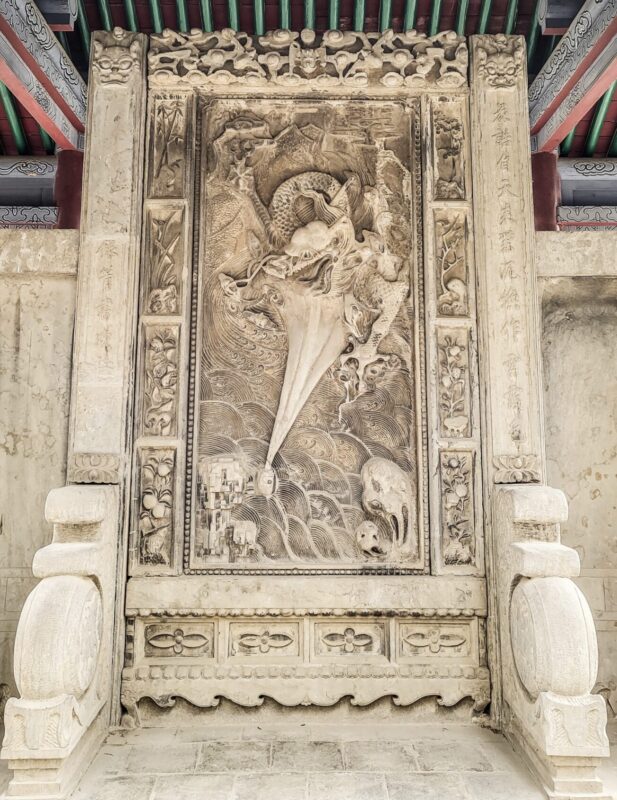
The legend that defines the koi’s cultural standing more than any other is the story of the Dragon Gate (龙门前). According to Chinese legend, as the Yellow River flows through the mountains, there exists a point called the Dragon Gate — a waterfall so steep and powerful that very few fish can pass through it. Each year, koi gather at the base of this cascade in enormous numbers. Most turn back. The few that summon enough strength and persistence to leap the falls are transformed by the journey: they emerge on the other side not as koi, but as dragons — creatures of the sky rather than the water, with power over both realms.
The phrase “the koi that crosses the Dragon Gate becomes a dragon” (鲤鱼跃龙门) has been part of Chinese idiom for over two thousand years. It is used to describe anyone who rises above ordinary circumstances through persistent effort — students facing examinations, entrepreneurs building businesses, artists developing their craft. The transformation is not a matter of luck: it is earned through the repeated, graceful act of pressing against the resistance and refusing to turn back. The koi that becomes a dragon is not given its new form; it becomes it through effort.
Koi in Japanese Tradition
Japanese culture adopted the koi with deep enthusiasm, adding its own layers of meaning. In Japan, the koi is associated with boys’ Day (Koinobori) — large carp-shaped windsocks flown from poles to honor the health and future success of young male children. The symbolism here is explicit: the koi swimming upstream represents the hopes of parents for their sons — that they grow into strong, persistent, successful adults who move against the currents of life without losing direction.
In Japanese art and mythology, black koi (Magoi) represent overcoming adversity and the transmutation of fear into calm strength. Gold or yellow koi (Yogoi) represent prosperity and abundance — their gold scales echoing the color of wealth in both the literal and metaphorical sense. The pairing of black and gold koi together carries both protective and attractant energy: the black koi wards off misfortune, the gold koi draws prosperity toward the wearer or viewer.
Feng Shui and the Koi
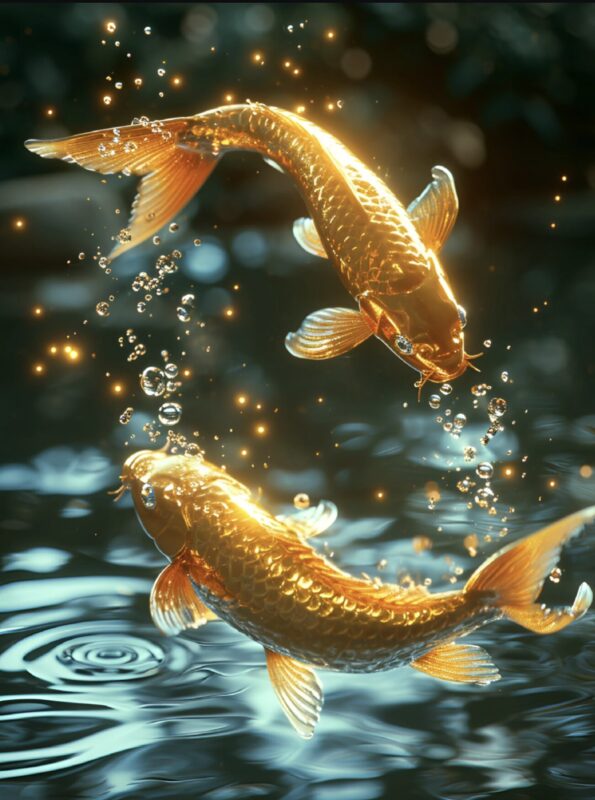
In feng shui practice, the koi is among the most widely used symbols for activating specific areas of life. A pair of koi — one black, one gold — swimming in afigure-eight pattern or circling in a fountain or aquarium is traditionally used to balance fortune (the gold koi) and protection (the black koi) simultaneously. The number of koi in a feng shui display carries specific meaning: two represents partnership or the balance of yin and yang; nine represents completeness and the fullest expression of fortune.
The direction a koi faces in a feng shui display matters: koi swimming toward the center of a room or space are believed to draw energy and opportunity inward; koi swimming outward carry energy away, dispersal rather than attraction. The orientation is chosen based on what the practitioner wishes to strengthen or protect in a given space.
Spiritual Properties & Energetic Qualities
In the modern crystal and energy lexicon, the koi is not a stone but a symbol — and symbols carry their own energetic weight. The qualities most commonly associated with the koi in contemporary practice are drawn directly from its cultural heritage, reinterpreted through the lens of personal development and intentional living rather than literal mythology.
The quality most consistently attributed to the koi is perseverance — not the aggressive, pushing-through resistance of yang energy in its most forceful expression, but the patient, graceful persistence of a creature that has learned to move with the current when it must and against it when it must. This is a particular kind of strength: not the absence of opposition, but the capacity to maintain direction and grace regardless of what the opposition looks like.
Practitioners describe the koi symbol as a supportive companion during periods of transition or significant change — when the wearer is stepping into a new professional chapter, leaving a relationship, relocating, or taking on a challenge that requires sustained effort without immediate visible results. The koi does not promise that the outcome will be favorable; it is associated with the quality of effort itself — with the idea that the act of persistently moving in the right direction, regardless of the outcome, is itself a form of transformation.
The koi is also described as a stone of balance between opposing forces — darkness and light, resistance and flow, holding on and releasing. This makes it particularly resonant in contexts where the challenge is not choosing between two goods or two bads, but navigating the tension between two apparently opposite truths simultaneously. The koi does not resolve the tension by eliminating one side; it holds both and moves through.
Who Is the Koi For
The koi symbol is among the most universally applicable in the jewelry lexicon — not tied to a specific mineral or stone, it carries its meaning through cultural resonance rather than material properties. That said, certain contexts and personalities draw to the koi particularly strongly.
If you are in a period of sustained effort toward a goal whose outcome is not yet visible — building something, studying for something, training for something, creating something that requires more time than you currently have evidence for — the koi is traditionally used as a daily reminder of that orientation: keep moving in the right direction. The result is not guaranteed, but the effort is the thing.
If you are navigating a transition — a career change, a relocation, the end of a chapter and the uncertain beginning of the next — the koi is described as a supportive companion during that passage. It is not associated with certainty or guarantees; it is associated with the capacity to move through uncertainty without losing your sense of direction or your willingness to keep moving.
If you find yourself in a situation where you need to maintain a quality of grace under pressure — where your response to opposition matters as much as your technical competence — the koi carries that particular quality: calm, persistent, directional strength that does not need to announce itself to be effective.
And if you are drawn to the visual beauty and artistic richness of the koi motif itself — the sinuous form, the interplay of scales and water, the depth of cultural memory embedded in the image — that aesthetic resonance is itself a completely valid reason to wear a koi charm. The meaning deepens with wear.
When to Wear
- During periods of sustained effort toward a long-term goal — when visible progress is slow and patience is required.
- During transitions and passages — career changes, relocations, the end of one chapter and the uncertain beginning of another.
- In situations that call for graceful persistence rather than forceful pushing — when the quality of your sustained effort matters more than any single dramatic action.
- In contexts where you need to hold opposing tensions without rushing to resolve them — complex professional or personal situations that require patience and perspective.
- As a daily companion during the slow, patient work of building something — when the koi that becomes a dragon is still very much in the water.
Small pauses.Big shifts.Find your piece→
Care Guide
Because the koi is a symbol rather than a stone, care considerations depend entirely on the material it is rendered in — silver, gold, jade, or other materials. The following applies to koi charms and jewelry in metal or stone.
For koi charms in sterling silver: wipe with a soft dry cloth after wearing. If the silver develops a patina, a gentle polish with a soft silver cloth restores brightness without damaging the surface. Avoid prolonged exposure to moisture, chlorine, or saltwater, which can accelerate tarnishing. Apply perfumes, hairsprays, and cosmetics before putting on silver koi jewelry.
For jade koi carvings: jade is durable but can be scratched by harder materials. Clean with a soft cloth and mild soap if needed. Avoid harsh chemicals, extreme temperature changes, and prolonged exposure to direct sunlight, which can affect some jade varieties over time.
For energetic clearing of koi jewelry: because the koi is associated with movement, transition, and active energy rather than deep stillness, many practitioners prefer to cleanse koi jewelry with movement-oriented methods — running water (if the material permits), sound healing with bells or singing bowls, or brief exposure to sage or palo santo smoke. Moonlight is also effective for most materials.
Further Reading & References
1. The Book of Symbols — edited by Miriam R. Loose, Taschen, 2011 (first edition 1978, AMACOM). A comprehensive exploration of symbol systems across cultures, with entries on fish symbolism and water imagery.
2. Asian Symbols: A Search for Meaning — Marshall Cavendish Reference, 2008. An accessible reference for symbol meanings across East and Southeast Asian traditions.
3. The Dictionary of Symbols — Jean Chevalier & Alain Gheerbrant, translated by John Buchanan-Brown, Penguin Books, 1996 (original French 1969). One of the most comprehensive symbol dictionaries in any language, with extensive entries on fish, water, and transformation.
4. Feng Shui: Understanding the Chinese Art of Placement — Derek Walters, Eternalion Publishing, revised edition 2019. An authoritative reference on feng shui principles, including koi symbolism in practice.
5. Japanese Mythology — Philyp J. I. Marsham, Chartwell Books, 2017. A survey of Japanese mythological creatures and symbols, including koi and the Dragon Gate legend.
FAQ
The koi fish is one of the most enduring symbols in East Asian cultural tradition, associated primarily with perseverance, transformation, and the courage to move against the current. The legend of the koi that leaps the Dragon Gate and becomes a dragon — “鲤鱼跃龙门” — has been part of Chinese idiom for over two thousand years, describing the transformation that comes from persistent, graceful effort in the face of significant resistance. In Japanese tradition, the koi represents strength and the hope for a successful, purposeful life. In feng shui, a pair of koi (one black, one gold) balances protection and prosperity.
The upstream koi is the defining image of the koi symbol — a fish that moves against the current without turning back, pressing forward through the resistance because its direction is clear. This is not aggressive or reckless; it is the patient, persistent strength of a creature that has learned to draw energy from the opposition itself rather than being slowed or stopped by it. The upstream koi represents perseverance, direction, and the quality of transformation that comes from sustained effort over time.
In feng shui, koi are used to activate areas of life associated with fortune and protection. A common feng shui display features a pair of koi — black (Magoi) and gold (Yogoi) — swimming in a figure-eight pattern or circling in a aquarium or fountain. The gold koi attracts prosperity and abundance; the black koi wards off misfortune and provides protective energy. The pairing represents balance between the two. Direction matters: koi swimming toward the center of a space draw energy inward; the number of koi also carries specific meaning.
While the koi is particularly associated with yang energy and masculine vitality in traditional Chinese symbolism — and prominently featured in Japan’s Koinobori boys’ Day celebrations — it is not exclusively for men. In modern practice, the koi is worn and given as a symbol of perseverance and transformation by people of any gender who are navigating a period of sustained effort or transition. The meaning of the koi — persistence, graceful strength, transformation through effort — is fully universal.
Care depends on the material. Sterling silver koi charms: wipe with a soft dry cloth, avoid prolonged moisture and chemicals, store separately from harder gemstones. Jade koi carvings: clean with mild soap and soft cloth, avoid extreme temperature changes and harsh chemicals. For energetic clearing: movement-oriented methods work well — running water (if material permits), sound healing, or brief sage/palo santo smoke. Moonlight is also effective for most materials.