
Material
Jadeite — known in Chinese as Feicui (翡翠), and in mineralogical terms as jadeite — is a sodium aluminum silicate mineral (NaAlSi₂O₆) belonging to the pyroxene group. It is fundamentally and mineralogically distinct from nephrite (和田玉, hetian yu), despite both being grouped under the English term “jade” and sharing the Chinese character 玉. Where nephrite is a calcium-rich magnesium-iron silicate of the amphibole group, jadeite belongs to an entirely separate mineral family — and in terms of market value, optical transparency, and cultural prestige in the modern era, jadeite has come to define what the world means when it speaks of “jade.”
Jadeite’s crystal structure is monoclinic, and it most commonly occurs in dense, fibrous, or granular aggregate forms characterized by a distinctive interlocking crystalline texture — a micro-structure that gives jadeite its remarkable toughness and resistance to fracturing when struck, a quality that made it uniquely valuable to ancient civilizations who worked it without modern tools. This same quality, known in gemology as ‘toughness,’ means that jadeite is remarkably resistant to breakage from impact — a property not shared equally by all gemstones.
Jadeite has a Mohs hardness of 6.5 to 7 — harder than nephrite — and its most celebrated quality is the extraordinary range and depth of its color. The most prized jadeite specimens display an intense, evenly distributed vivid green called “imperial green” (帝王绿) — a saturated, translucent green that is among the most valuable gemstone colors in the world. Jadeite also occurs in lavender and purple (“chun cai,” or “spring color”), red and yellow (“hong huang fei,” red-yellow jadeite), white, gray, and black. The presence of chromium (Cr) and iron (Fe) trace elements creates jadeite’s green and other colors respectively — and the degree to which these colors are vivid, evenly distributed, and translucent determines the stone’s value dramatically. “Glass种” (glass variety) jadeite, the most coveted grade, is nearly transparent and produces a luminous, “waxy” or “mrystalline” glow when light interacts with its internal structure — an optical phenomenon that is among the most sought-after in all of gemology.
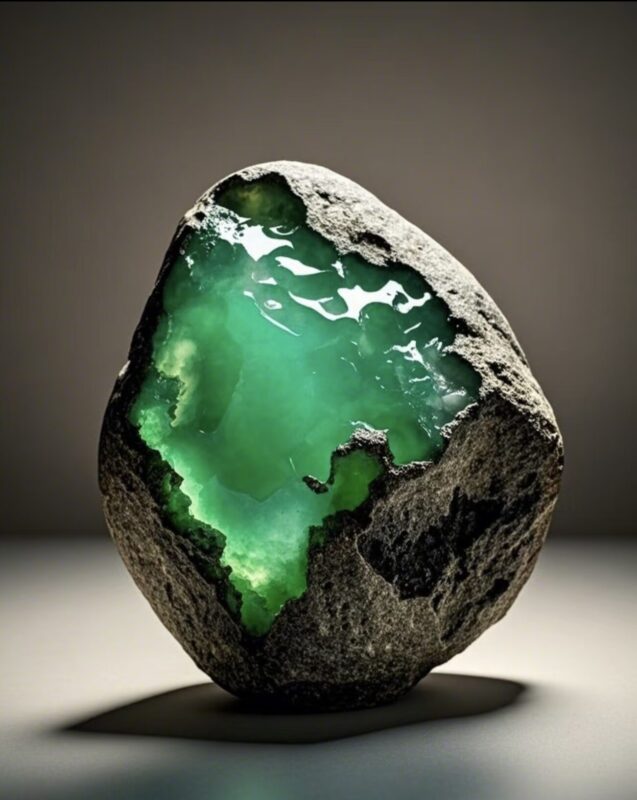
Jadeite is mined primarily in the Kachin State of northern Myanmar (Burma), where gemstone-grade material forms under the high-pressure, low-temperature conditions of a subduction zone — making it one of the most geologically unusual and concentrated gemstone deposits on Earth. Minor jadeite deposits exist in Guatemala, Japan, Russia, and California, but virtually all gem-quality jadeite on the global market originates from Myanmar. Jadeite has been traded in China since at least the Ming and Qing dynasties, and today the raw jadeite market (“stone gambling” or 赌石, dueye) remains a highly specialized and speculative trade centered in Guangzhou, Yangzhou, and markets along the China-Myanmar border. A single piece of rough jadeite stone, still in its waterworn river pebble form, can command prices ranging from a few dollars to millions — based entirely on what an experienced buyer can intuit from its external appearance before the stone is cut.
Cultural Significance
Jadeite’s position at the summit of Chinese gem culture is a relatively recent historical phenomenon — and one that is intimately tied to one of the most powerful women in Chinese imperial history.
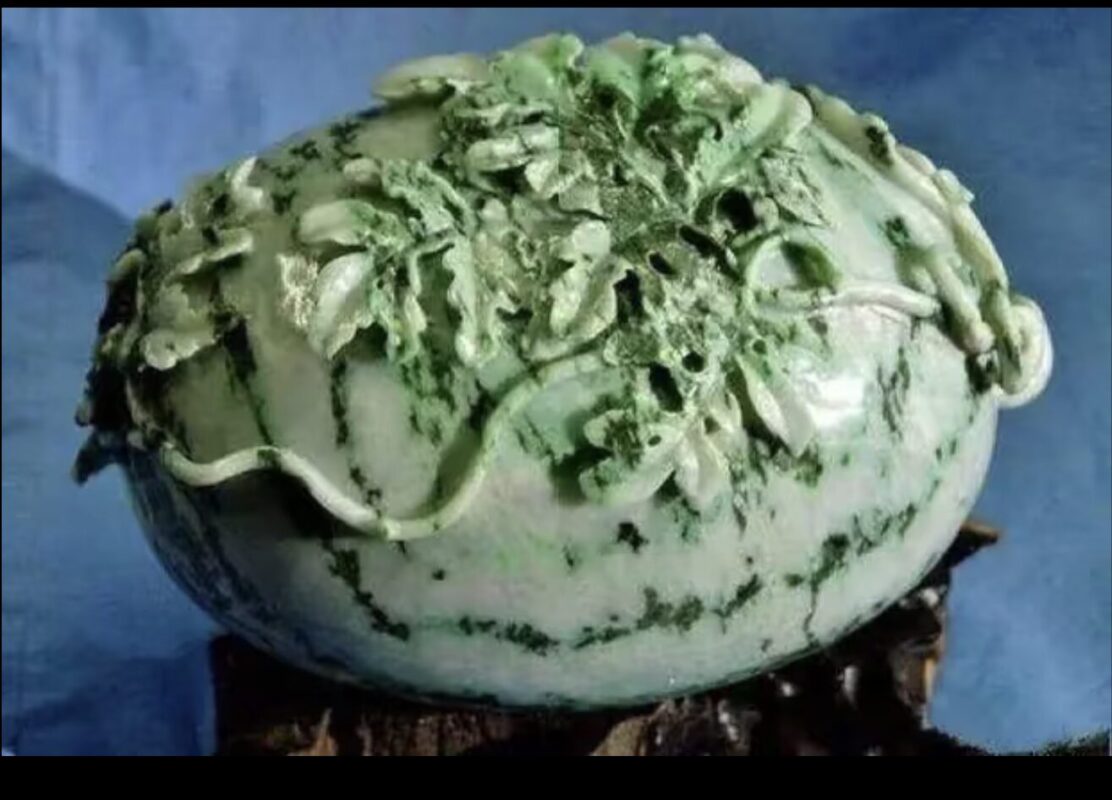
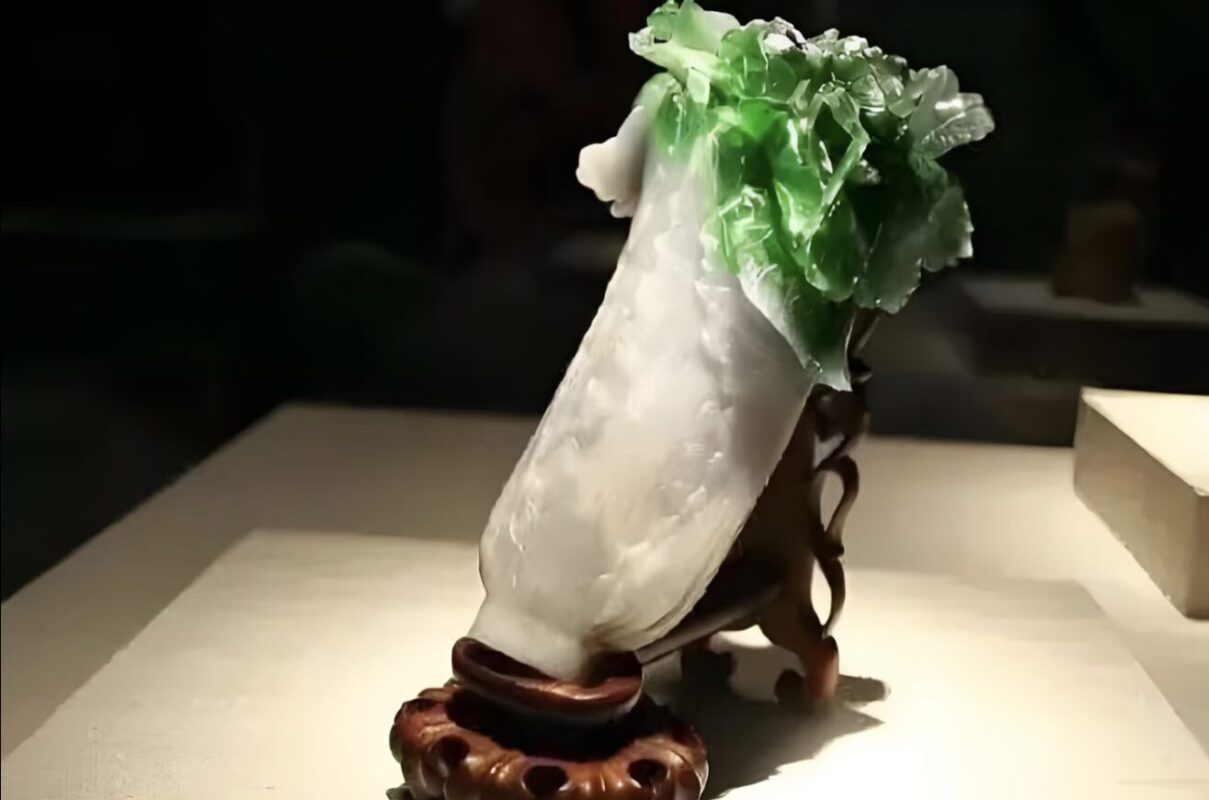
The Qing Dynasty and Imperial Jade: Jadeite rose to prominence in Chinese court culture under the influence of Empress Dowager Cixi (慈禧太后, 1835–1908), one of the most powerful and longest-reigning figures in Chinese history. Cixi is said to have had an extraordinary passion for jadeite — her personal collection included some of the finest jadeite carvings in existence, the most famous being the so-called “Jadeite Cabbage” and “Jadeite watermelon” (currently housed in the National Palace Museum in Taipei) — objects so exquisitely carved from a single piece of translucent green and white jadeite that they are considered among the greatest jade carvings ever made. Under Cixi’s influence, jadeite became the jade of China’s imperial and aristocratic circles, displacing the nephrite that had dominated Chinese jade culture for millennia. Jadeite pendants, prayer beads, and bangles became symbols of status, wealth, and cultivation among Qing court elites — a prestige hierarchy that persists in Chinese society to this day, where jadeite holds a unique position as the most prestigious and valuable jade variety in the market.
Republic of China and Modern Era: The jadeite collections of prominent Republican-era figures — Soong Ching-ling (宋庆龄), Zhang Xueliang (张学良), among others — further entrenched jadeite’s association with East Asian elegance and intellectual sophistication. In contemporary Asia, jadeite is the single most important gemstone in the Chinese-language jewelry market, with primary demand centers in mainland China, Hong Kong, Taiwan, and Southeast Asian Chinese communities. A fine jadeite bangle, passed down through a family across generations, often carries emotional value that far exceeds its market price — making it more akin to a family heirloom than mere jewelry.
Myanmar and Southeast Asia: Jadeite holds an equally significant place in Burmese (Myanmar) culture, where it is known as “Nat Htwe” — “prince stone” — and is traditionally believed to be a gift from heaven to the Burmese people. With the introduction of Buddhism to Myanmar, jadeite became widely used in Buddhist sculpture and temple decoration — jadeite Buddha statues represent one of the highest forms of Burmese Buddhist art. The jadeite quarries of Hpakan (Hukawng Valley), among the oldest and most productive in the world, have been continuously worked for over a thousand years.
Japan: Jadeite (known as hisui, 翡翠, in Japanese — the same name) has been part of Japanese culture since the Jomon period (14,000–300 BCE), when it was carved into magatama (勾玉, curved comma-shaped beads) — crescent or comma-shaped ritual objects that were among the most sacred possessions of Japanese aristocracy and religious authority. Many Jomon period magatama beads, carved from locally sourced jadeite, have been found in ancient burial sites and remain highly significant in Japanese cultural identity.
Mesoamerica: For the Maya and other Mesoamerican civilizations, jadeite was the most sacred of all materials — valued above gold. The Maya used jadeite primarily for elite burial objects, ceremonial blades, and beads — and the word for jade in several Mayan languages (jade, yax) is synonymous with the color green and with concepts of life, vitality, and the growing force of nature. A jadeite bead found in a Maya royal tomb was not merely a luxury object — it was a statement about the divine authority and eternal vitality of the king who wore it.
Recurring Theme: The most consistent cross-cultural theme around jadeite is its role as a bridge between the material and the spiritual — a stone believed to be capable of connecting human beings to something larger than themselves, whether that is the cosmos, the divine, or the accumulated wisdom of ancestors. This quality of “sacred connection” is what separates jadeite from all other green gemstones, and what drives its enduring prestige across civilizations separated by thousands of years and miles of ocean.
Energetic Qualities
Jadeite’s most central traditional energetic quality in Chinese culture is benevolence — ren (仁), one of the five Confucian virtues. The stone’s smooth, cool, and luminous quality has long been understood as the physical counterpart to the inner quality of compassion and care for others that Confucian ethics prizes above all else — a stone whose outer beauty is inseparable from its inner virtue.
Protective Presence: Jadeite has been worn as a protective talisman across virtually every culture that has valued it. Its cool, dense quality creates a physical sensation of calm and containment that wearers consistently describe as grounding — a stone that seems to establish an energetic boundary between the wearer and the noise of the outside world.
Emotional Balance and Harmony: Jadeite’s most celebrated energetic quality in the Chinese tradition is its capacity to support emotional equilibrium — a stone whose steady, cool presence is said to help its wearer remain calm, measured, and thoughtful rather than reactive in difficult situations. In contemporary terms, this can be understood as supporting composure and measured response under pressure.
Abundance and Rightful Prosperity: In Chinese folk traditions, the rich green color of jadeite — particularly the vivid imperial green — is associated with zhen cai (正财), wealth accumulated through legitimate means, as opposed to speculative or unethical gain. Jadeite is traditionally believed to support the wearer in building sustainable prosperity through honest effort and wise judgment.
Intergenerational Connection and Family Harmony: Perhaps jadeite’s most distinctive energetic application in the Chinese tradition is its role in family lineage — jadeite bangles and bracelets are among the most commonly inherited pieces of jewelry in Chinese families, passed from mothers to daughters or mothers-in-law to daughters-in-law. This practice reflects the jadeite’s traditional association with the continuity of family harmony and the blessing of strong, peaceful family bonds across generations.
Who It Suits
Those who identify deeply with Chinese or East Asian cultural heritage and want a piece of jewelry that carries this civilizational weight with authenticity — jadeite is the most culturally resonant jade variety in the contemporary Chinese-speaking world.
Individuals entering a significant new life chapter — marriage, the birth of a child, a new business venture, relocation — where the traditional associations of jadeite with protection, balance, and auspicious beginnings are directly applicable and culturally meaningful.
People in high-pressure professional environments who value composure and measured presence — jadeite’s traditional association with calm, centered equilibrium makes it a meaningful companion for those who need to lead, decide, or perform under sustained pressure.
Serious gemstone collectors and connoisseurs who understand that jadeite’s value is determined by four interlocking factors —种地 (structure/transparency), 水头 (luster/clarity), 颜色 (color quality), and 工 (carving/craftsmanship) — and who appreciate the extraordinary depth of knowledge required to evaluate jadeite with expertise.
Anyone seeking a piece of jewelry with genuine potential for intergenerational transmission — jadeite is among the few gemstone categories where the emotional and financial value genuinely appreciates with time, and where the act of passing a jadeite piece to a daughter or granddaughter carries deep, specific cultural meaning.
When to Wear It
Weddings and life ceremonies: Jadeite is one of the most traditional choices for Chinese and East Asian wedding jewelry — jade bangles or necklaces given by a mother to a new bride carry the full weight of family blessing and “gold and jade filling the hall” (金玉满堂), one of the most auspicious wishes in Chinese tradition.
Business and formal occasions: The understated elegance and gravity of jadeite makes it ideal for formal business settings and professional occasions — it communicates quiet confidence, cultural depth, and discriminating taste without ostentation or display.
Daily cultivation: A jadeite pendant or a simple pair of jadeite studs, worn as part of a daily personal practice, becomes more beautiful with time as the stone absorbs the wearer’s energy and attention — an intentional daily companion that rewards consistency.
Family rituals and intergenerational gifting: The act of presenting or receiving jadeite at a birthday, graduation, wedding, or family anniversary is a moment that extends beyond the individual — it is a statement about family continuity, shared values, and a blessing for the next generation.
Cultural occasions and travels: When visiting museums, cultural exhibitions, jade carving workshops, or jade markets — or when traveling to Myanmar, Yunnan, or Guangzhou, the heartlands of the jadeite trade — wearing jadeite creates a natural, resonant connection to the cultural context.
Small pauses.Big shifts.Find your piece→
Care Instructions
Protect from impact: Jadeite’s hardness (6.5–7) is high, but its crystalline structure makes it susceptible to cracking or chipping when struck against hard surfaces — remove jadeite jewelry before exercise, heavy lifting, or any activity where impact is possible. A jadeite bangle, if dropped on a hard floor at the right angle, can shatter completely.
Avoid chemicals and cosmetics: Perfume, cosmetics, hairspray, and cleaning agents contain acids and alkalis that can dull jadeite’s surface luster over time — apply all cosmetics before putting on jadeite jewelry, and remove it before swimming, showering, or cooking.
Clean with lukewarm water: Rinse jadeite in warm (not hot) water and wipe clean with a soft cloth; a soft-bristled brush can be used for hard-to-reach areas. Avoid ultrasonic cleaners, steam cleaners, and any commercial jewelry cleaners not formulated for jadeite.
Store carefully and separately: Keep jadeite in a soft pouch or a lined jewelry box, always separated from harder gemstones — particularly diamond, sapphire, and ruby, which can scratch jadeite’s polished surface. Jadeite bangles should be stored in a padded ring roll or compartment to prevent accidental rolling and falling.
Avoid extreme temperatures and sudden thermal changes: Prolonged heat or rapid temperature shifts can cause internal stress in jadeite over time; store jadeite away from direct sunlight and heat sources.
“Nourish” your jadeite: There is a well-known saying in Chinese jade culture — “people nourish jade, and jade nourishes people” (人养玉,玉养人). Regular wearing of jadeite allows the stone to absorb natural skin oils, which over time develop its luster and deepen its color — the stone becomes more beautiful with years of wear. This is also the most practical reason jadeite is best worn, not stored: the natural oils of the skin are among the best maintenance treatments available.
Further Reading & References
The Book of Stones Robert Simmons & Naisha Ahsian, North Atlantic Books, multiple editions since 2005. — Widely regarded as the most authoritative reference in the modern crystal and mineral field, with detailed entries on both jadeite and nephrite.
The Crystal Bible Judy Hall, Godsfield Press, 2003. — One of the world’s best-selling crystal reference guides, with extensive entries on jadeite varieties and their cultural applications.
Hartmann, G.F. — “The Jade of the Maya.” Journal of Archaeological Science, Elsevier. (Academic journal article exploring jadeite’s supreme status in Maya civilization — valued above gold.)
Guangdong Gemstone Testing Center & NGTC — Jadeite Grading Standards China National Standard GB/T 34545-2017, National Gemstone Testing Center. — The official Chinese national standard for jadeite quality grading, covering color, transparency, structure, and craftsmanship ratings.
National Palace Museum, Taipei — Jadeite Cabbage & Jadeite Watermelon https://www.npm.gov.tw/ (accessed 2026) — The National Palace Museum’s official collection pages for its two most famous jadeite carvings — among the most widely recognized jadeite objects in the world.
Smithsonian National Museum of Natural History — Gems & Minerals Collection https://naturalhistory.si.edu/ — The Smithsonian’s official minerals and gems collection, with jadeite specimens and information.
GIA — Gemological Institute of America: Jadeite https://www.gia.edu/ — The Gemological Institute of America’s official jadeite information page, covering formation, sources, and quality factors.
FAQ
Jadeite (翡翠, feicui) and Nephrite (和田玉, hetian yu) are two entirely distinct minerals despite sharing the generic English term “jade” and the Chinese character玉. Jadeite is a pyroxene mineral (sodium aluminum silicate, NaAlSi₂O₆) — it can achieve high transparency (“glass variety”), is primarily sourced from Myanmar, and is evaluated based on four quality dimensions:种地(structure/transparency),水头(luster),颜色(color), and工(craftsmanship). Nephrite is an amphibole mineral (calcium magnesium iron silicate) — typically translucent to opaque, primarily sourced from Xinjiang and Qinghai, and valued primarily for whiteness, fineness, and oily luster. Understanding this distinction is essential for any serious jade buyer or enthusiast.
Jadeite quality is assessed across four key dimensions: Structure and transparency (种地): Glass variety (most translucent) > Ice variety > Glutinous variety > Bean variety — the more transparent and even the internal structure, the more valuable. Luster and clarity (水头): A well-polished jadeite surface that exhibits a characteristic waxy, “crystalline” glow when light interacts with its internal structure is the hallmark of top-grade material. Color: The most valuable jadeite displays an intense, evenly saturated vivid green called “imperial green” (帝王绿). Purple (“chun cai”), red-yellow, white, and other colors each have their own quality hierarchies. Craftsmanship (工): The skill and detail of the carving — whether a bracelet, pendant, or sculptural object — significantly affects value, particularly for carved pieces.
Jadeite makes a particularly meaningful gift for: a bride or family member at a wedding — jade bangles or necklaces are among the most traditional and auspicious wedding gifts in Chinese and East Asian culture; a friend or family member starting a new business or professional chapter, given jadeite’s traditional association with rightful prosperity and wise judgment; new parents receiving a jade pendant for their child’s full-month or birthday celebration — a time-honored tradition in Chinese families; and anyone who identifies with Chinese or East Asian heritage and values jewelry that carries genuine civilizational depth and historical resonance.
Protect from impact: A jadeite bangle shattered by a fall is one of the most common forms of jadeite damage — handle with particular care over hard surfaces like bathroom floors or kitchen counters.
Avoid chemicals and cosmetics: Perfume, sunscreen, cleaning agents, and acids can gradually erode jadeite’s surface luster over time.
Clean with lukewarm water: Rinse and wipe with a soft cloth; avoid ultrasonic or steam cleaners, which may stress the stone’s internal structure.
Nourish through wear: Jadeite is said to improve with body contact — natural skin oils help develop the stone’s luster and deepen its color over time, which is also why jadeite is best worn rather than stored.
Store separately: Keep in a soft pouch or padded compartment, away from harder gemstones (especially diamond) that can scratch jadeite’s polished surface.