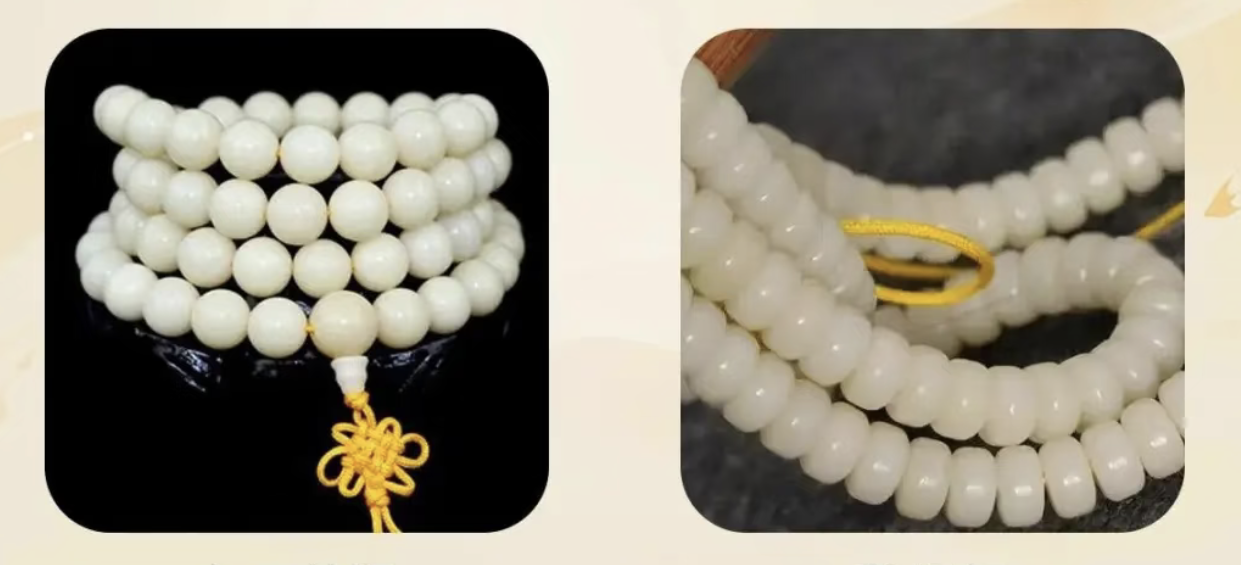
Bodhi Root (菩提根) and White Jade Seeds (白玉菩提) are among the most misunderstood varieties in the bodhi seed market. This guide separates fact from folklore.
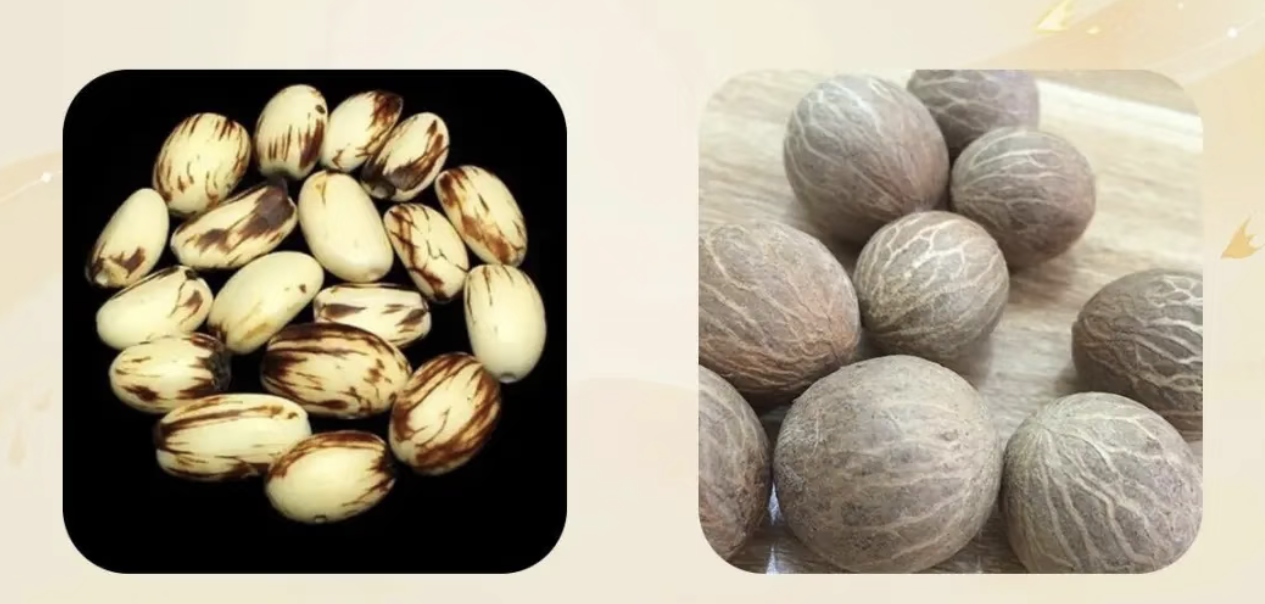
Material
What Bodhi Root Actually Is
Bodhi Root (菩提根) is the seed of the Talipot Palm (Corypha umbraculifera L.), a species in the Arecaceae (palm) family. It is not a root — the name is a poetic folk designation, explained below.
Tree of Origin
Corypha umbraculifera, commonly known as the Talipot Palm, Belu, or Ice Apple. Native to Sri Lanka and the Indian subcontinent, it was introduced across Southeast Asia via Theravada Buddhist missionary routes. In China, it has been cultivated in temple grounds and botanical gardens for over 700 years, with particular concentration in Xishuangbanna, Yunnan Province — where it was planted near Buddhist monasteries (缅寺, miǎn sì).
Botanical Characteristics
A massive single-stemmed palm reaching up to 25 meters in height, with palmate leaves up to 7 meters across. It produces one of the world’s largest inflorescences — a branching structure up to 7 meters long bearing hundreds of thousands of small cream-white flowers.
Crucially, the Talipot Palm flowers only once in its lifetime and dies after fruiting. A seed germinated today will not flower for approximately 20 years, and that single flowering-and-fruiting event marks the end of the plant’s life. This extraordinary biological characteristic is central to the seed’s cultural symbolism.
The fruit is spherical, 3-4 cm in diameter, brown when mature. The seed inside is roughly spherical, 1.8-2.0 cm in diameter, with a dense, ivory-white interior. Source quality: The finest Bodhi Root traditionally comes from Myanmar (Burma), followed by Sri Lankan and Indian stock.
What White Jade Seeds Actually Are
White Jade Seeds (白玉菩提) are the seeds of the Oil Palm (Elaeis guineensis Jacq.), also in the Arecaceae family — but from an entirely different genus. Native to West Africa, the Oil Palm is now one of the world’s most widely cultivated tropical economic crops, with vast plantations across Indonesia, Malaysia, Thailand, and Myanmar. Its primary use is palm oil production — the seeds are a byproduct of the vegetable oil industry.
A perennial palm producing fruit year after year (unlike the Talipot Palm’s single flowering event). Seeds are considerably smaller than Bodhi Root seeds, typically around 1 cm in diameter. The term ‘White Jade Seeds’ is a modern Chinese collectibles market coinage, not a traditional Buddhist or botanical term — it describes the seed’s appearance after polishing: milky white, smooth, and lustrous.
The Fundamental Misconception: Neither Comes from the Bodhi Tree
A critical clarification: neither Bodhi Root nor White Jade Seeds comes from the Bodhi Tree.
The true Bodhi Tree (Ficus religiosa L.), the Sacred Fig under which Siddhartha Gautama attained enlightenment, belongs to the Moraceae (fig) family — an entirely different plant family from palms. Its fruit is a synconium (the same structure as a fig), small, soft, and without a hard seed suitable for bead-making. It is botanically impossible to produce a ‘Bodhi Tree seed’ bead.
In Chinese collectibles culture, any hard, durable seed that can be polished and strung for counting mantras qualifies as a ‘菩提子’ (bodhi seed). This convention has been in use for centuries and is not a botanical classification.
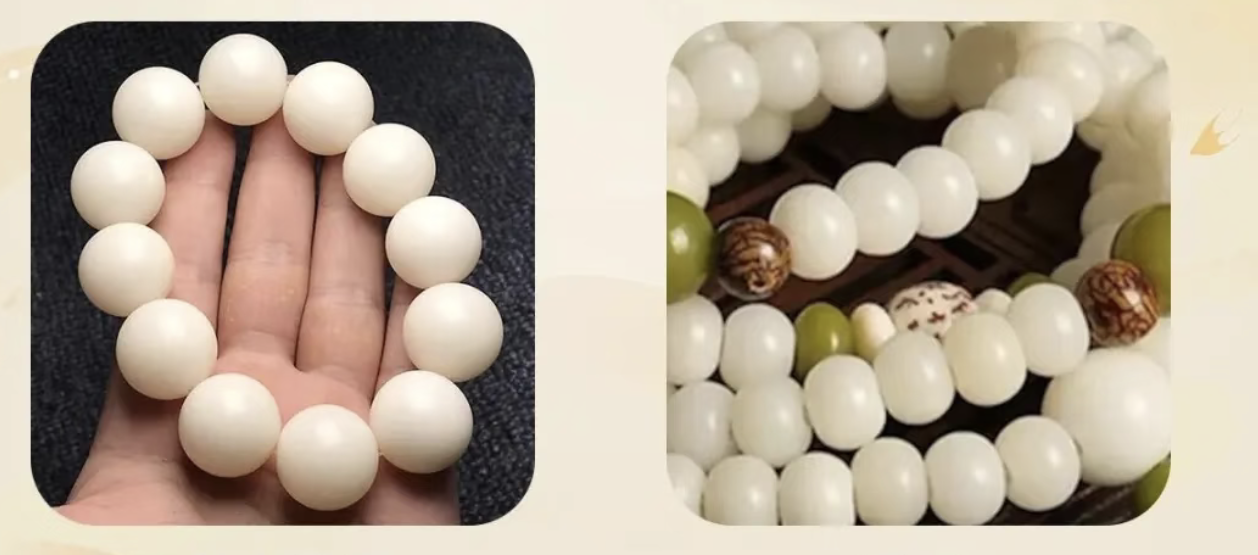
Cultural Significance
Bodhi Root: The Seed of Buddhist Manuscript Culture
Bodhi Root carries one of the most direct connections to Buddhist textual tradition of any bodhi seed variety, because of what its parent tree’s leaves were used for.
Before the spread of paper into Southeast Asia, Buddhist scriptures in India, Sri Lanka, Thailand, Myanmar, and Dai communities in Yunnan were inscribed onto palm leaves — specifically the leaves of the Talipot Palm. These inscriptions, known as palm-leaf manuscripts or 贝叶经 (bei ye jing) in Chinese, represent one of the oldest and most durable manuscript traditions in the world. Palm-leaf manuscripts from the 5th century CE survive in excellent condition today.
Wearing Bodhi Root is, in a tangible sense, wearing the progeny of the tree whose leaves once held the Dharma. The Talipot Palm’s biological signature — flowering only once, at the end of its life, after decades of growth — has made it a symbol of irreversible commitment and the culmination of a long spiritual journey in Buddhist and Southeast Asian cultural traditions.
White Jade Seeds: The Unexpected Story of a Tropical Commodity
White Jade Seeds have a less ancient and more surprising story — and it is worth understanding clearly.
White Jade Seeds are, at their origin, an industrial agricultural byproduct. The Oil Palm (Elaeis guineensis) is cultivated on a massive global scale — over 30 million hectares worldwide — for palm oil. The hard seeds left after oil extraction would otherwise go to waste. The Chinese collectibles market’s adoption of these seeds as a bead material is a remarkable example of creative repurposing — taking what industry discards and transforming it into objects of beauty and contemplation.
Visual Distinction
Understanding the material differences between the two is essential for identification:
| Feature | Bodhi Root (Talipot Palm) | White Jade Seeds (Oil Palm) |
| Tree family | Arecaceae, Corypha genus | Arecaceae, Elaeis genus |
| Origin | Sri Lanka, India, Myanmar, Yunnan | West Africa (native); Indonesia, Malaysia (cultivated) |
| Biological cycle | Monocarpic — flowers and fruits once, then dies | Polycarpic — fruits every year |
| Seed size | Larger, ~1.8-2.0 cm diameter | Smaller, ~1 cm diameter |
| Color (polished) | Ivory white to warm cream | Cool, bright milky white |
| Luster | Warm, satiny, matte-to-semi-gloss | Slightly cooler, denser glass-like luster |
| Feel on touch | Smooth, substantial weight | Denser, colder to touch |
| Price segment | Low-mid (tens of RMB per strand) | Very low (often under 30 RMB per strand) |
Practical field identification:
- By size: Oil Palm seeds are noticeably smaller. A string of 8mm beads that appears very white and compact is more likely Oil Palm.
- By temperature: Oil Palm seeds feel distinctly colder and denser in the hand.
- By asking about origin: References to 贝叶经 (palm-leaf sutras) or temple cultivation — Bodhi Root. References to Indonesia, palm oil, or agricultural origins — White Jade Seeds.
- By price: The absolute floor of the market, described as ‘the cheapest bodhi variety’ — almost certainly Oil Palm White Jade Seeds.
Energetic Qualities
Bodhi Root
Bodhi Root is valued in Chinese spiritual traditions for qualities that derive directly from its cultural narrative: completion, irreversible commitment, and the weight of accumulated time. It is associated with the kind of practice that happens once, deliberately, and with full presence — mirroring the tree’s own biological story. Practitioners describe it as having a grounded, patient energy — appropriate for seated practice, mindfulness routines, and daily wear as a quiet anchor to one’s intentions.
White Jade Seeds
White Jade Seeds carry an energy that is cleaner, cooler, and more austere — reflecting their origin as industrial material transformed into objects of beauty through human intention. They are associated with practical clarity, simplicity, and the ability to find value in what others overlook or discard. In Chinese metaphysical tradition, there is a recognized value in ‘白’ (white/pure) seeds — objects that begin without agenda and are shaped entirely by the wearer’s use over time.
Who It Suits
Bodhi Root is for:
- Those drawn to Buddhist manuscript culture and the material history of Buddhist textual transmission
- Practitioners who find meaning in the ‘once-and-final’ biological narrative of the Talipot Palm
- Collectors who value cultural provenance and narrative depth in their bead materials
- Anyone who appreciates ivory-white beads with a warm, organic character
White Jade Seeds are for:
- Those who value the philosophical narrative of finding beauty in overlooked materials
- Beginners in the bodhi seed world who want to experience the full arc of wearing and patina development without significant financial commitment
- Anyone who prefers a cooler, brighter white aesthetic in their beads
- Wearers who appreciate simplicity and want a daily-wear strand without worry about damage
When to Wear It
Bodhi Root
- Meditation and contemplative practice — its temple origins and cultural weight make it a natural companion for seated practice
- Daily mindfulness wear — as a quiet daily reminder of intention and presence
- Temple visits and Buddhist occasions — an appropriate and respectful accessory in sacred settings
- Quiet, significant life moments — a grounded companion for periods of reflection or important personal decisions
White Jade Seeds
- Daily casual wear — affordable, durable, and practical for everyday use without anxiety
- Beginning a bodhi seed practice — the ideal ‘first strand’ for new collectors
- Periods of deliberate simplification — when one wants to strip away complexity
- Gifting — an accessible and thoughtful introduction to the bodhi seed world for someone new
Care Instructions
Bodhi Root
- Remove before bathing, swimming, or any activity involving prolonged moisture — the porous kernel can absorb water, leading to swelling, cracking, or mold
- Clean with a dry or slightly damp soft cloth; avoid soaps, solvents, or chemical cleaners
- Store in a breathable pouch; do not leave in sealed plastic bags, which trap humidity
- Avoid prolonged direct sunlight, which may cause yellowing over time
- Handle with clean hands — natural oils from regular handling contribute to a healthy, developing patina
- The warm yellowing and amber patina that develops over years of use is a sign of a well-loved strand
White Jade Seeds
- Wipe clean with a dry or slightly damp cloth; do not submerge in water or expose to prolonged moisture
- Store in a breathable container; avoid sealed plastic bags for extended periods
- Important: White Jade Seeds have relatively high moisture content and are more susceptible to cracking from rapid temperature or humidity changes. Avoid air-conditioned direct cold airflow or cars during temperature extremes
- Handle with reasonably clean hands — consistent oil contact improves surface luster over time
- Patina development is slower than Bodhi Root; cream to yellow to amber color changes represent an equally meaningful record of wear
Further Reading
1. 科普中国科学百科 (Science Popularization China). ‘菩提根’ (Bodhi Root). China Association for Science and Technology, 2019. https://cloud.kepuchina.cn/h5/detail?id=6974137151813709824
2. 人民网收藏频道 (People’s Daily Art Collection). ‘组图:菩提根知识全解读 看完秒变专家’ (Bodhi Root Knowledge Guide). December 17, 2015. http://art.people.com.cn/n1/2015/1217/c206244-27941316.html
3. 洛潇金银珠宝观察室 (Luoxiao Jewelry Observation). ‘白玉菩提到底是什么东西?’ (What Are White Jade Seeds Really?). Toutiao, 2024. http://m.toutiao.com/group/7586588090442039849/
4. 星光盘史 (Xingguang Panshi). ‘盘点文玩菩提子,种类有200多种,没一个产自菩提树?’ (Bodhi Seed Market Overview). Toutiao, 2024. http://m.toutiao.com/group/7609917242309870086/
5. Baidu Baike (百度百科). ‘贝叶棕’ (Corypha umbraculifera L.). https://m.baike.com/wiki/%E8%8F%A9%E6%8F%90%E6%A0%B9/5298623
6. 花百科 (Huabaike). ‘白玉菩提是什么植物的种子’ (What Plant Do White Jade Seeds Come From). https://wenda.huabaike.com/zwyh/92122.html
7. Gropp, R. Eric. ‘贝叶经:佛教抄本的植物纤维载体’ (Palm Leaf Manuscripts as Buddhist Textual Vectors). Arts of Asia, Vol. 34, No. 4, 2004.
8. Chinese Zen Jewelry. ‘The Significance of the Bodhi Tree Seeds in Buddhism.’ https://www.chinesezenjewelry.com/about-3
9. 中国科学院植物研究所 (Institute of Botany, Chinese Academy of Sciences). ‘Yulania denudata (Desr.) D. L. Fu — 白玉兰’ (White Magnolia). https://www.iplant.cn/info/Yulania%20denudata
10. 中国科学院植物研究所 (Institute of Botany, Chinese Academy of Sciences). ‘油棕 Elaeis guineensis Jacq.’ (Oil Palm). https://www.iplant.cn/