
Material
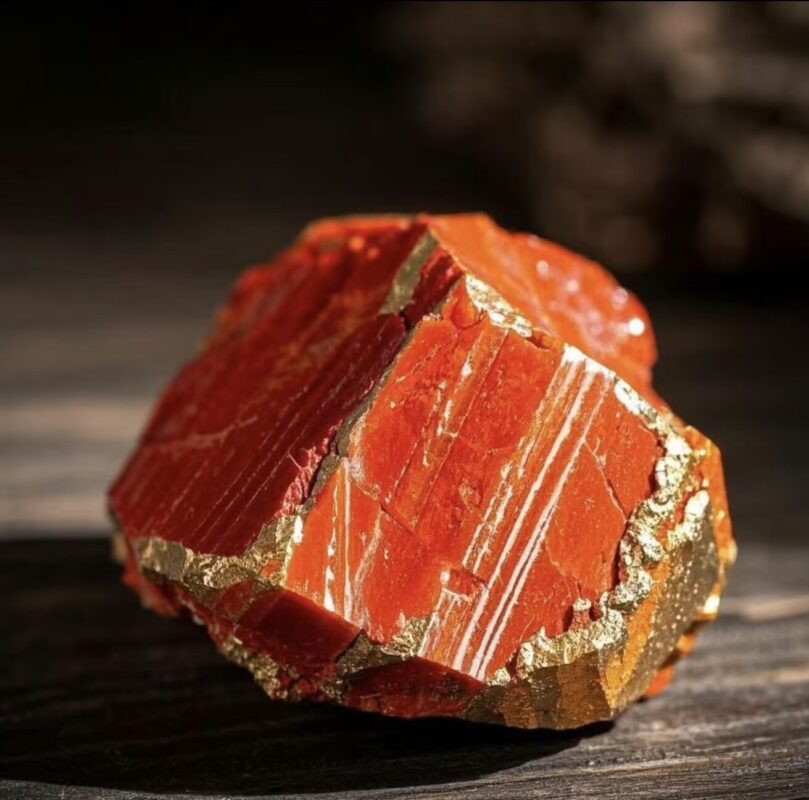
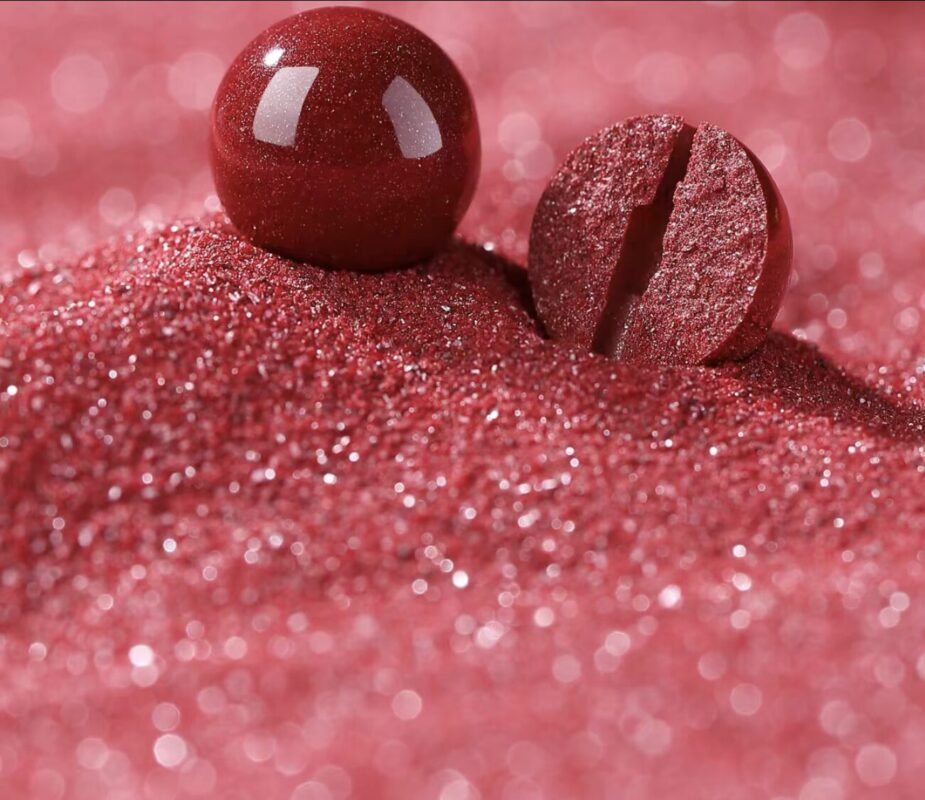
Cinnabar — known in Chinese as Zhu Sha (朱砂), Dan Sha (丹砂), or Chen Sha (辰砂) — is the crystalline mineral form of mercury sulfide (HgS). It belongs to the trigonal crystal system and occurs most commonly as rhombohedral or tabular crystals, though it is more frequently found in massive, granular, or earthy aggregate forms. Cinnabar’s most defining characteristic is its vivid bright red to deep dark red coloration — a hue so distinctly associated with the stone that the Chinese character 朱 (zhu), meaning ‘vermilion red,’ derives directly from the stone’s name.
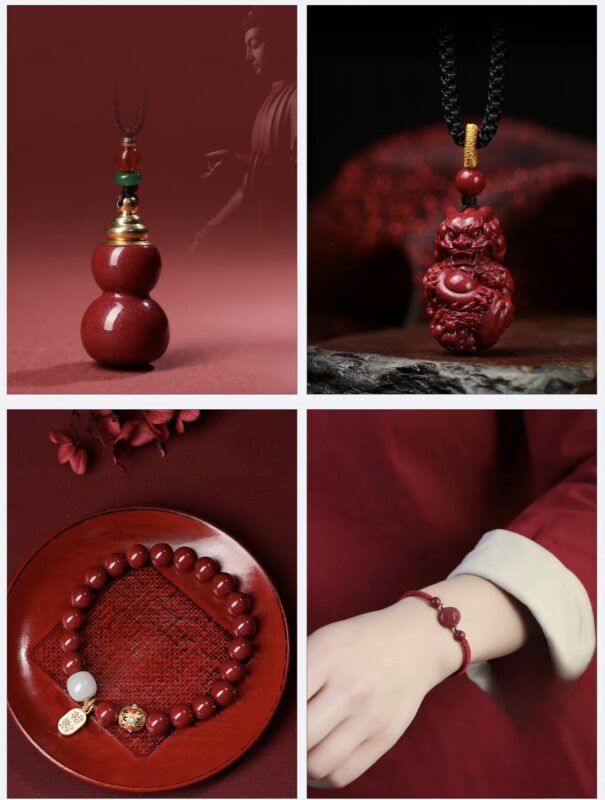
Cinnabar has a relatively low Mohs hardness of approximately 2 to 2.5 and exhibits an adamantine to subadamantine luster, with a streak color of vivid red. In modern jewelry design, cinnabar is typically set in bezel or backless settings that protect the stone while displaying its rich red color. Cinnabar is most commonly found as carved pendants, beads, and small sculptural objects — pieces that celebrate the stone’s color and cultural significance rather than its transparency or brilliance.
Cultural Significance
Cinnabar holds a position in Chinese civilization unlike almost any other mineral: it is not merely valued for its beauty, but is woven into the language, the philosophy, the rituals, and the spiritual imagination of an entire culture. Zhu Sha is, in a very real sense, the mineral embodiment of Chinese civilization’s relationship with the color red itself.
Ancient Chinese Painting and Seal Carving: Cinnabar was one of the most important red pigments in Chinese painting from the pre-Qin period onward. The Palace Museum (Forbidden City) in Beijing houses an extraordinary collection of ancient paintings, murals, and lacquered objects whose vivid reds — executed in cinnabar — have remained remarkably intact over centuries. Seals carved with ‘relief text’ (朱文印) are stamped using cinnabar-based ink paste — cinnabar is the material substance of Chinese official and artistic identity, present on the most important documents, paintings, and ceremonial objects in Chinese history.
Taoism and Alchemy: Cinnabar occupies a central, almost mythological position in Taoist tradition, where it is known primarily as Dan Sha (丹砂) — literally “elixir cinnabar.” It was the principal mineral used in the production of “external elixirs” (外丹, waitan) — mineral-based preparations whose consumption was believed to confer immortality or superhuman abilities. While modern science has definitively established the dangers of ingesting cinnabar, its symbolic meaning in Taoism persists: cinnabar is still used today in Taoist ritual to draw talismans, write sacred texts, and inscribe protective symbols.
Imperial China: Vermilion red (derived from cinnabar) was one of the reserved colors of the Chinese emperor. The walls of the Forbidden City are painted in this distinctive deep red — so identified with imperial authority that “red gates” (朱门) became a metonym for aristocratic wealth and power in Chinese literature.
Chinese Folk Belief: Cinnabar is deeply embedded in Chinese folk spiritual practice, used in rituals for house protection, exorcism, and the “opening light” (开光) ceremonies that are believed to activate the spiritual power of talismans, amulets, and religious statues. A widely observed tradition involves dotting a child’s forehead with cinnabar — the “opening wisdom” (开智) ceremony — performed at an early age as a blessing for intelligence and clear sight.
Energetic Qualities
Centering and Concentration: The stone’s weight and the gravity of its color have traditionally associated cinnabar with “settling the spirit” — helping the wearer reduce mental scatter and distraction and cultivate a quality of focus and stillness. In contemporary practice, this can be understood as supporting emotional stability and sustained attention.
Yang Energy and Vitality: In the framework of Chinese five-element theory, red corresponds to “fire” and the heart, representing yang energy — activity, warmth, and the life force. Cinnabar is traditionally valued as a stone that helps restore and strengthen this vital energy, supporting confidence, motivation, and a sense of aliveness.
Environmental Purification: Perhaps cinnabar’s most widely recognized traditional application is its use in clearing and protecting living spaces from disruptive or unwanted energies. Taoist and folk practitioners have used cinnabar to draw protective symbols on doors, windows, and thresholds — a practice that reflects the stone’s perceived ability to establish and maintain a clean, protected energetic environment.
Grounding and Stillness: Unlike more radiant red gems, cinnabar’s color is deep, dense, and opaque — qualities that align it with stillness rather than excitation. It is traditionally regarded as a stone for those who need to settle, ground, and stabilize — to find a quiet center.
Protective Presence: Throughout its long history, cinnabar has been used as a protective talisman — worn on the body, placed in homes, or applied to objects of spiritual significance. This quality of protection is understood as the establishment of an intentional boundary — a physical and symbolic declaration of intentional space.
Who It Suits
Individuals with a deep connection to Chinese culture, Taoist tradition, or East Asian folk spiritual practice who want a piece of jewelry that carries this civilizational weight with authenticity and meaning.
Those who are drawn to practices of centering and stillness — meditation practitioners, calligraphers, artists, or anyone engaged in work that requires sustained focus and a settled mind.
People who resonate with the concept of environmental energetic boundaries and who maintain personal or household practices around space clearing, protection, and intentionality.
Collectors and connoisseurs who understand the difference between common red stones and genuine cinnabar, and who value authenticity, provenance, and cultural depth over mere appearance.
Anyone seeking a meaningful object for a significant life transition — a new home, a new phase of study, a meditative commitment — where the stone’s traditional associations with stability, protection, and the establishment of intention are directly relevant.
When to Wear It
Meditation and contemplative practice: Holding or wearing cinnabar during seated practice creates a natural tactile anchor — the weight of the stone and the depth of its color support an inward, settled quality of attention.
Daily ritual and intention setting: As part of a daily personal ritual, cinnabar worn as a pendant or kept on a personal altar serves as a physical reminder of one’s intentions for the day or the season.
Periods requiring focus and stability: During demanding periods of study, creative work, or any life phase where mental scatter is a challenge, cinnabar’s traditional association with settling the spirit can serve as a meaningful support.
Transitions and new beginnings: In the Chinese and East Asian tradition of using cinnabar to establish protective boundaries for new spaces and new phases of life, wearing or placing cinnabar when moving to a new home, beginning a new job, or starting a significant chapter carries genuine cultural resonance.
Cultural and artistic occasions: At events, classes, or gatherings centered on Chinese traditional arts — calligraphy, painting, tea ceremony, classical music — cinnabar jewelry creates a natural and deeply appropriate connection to the cultural moment.
Small pauses.Big shifts.Find your piece→
Care Instructions
Avoid direct prolonged skin contact: Cinnabar contains mercury, and while the risk from properly sealed jewelry is minimal, it is advisable to minimize direct skin contact, particularly for children and pregnant individuals. Choose bezel-set or back-protected designs that shield the stone.
Clean gently: Wipe the surface with a clean, soft cloth dampened with lukewarm water; avoid chemical cleaners, ultrasonic cleaners, or any acidic or alkaline substances, which may damage the stone’s surface luster over time.
Avoid heat and prolonged sunlight: Extended exposure to high temperatures or strong direct sunlight may cause the stone’s color to fade or its surface to deteriorate; store in a cool, dry place away from heat sources.
Store separately: Keep in a soft pouch or a lined jewelry box with separate compartments; avoid placing cinnabar alongside harder gemstones (diamond, sapphire, ruby) that may scratch its relatively soft surface.
Keep dry: Remove before swimming, showering, or any activity involving water or humidity; moisture can dull the stone’s natural luster over time.
Handle with awareness: If the stone becomes chipped or cracked, discontinue wearing it; mercury-containing materials should be handled responsibly and disposed of appropriately.
Further Reading & References
The Crystal Bible Judy Hall, Godsfield Press, 2003 (first edition); revised and expanded in subsequent editions. — One of the world’s best-selling crystal reference guides, with entries covering a broad range of mineral specimens including cinnabar and its historical applications.
The Book of Stones Robert Simmons & Naisha Ahsian, North Atlantic Books, multiple editions since 2005. — Widely regarded as one of the most authoritative references in the modern crystal field.
Liu Huiqing — History of Cinnabar in China 刘徽清。《中国朱砂史》。地质出版社,2015. — A systematic study of cinnabar’s role in Chinese history, from geological origins to cultural applications — a valuable scholarly reference.
Yan Zhihua — A Study of Taoist Alchemy 颜志华。《道教金丹术研究》。中华书局,2008. — A thorough examination of cinnabar’s role in Taoist elixir-making and the historical context of its spiritual significance.
Smithsonian National Museum of Natural History — Minerals Collection https://naturalhistory.si.edu/ — The Smithsonian’s official minerals collection page, with information on cinnabar formation and properties.
GIA — Gemological Institute of America: Colored Stone Information https://www.gia.edu/ — The Gemological Institute of America’s official colored stone information page.
FAQ
Cinnabar — known in Chinese as Zhu Sha (朱砂) or Chen Sha (辰砂) — is the crystalline mineral form of mercury sulfide (HgS). It is the most significant source of the color vermilion red in Chinese civilization, prized for thousands of years as a premium pigment, a ritual material in Taoist tradition, and a carved ornamental stone. In jewelry, cinnabar is typically set in protective bezels or backings to minimize direct skin contact, and is most commonly found as carved pendants, beads, and small sculptural objects.
Properly set cinnabar jewelry — where the stone is enclosed in a bezel or back-protected setting that prevents direct skin contact — is considered safe for normal wearing. The mercury content is locked within the mineral structure and is not released through intact skin contact. However: choose jewelry where the back of the stone is also sealed, not exposed; children, pregnant individuals, and those with heightened skin sensitivity should exercise particular caution; if the jewelry becomes cracked or damaged, discontinue wearing it immediately and handle responsibly.
Cinnabar (mercury sulfide, HgS) and red carnelian (a red variety of chalcedony, a micro-crystalline quartz) are entirely different minerals with different chemical compositions, hardness levels, and cultural histories. Cinnabar has a Mohs hardness of 2 to 2.5, a distinctive adamantine luster, and an opaque vivid red to dark red color. Carnelian has a hardness of 6.5 to 7, a waxy luster, and ranges from translucent to opaque in red to orange-red tones. In Chinese culture, cinnabar carries unique Taoist and folk spiritual associations that carnelian does not share.
Cinnabar is particularly meaningful for: individuals with a deep connection to Chinese culture, Taoist tradition, or East Asian folk spiritual practice; those in periods requiring sustained focus — students, creative professionals, meditation practitioners — who value the stone’s traditional association with settling the spirit and supporting concentration; friends or family members entering a new home or a new life chapter, in the Chinese tradition of using cinnabar to establish protective boundaries; and anyone drawn to the cultural depth and historical resonance of China’s most iconic red mineral.
Protect from prolonged skin contact: choose bezel-set or back-sealed designs that shield the stone from direct contact with skin, particularly for children and pregnant individuals.
Clean gently: wipe with a clean, soft cloth dampened with lukewarm water; avoid chemical cleaners, ultrasonic cleaners, or acidic/alkaline substances.
Avoid heat and direct sunlight: high temperatures and prolonged UV exposure can fade the stone’s color over time; store in a cool, dry place.
Store separately: keep in a soft pouch or lined jewelry box, separate from harder gemstones (diamond, sapphire, ruby) that may scratch cinnabar’s relatively soft surface.
Handle with awareness: if the stone chips or cracks, discontinue wearing it; handle and dispose of any mercury-containing fragments responsibly.