
The Stone That Defined Itself
Of all the crystals in the world, clear quartz carries the most names — and the least baggage. Ancient cultures called it crystallos, meaning “clear ice,” believing it was ice that had frozen so thoroughly it would never melt. Inuit peoples across the Arctic region have worked with quartz crystals for thousands of years, using them for tools, fire-starting, and ceremonial purposes. Chinese geomancers placed clear quartz points in homes and temples, believing the stone could channel and concentrate qi — the vital life force that flows through all things. Modern science eventually gave it the name quartz, from the German Quarz, and classified it as the most common mineral on Earth’s surface.
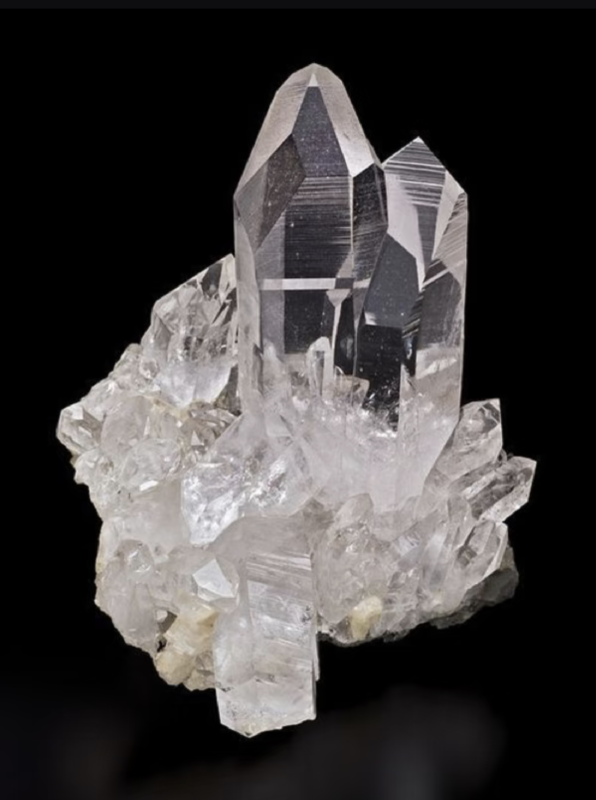
Clear quartz belongs to the trigonal crystal system, growing in long, six-sided prisms topped with pyramid-like terminations. These naturally occurring points have fascinated humans for so long that they appear in the mythologies of nearly every culture that encountered them. A clean, well-terminated quartz crystal point can look almost artificial — its geometry is so precise.
Chemically, clear quartz is composed of silicon dioxide (SiO₂), the same basic chemistry as sand and glass. Its Mohs hardness is 7 — hard enough to scratch most metals and durable enough to last millennia. What sets quartz apart from most other crystals is its piezoelectric property: when you apply pressure to a quartz crystal, it generates a tiny electrical charge. This property made quartz essential to modern technology — you will find quartz crystals inside every smartphone, every computer, and most wristwatches made before digital technology. The fact that the same stone that ancient shamans used to enter trance states now powers the devices we carry in our pockets is one of the stranger coincidences in material history.
A Stone That Crossed Every Culture
Clear quartz appears in the material culture of more civilizations than perhaps any other stone — not because it was the most rare or valuable, but because it was the most versatile.
Ancient Greece & Rome: Greek and Roman lapidaries carved quartz into seals, intaglios, and cameos. Roman soldiers carried quartz crystals as talismans in battle, believing the stone could sharpen perception and protect against harm. Pliny the Elder, in his Natural History, described quartz as a form of permanent ice found in the coldest parts of the Alps.
Indigenous Cultures of the Americas: Quartz crystals held deep ceremonial significance across many Native American tribes. The Lakota used large quartz crystals in vision quests, believing that the transparent stone facilitated a direct connection between the physical and spiritual worlds. Cherokee medicine traditions incorporated quartz crystals in healing ceremonies, where shamans used them to locate energetic blockages and direct energy through the body. Archaeological sites throughout the American Southwest have yielded quartz crystal tools dating back thousands of years.
China & East Asia: In Chinese tradition, clear quartz — known as bai shuijing (白水晶) — has long been associated with clarity of mind, purity of intent, and the amplification of positive energy. Feng shui practitioners use large quartz crystals and crystal clusters to activate specific areas of a space, believing the stone can attract and multiply the energy already present. Taoist traditions incorporated quartz crystals into meditation practices as aids for achieving mental stillness and spiritual insight.
Ancient Egypt: Egyptian lapidaries worked clear quartz into jewelry, beads, and ceremonial objects. The translucency and light-carrying quality of quartz made it particularly associated with the sun god Ra, and the goddess Isis was sometimes depicted holding a clear crystal staff. Egyptian healers used quartz crystals in a practice that modern practitioners describe as energy work, placing crystals on specific points of the body to support the flow of vital energy.
Across every tradition that valued clear quartz, one quality remained central: clarity. Not merely the physical transparency of the stone, but the deeper association between a clear, pure crystal and a clear, focused mind.
Spiritual Properties & Energetic Qualities
In the modern crystal lexicon, clear quartz occupies a unique position: it is considered the master amplifier among stones.
Contemporary energy practitioners describe clear quartz as a stone that amplifies the energy around it — whether that energy comes from other crystals, from one’s own thoughts and intentions, or from the surrounding environment. This is not a claim about the stone’s physical properties; it is a description of how practitioners have traditionally worked with it as a tool of intention. If you hold a clear quartz crystal and set an intention — for clarity, for focus, for positive energy — practitioners describe the stone as holding and reinforcing that intention throughout the day, much like a physical anchor for a mental or spiritual practice.
Clear quartz is also described as a stone that brings mental clarity and promotes objective perception. When your thoughts feel scattered or foggy, working with clear quartz — whether through meditation, wearing it as jewelry, or simply keeping a crystal nearby — is traditionally described as a way to restore mental focus and see situations more clearly. It is often used in meditation practices as an aid for quieting the mind and entering a state of present-moment awareness.
Finally, clear quartz is widely regarded as a versatile pairing stone. Because it is described as amplifying rather than imposing its own energy, practitioners often combine it with other crystals to reinforce their properties. Placing clear quartz points on a crystal grid alongside other stones is a common practice — described not as a substitute for genuine healing work, but as a supportive energetic framework for intention-setting and spiritual practice.
Who Is Clear Quartz For
Clear quartz is one of the most accessible crystals you can work with, and it suits almost everyone — but it is especially meaningful for those who are just beginning to explore crystal work. Because it is described as amplifying your own energy and intention rather than imposing specific properties, it works with you rather than for you — making it an ideal first stone for anyone new to working with crystals.
If you practice meditation or mindfulness, clear quartz may serve as a physical focal point — a stone to hold, to gaze into, to return your attention to when the mind wanders. If you tend to overthink, feel mentally scattered, or struggle with indecision, clear quartz is traditionally described as a stone that supports mental clarity and focus. If you work creatively — whether as a writer, artist, strategist, or planner — clear quartz is frequently used as a creative aid, described as helping to bring structure and clarity to complex ideas.
When to Wear
- During meditation or mindfulness practice, as a physical anchor for your attention.
- On days when you need mental clarity and focus — before important meetings, creative sessions, or difficult decisions.
- When starting a new intention or personal practice — to support and reinforce your commitment.
- As a daily companion for anyone new to crystal work — clear quartz is gentle, versatile, and adapts to your personal intention.
Small pauses.Big shifts.Find your piece→
Care Guide
Clear quartz is one of the most durable crystals you can own, but it still benefits from basic care. A Mohs hardness of 7 means it can scratch glass and most metals, but it can be scratched by diamonds, sapphires, and topaz — so store it separately from harder stones.
Clean your quartz with warm, soapy water and a soft brush. It is safe in water for most cleaning purposes, though prolonged soaking is unnecessary. Avoid harsh chemicals and ultrasonic cleaners, which are generally unnecessary for this durable stone.
Quartz crystals and crystal clusters can accumulate dust and lose some of their luster over time. Periodically rinsing them under running water and wiping them dry with a soft cloth restores their shine. If you use your quartz energetically, smudging with sage or placing it in moonlight are gentle and effective ways to refresh its energetic qualities — clear quartz responds particularly well to sunlight, moonlight, and sound cleansing.
Further Reading & References
1. The Crystal Bible — Judy Hall, Godsfield Press, 2003 (first edition); revised and expanded in subsequent editions.
One of the world’s best-selling crystal reference guides, with a comprehensive entry on clear quartz as the “master crystal.”
2. The Book of Stones — Robert Simmons & Naisha Ahsian, North Atlantic Books, multiple editions since 2005.
Widely regarded as one of the most authoritative references in the modern crystal field. The clear quartz entry is among the most detailed in the book.
3. The Encyclopedia of Crystals, Herbs, and New Age Items — Rosemary Gladstar, Storey Publishing, 2012.
A foundational reference in the contemporary crystal and holistic wellness community.
4. Pliny the Elder — Natural History (English translation) — Pliny the Elder, translated by John Bostock and H.T. Riley, various modern editions. Original work circa 77–79 CE.
The ancient Roman naturalist’s comprehensive encyclopedia includes one of the earliest written descriptions of quartz as “crystallos” — a form of permanent ice.
5. Smithsonian — Minerals & Gems Collection — https://naturalhistory.si.edu/ (accessed 2026)
The Smithsonian Institution’s public mineralogy resources document quartz’s piezoelectric properties and its role in both ancient tool-making and modern technology.