
The Stone
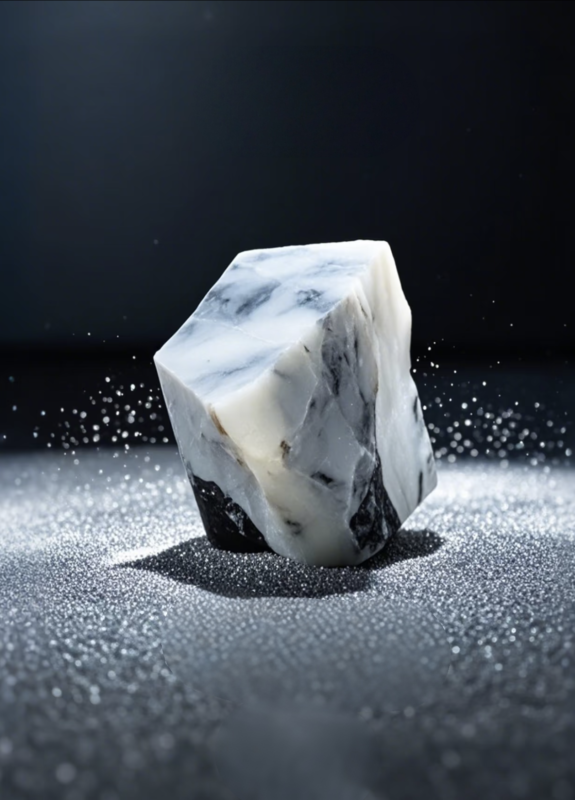
White marble howlite — commonly known as white howlite — is a borosilicate mineral with the chemical composition Ca₂B₅SiO₉(OH). It occurs naturally in clean white to pale grey tones, often marked by delicate grey or black veining that resembles marble or limestone. The veining is natural and unique to each specimen — no two pieces are identical, which is part of its quiet appeal.
With a hardness of 3 to 3.5 on the Mohs scale, howlite is relatively soft and easy to carve, making it a popular material for beads, sculptures, and ornamental objects. It was first commercially mined in California in the 19th century and quickly gained popularity in jewelry and decor for its elegant white appearance, which closely resembles more expensive white gemstones at a fraction of the cost.
Cultural Significance
White howlite does not carry the ancient lineage of nephrite jade in Chinese tradition, but its symbolic associations resonate with contemporary seekers who value simplicity and depth equally.
In some Native American traditions, white stones were used in meditation and ceremonial practice — carved into pipes, prayer beads, and amulets as a way of connecting the physical and spiritual realms. White was regarded as the color of purity and clarity before entry into sacred spaces.
In modern Chinese stone culture, white stones of any kind — whether nephrite, agate, or howlite — are consistently associated with clarity, purity, and a quality of inner stillness. White howlite, with its calm grey veining and cool touch, is often chosen by those who want the essence of “white stone” energy without the formality of traditional jade.
Across traditions, the through-line is consistent: white stones speak to clarity of mind, purity of intent, and the capacity to remain undisturbed.
Energetic Qualities
White howlite has a cool, calming presence. Its luster is soft rather than bright, and its touch is smooth and cool against the skin. It is widely described as a stone of quietude — something that does not energize or stimulate, but rather settles and stills.
It is commonly associated with:
- Encouraging mental calm and reducing scattered thinking
- Supporting a clear, present state of mind during transitions or high-stimulation periods
- Symbolizing the quality of “emptiness” — not as lack, but as the capacity to not be filled by noise
Core energetic signature: clear, still, self-contained.
Who It’s For
- People whose minds tend to race and who are looking for a small, quiet anchor in daily life
- Those who are drawn to minimalism with depth — understated pieces that carry meaning without announcing it
- Meditators and stillness seekers who value a physical object as a tactile reminder to return to presence
- Creative professionals and designers who want a stone that does not compete with their work but remains present in the background
When to Wear
- Morning ritual: As a first gesture before the day begins — a small anchor as you enter the world
- During meditation or quiet practice: A cool, smooth touch that many find grounding during stillness
- During long work sessions or creative projects: A subtle signal to pause and breathe before continuing
- As an evening companion: Helping to settle the mind before rest, transitioning from the day’s noise
Small pauses.Big shifts.Find your piece→
Care Guide
- Howlite is relatively soft — protect it from impact and contact with harder materials to prevent scratches
- Avoid contact with perfumes, lotions, and cleaning products, which can dull the stone surface over time
- Clean gently with a soft, dry cloth after wearing
- Avoid prolonged exposure to strong heat or direct sunlight, which can cause thermal stress cracks
Further Reading
- The Crystal Bible, Judy Hall, Godsfield Press, 2003 — A comprehensive reference guide to the crystal and mineral world
- The Book of Stones, Robert Simmons & Naisha Ahsian, North Atlantic Books, 2007 — Authoritative reference on crystal and mineral energetic properties
- Mindat.org — Howlite Mineral Database: mindat.org/minium/42283.html — Official mineralogical reference
FAQ
No. White marble howlite is a borosilicate mineral (Ca₂B₅SiO₉(OH)) — a completely different mineral family from jade, which is either nephrite (a silicate of calcium and magnesium) or jadeite (a sodium aluminum silicate). While they share a similar white appearance, they differ in hardness, mineral composition, and optical properties.
White howlite is typically pure white or off-white with natural grey or black veining that resembles marble. It has a smooth, waxy luster and a cool, pleasing touch. Each piece has unique veining patterns — no two beads look exactly the same.
Yes, but with care. With a hardness of 3–3.5 on the Mohs scale, howlite is relatively soft compared to other jewelry stones. It is best removed during high-impact activities, exercise, or swimming to prevent scratching or damage.
Wipe with a soft, dry cloth after wearing. Avoid chemical cleaners, perfumes, and lotions. Store separately in a soft pouch or jewelry bag to prevent contact with harder materials that could scratch its surface.
White howlite is widely described as a calming and stabilizing stone. In crystal traditions, it is associated with promoting mental clarity and reducing stress. As with all stones, these associations are traditional and cultural — not scientifically verified.
White howlite is commonly associated with the Crown Chakra (Sahasrara) — the energy center at the top of the head associated with clarity, higher consciousness, and spiritual connection. It is also sometimes linked to the Third Eye Chakra for its calming mental effects.