
The Stone with Seeds Inside
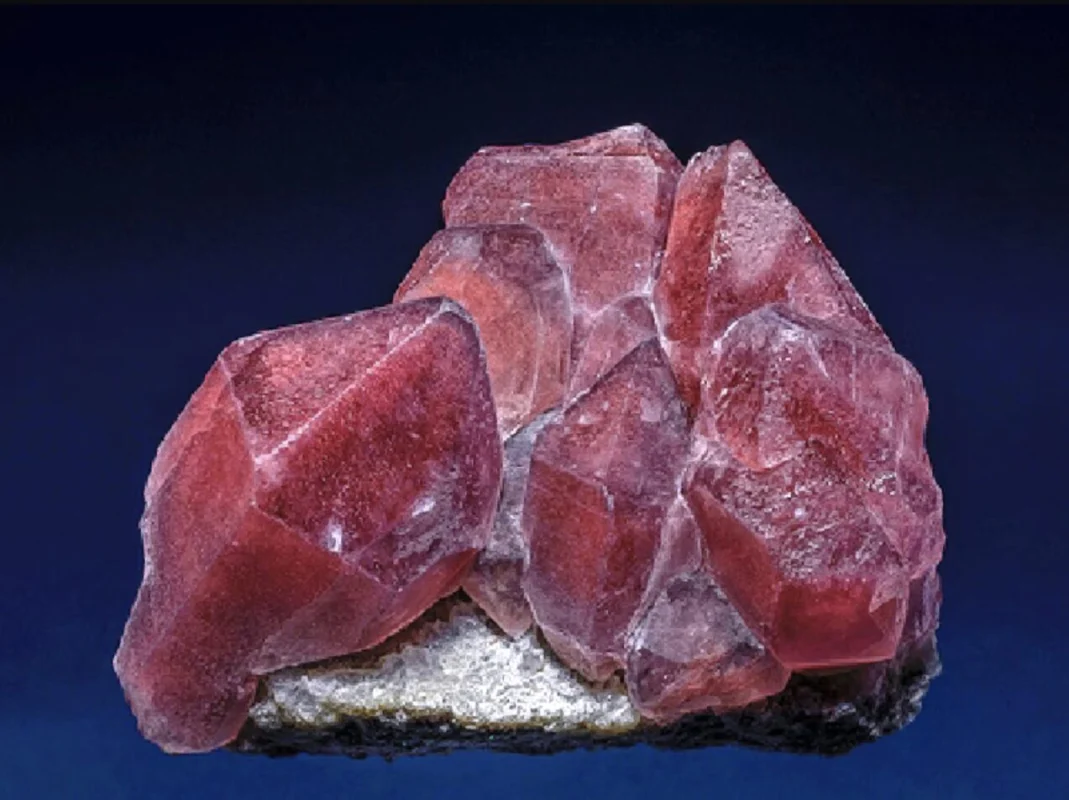
Strawberry quartz is one of the more quietly dramatic varieties of quartz — translucent enough to pass light, and distinguished by the characteristic inclusions of iron oxide, hematite, or mica scattered throughout its body like seeds frozen in ice. The inclusions range from deep rust-red to soft pink-brown, and their distribution within each crystal is entirely unique to that specimen: no two pieces of strawberry quartz look the same, which is precisely why the material has held the attention of collectors and carvers for centuries.
The formation of strawberry quartz is a story of interruption. When a quartz crystal is growing — silica-rich solution depositing in layers — iron-rich solutions or mica-bearing rock can become trapped within the structure. Rather than disrupting the crystal’s growth, these inclusions are incorporated into the mineral matrix as it continues to form around them. The result is a stone that carries its inclusions as permanent guests: the red flecks suspended inside the clear or milky quartz body catch and scatter light differently depending on the angle of observation, which is why strawberry quartz appears to glow and shift when turned in the hand.
The colour and density of the inclusions vary considerably by source. Japanese strawberry quartz — the most prized variety — tends toward a lighter, more translucent body with soft pinkish-red inclusions evenly distributed. Russian and Kazakhstan sources produce a more vivid variety, with deeper red-brown inclusions and a slightly milky body. Brazilian strawberry quartz is typically more transparent with more sparsely distributed inclusions. Whatever the source, the defining quality is the same: the contrast between the clear or milky quartz body and the warm inclusions suspended within it. The stone is valued precisely for this contrast — and for the fact that no two pieces are alike.
Strawberry quartz rates 7 on the Mohs scale — the same hardness as regular quartz and amethyst — making it a durable material suitable for everyday jewelry wear. Its crystalline structure takes a high polish well, which is why it is most commonly found as polished round beads, cabochons, and carved shapes. The polished surface allows the inclusions to catch and scatter light to best effect; a raw or unpolished piece tends to appear muted by comparison.
A Stone of Warmth and Feeling
Unlike some of the more historically documented gemstones — tiger eye with its Roman military applications, or lapis lazuli with its Egyptian ceremonial use — strawberry quartz does not have an ancient documented history as a separate material. The reason is partly geological: high-quality strawberry quartz deposits large enough and clear enough for significant use are relatively rare and were not always accessible. The material as it is known today emerged more gradually in the lapidary and crystal trade, particularly as Japanese sources became known to Western collectors in the twentieth century.
What strawberry quartz lacks in ancient documentation it makes up for in the clarity of its contemporary symbolism. The visual metaphor is so direct — pink or red inclusions like seeds suspended in clear quartz — that it has become one of the most immediately understood materials in the modern crystal lexicon. The seed is the dominant symbol: potential held in a dormant state, the beginning of something living,生命的原始物质. Applied to the emotional and relational sphere — which is where strawberry quartz is almost exclusively positioned — this translates into a stone associated with the heart and with love that is in the early stages of forming, or love that has been tested and has survived, or love that requires patience to grow into its full expression.
In Japanese crystal traditions specifically, strawberry quartz is associated with the heart chakra (心輪) and with the quality of warmth in interpersonal relationships — not passion in the dramatic sense, but the sustained warmth of genuine affection and care. This is love as a practice rather than love as an event: something that requires tending and that grows stronger through consistent attention. Japanese crystal practitioners often describe strawberry quartz as a stone that supports the development of emotional depth — helping the wearer or practitioner stay present with feeling rather than deflecting into intellect or irony.
Spiritual Properties & Energetic Qualities
In the modern crystal lexicon, strawberry quartz is positioned as a heart-centered stone — but with a specific and important qualification that distinguishes it from rose quartz, its more famous pink cousin. Where rose quartz is characterised by an open, receptive, unconditionally accepting quality — the quality of love that is given without expectation — strawberry quartz is characterised by something slightly warmer and more grounded: the quality of love that has moved beyond its initial openness and has begun to develop roots.
Contemporary energy practitioners describe strawberry quartz as a stone that supports emotional warmth and the capacity for genuine feeling. It is not typically positioned as a stone for new love or the early stages of attraction — that territory belongs more to rose quartz or rhodonite. Strawberry quartz is characterised as a stone for relationships and emotional patterns that have depth and history: love that has survived a difficult conversation, a period of distance, a misunderstanding. The inclusion of the red-brown “seeds” — iron, hematite — grounds the otherwise light quality of the pink stone, adding a quality of warmth and body that rose quartz sometimes lacks.
Practitioners also describe strawberry quartz as a stone that supports self-compassion — particularly for people who are habitually hard on themselves or who carry a persistent sense of not being enough. The warm, nurturing quality attributed to strawberry quartz is described as a supportive energetic presence during periods of self-examination or growth: not as a stone that removes the difficulty of honest self-reflection, but as one that makes the process feel less lonely — a warmth held nearby while the harder internal work is being done.
The amplification quality of clear quartz — strawberry quartz is always clear or translucent quartz with inclusions, never opaque — adds a clarifying dimension to the heart-centered properties. The clear quartz body is not incidental: it means that strawberry quartz is not simply warm or nurturing. It is also honest. The inclusions do not disappear when the stone is turned; they are visible and present. This is a stone that does not encourage sentimentality or rose-colored reinterpretation of difficult feelings. It invites warmth and clarity simultaneously.
Who Is Strawberry Quartz For
Strawberry quartz is one of the more emotionally specific materials in the crystal lexicon — suited to particular contexts and relational situations rather than being a broadly applicable everyday stone.
If you are in a relationship or friendship that has depth and history — one that has survived something, that has been tested — strawberry quartz is traditionally used as a supportive companion for that bond. Not as a guarantee or a protective charm, but as a warmth held nearby: a stone that reminds the wearer that emotional depth and genuine warmth are worth the vulnerability they require.
If you are working on developing greater self-compassion — particularly if the inner critic is persistent and you find it difficult to extend to yourself the kindness you would offer a close friend — strawberry quartz may serve as a supportive energetic presence during that practice. It is described as particularly useful during periods of honest self-examination: the kind that feels necessary but is not easy.
If you are drawn to the visual quality of the stone itself — the contrast between the clear body and the warm inclusions, the way the red flecks shift and glow as the stone moves — that aesthetic connection is entirely valid. Strawberry quartz is a material that rewards attention: the more closely you look, the more you see. That quality of depth — of the inclusions being present but not immediately obvious — is part of what makes the stone compelling, and wearing it is a legitimate form of engagement with its energy.
If you are a crystal collector or someone who values the geological story embedded in a material, strawberry quartz is among the more narratively interesting varieties of quartz: its formation is a record of interruption and continued growth, a stone that absorbed something foreign and made it part of itself. That story — something difficult that became part of the structure rather than a flaw in it — is one of the most resonant metaphors in the crystal lexicon.
When to Wear
- During periods of emotional deepening — when a relationship or friendship is moving into a more authentic and intimate phase and you want to stay present with the feeling rather than deflecting.
- When working on self-compassion or inner kindness practices — particularly during the kind of honest self-reflection that does not feel comfortable but is recognized as necessary.
- As a daily warmth through difficult periods in relationships — not as a stone that fixes anything, but as a supportive presence held nearby during times when warmth feels hard to maintain.
- In creative work that requires emotional presence — the warmth of strawberry quartz is described by some practitioners as supportive during creative processes that require genuine feeling rather than technique.
- As a daily presence during the quieter months or periods — the deep winter months, in particular, when the warm red-brown of the inclusions feels appropriate to the quality of light and the pace of life.
Small pauses.Big shifts.Find your piece→
Care Guide
Strawberry quartz is durable (Mohs 7) but benefits from a few straightforward care habits that will keep it looking its best over years of wear.
Clean strawberry quartz with warm, soapy water and a soft brush. The polished surface responds well to regular cleaning and the stone is safe in water for routine maintenance. Avoid harsh chemicals — particularly acids or alkalis — which can affect the iron oxide inclusions over time. Ultrasonic cleaners are generally safe for quartz but should be used with caution if the inclusions are close to the surface of the stone.
Store strawberry quartz separately from harder gemstones, particularly diamond, sapphire, and ruby, which can scratch the polished quartz surface. A soft pouch or individual compartment in a lined jewelry box is ideal. Avoid storing strawberry quartz in direct sunlight for extended periods — prolonged UV exposure can cause the colour of some varieties, particularly lighter pink inclusions, to fade over time.
For energetic clearing: strawberry quartz is responsive to most standard clearing methods. Sage smudging, palo santo smoke, running water (if the setting and materials permit), sound healing with a singing bowl or bell, or placing on a quartz cluster are all described as effective. Some practitioners prefer to clear strawberry quartz with a brief exposure to sunlight — a few minutes only, not hours — before returning it to storage or wearing it, on the grounds that the warm quality of sunlight resonates with the iron-rich inclusions.
Further Reading & References
1. The Crystal Bible — Judy Hall, Godsfield Press, 2003 (first edition); revised and expanded in subsequent editions. One of the world’s best-selling crystal reference guides, with an entry on strawberry quartz and its distinguishing characteristics.
2. The Book of Stones — Robert Simmons & Naisha Ahsian, North Atlantic Books, multiple editions since 2005. Widely regarded as one of the most authoritative references in the modern crystal field. The strawberry quartz entry covers its formation, inclusions, and energetic properties.
3. Love Is In The Earth: A Crystal Handbook and Description — Melody, Earth-Love Publishing House, 1995 (updated edition). A foundational reference in the crystal healing community, with detailed mineralogy and practitioner descriptions for a wide range of quartz varieties.
4. GIA — Gemological Institute of America: Quartz Varieties — https://www.gia.edu/quartz/ (accessed 2026). The Gemological Institute of America’s official information on quartz and its varieties, including formation and care.
5. Mindat.org — Mineral Database — https://www.mindat.org/ (accessed 2026). One of the world’s largest and most authoritative mineralogy databases, with detailed information on strawberry quartz formation, sources (including Japan, Russia, Kazakhstan, Brazil), and mineral properties.
FAQ
Strawberry quartz is a variety of translucent or milky quartz distinguished by inclusions of iron oxide, hematite, or mica scattered throughout its body — giving it the appearance of red or pink seeds suspended in clear or milky crystal. The inclusions form when iron-rich solutions or mica-bearing material becomes trapped inside a growing quartz crystal. Each piece is unique: the distribution and intensity of inclusions varies from stone to stone and from strand to strand. Sources include Japan, Russia, Kazakhstan, Brazil, and South Africa.
In the modern crystal lexicon, strawberry quartz is characterised as a heart-centered stone associated with warmth, emotional depth, and love that has survived something and remained tender. It is positioned as a deeper, warmer counterpart to rose quartz — adding body and grounded warmth to the open, receptive quality of the pink stone. It is described as a supportive stone for emotional deepening in relationships and for self-compassion practices.
The primary difference is visual and structural: rose quartz is typically translucent to opaque with an even, diffuse pink colour (caused by manganese and titanium), while strawberry quartz is translucent with visible inclusions of red, red-brown, or pink material (iron oxide, hematite, or mica) that look like seeds or flecks. Energetically, rose quartz is characterised by open, unconditional, receptive love; strawberry quartz is characterised by a warmer, more grounded quality of feeling — love with depth and history. Rose quartz is common; high-quality strawberry quartz is considerably rarer.
Clean with warm soapy water and a soft brush — the stone is safe in water for routine cleaning. Avoid harsh chemicals, ultrasonic cleaners (use with caution if inclusions are surface-near), and prolonged direct sunlight, which can cause the colour of lighter inclusions to fade over time. Store separately from harder gemstones. For energetic clearing: sage smoke, sound healing, running water (if setting permits), or brief sunlight (a few minutes only) are described as effective methods.
Yes — significantly. The defining characteristic of strawberry quartz is the inclusions, and their distribution, density, and colour intensity varies from piece to piece and from strand to strand. A strand of strawberry quartz beads will show natural variation: some beads will appear more translucent with lighter inclusions, others will appear more densely included with deeper red-brown tones. This variation is a defining feature of the material, not a quality issue. When purchasing strawberry quartz, expect and welcome natural variation.