
A Stone Soft in Color, Deep in Meaning
Rose quartz is one of the most beloved crystals in the world — and also one of the most misunderstood.
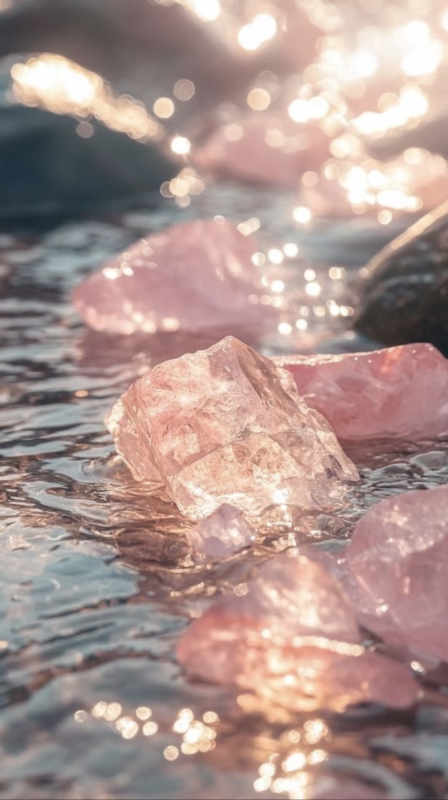
Unlike the dramatic origin stories of volcanic stones, rose quartz simply grew quietly, crystallizing slowly in silica-rich cavities deep within the Earth’s crust over millions of years. Its signature soft pink color comes from trace amounts of titanium, iron, or manganese embedded within its structure. It belongs to the quartz family — the same mineral family as clear quartz, amethyst, and citrine — but its microscopic crystal structure sets it apart. Where other quartz forms in large, visible hexagonal prisms, rose quartz occurs in massive, non-crystalline form, meaning its crystal structure can only be seen under a microscope.
The color of rose quartz ranges from the palest blush to a warm, saturated dusty rose. It is never a bright, saturated pink — its softness is part of its character. High-quality rose quartz is prized for its translucency, often displaying a soft, cloud-like depth when held up to light. Its translucency and delicate color have made it a favored material for jewelry, carvings, and decorative objects for thousands of years.
Chemically, rose quartz is composed of silicon dioxide (SiO₂) with a Mohs hardness of 7 — making it durable enough for daily wear in jewelry while still soft enough to be carved and polished into beads, cabochons, and sculptural shapes.
A Stone Wrapped in Legend
Rose quartz has been cherished across civilizations not for its rarity, but for what it was believed to represent — love, beauty, and emotional harmony.
Ancient Rome & Greece: Rose quartz was worked into jewelry, intaglios, and seals as early as 600 BCE. Roman and Greek engravers prized it for its ability to hold a high polish and its subtle translucent quality. Seals carved from rose quartz were used to authenticate documents and correspondence — an act of trust and authority in ancient society. The stone’s association with emotional matters likely grew from these uses: a seal pressed into wax on a letter of love or friendship carried the warmth of the sender’s intent.
Ancient Egypt: Rose quartz has a long history in Egyptian beauty rituals. According to legend, Cleopatra — one of history’s most legendary figures — was said to have used crushed rose quartz as a facial treatment to maintain her legendary beauty. Whether or not the story is literally true, it reflects a centuries-old association between rose quartz and the care and nurturing of the self. Egyptian artisans also carved rose quartz into beads, amulets, and small vessels.
China & East Asia: Jade has always been the dominant stone in Chinese culture, but rose quartz — known in Chinese as fenjing (粉晶), or “pink crystal” — was used as a jade substitute in decorative objects and personal ornaments when jade was too rare or expensive. It was associated with feminine energy, softness, and the gentler aspects of beauty.
Japan: According to one Japanese legend, the goddess of love created rose quartz and left it in a riverbed, where it was discovered by a wandering poet who brought it back to his village. The stone was said to spread love and goodwill wherever it traveled — a story that reflects how rose quartz has been used across cultures as a symbol of spreading warmth rather than possessing it.
What connects these disparate traditions is this: rose quartz was never a stone of conquest or power. It was a stone of tenderness — of softening, opening, and nurturing.
Spiritual Properties & Energetic Qualities
In the modern crystal lexicon, rose quartz is universally known as the stone of unconditional love — understood not as romantic love alone, but as the broader quality of emotional openness, self-compassion, and gentleness toward oneself and others.
In contemporary energy work, rose quartz is described as a stone that gently opens the heart chakra — the energetic center located at the chest associated with vulnerability, compassion, and emotional receptivity. It is not a stone of intense transformation; rather, it is described as a stone that softens edges, quiets defensive walls, and creates space for gentleness to return. People who feel emotionally guarded, who have difficulty accepting kindness, or who struggle with self-worth are often drawn to rose quartz for this reason.
Rose quartz is also widely regarded as a stone that supports emotional balance. It is described as a calming presence — not one that suppresses difficult emotions, but one that helps the wearer approach those emotions with greater tenderness and less reactivity. In this reading, rose quartz is less a stone of getting what you want, and more a stone of being who you already are.
Finally, rose quartz is often used in rituals of self-care and renewal. Placing a piece of rose quartz on a bedside table, wearing it close to the skin during times of emotional stress, or simply holding it during moments of pause are all practices described in the modern crystal tradition — framed not as a remedy for specific conditions, but as a supportive companion in the ongoing practice of caring for oneself.
Who Is Rose Quartz For
Rose quartz may be a meaningful companion if you have difficulty accepting kindness — if compliments make you deflect, if love offered feels uncomfortable, if your first instinct is to protect rather than to receive. If you are navigating the aftermath of a difficult relationship, rose quartz is traditionally regarded as a stone that helps restore a sense of warmth and openness without forcing you to rush the process. If you tend to be hard on yourself — perfectionist, self-critical, always pushing forward without pausing — rose quartz is often described as a reminder that gentleness is not weakness. And if you simply appreciate quiet beauty, the translucency and soft color of rose quartz make it one of the most visually calming stones you can wear.
When to Wear
- During moments when you need to practice self-acceptance — after a failure, a rejection, or a difficult conversation.
- On days when you want to lead with warmth rather than defensiveness — in relationships, at work, in social situations.
- During travel or transitions, when a sense of emotional stability and openness is especially comforting.
- As a daily reminder: that you are worthy of the same gentleness you extend to others.
Small pauses.Big shifts.Find your piece→
Care Guide
Rose quartz ranks 7 on the Mohs scale, making it durable enough for everyday jewelry wear. That said, its beauty is best preserved with a few simple habits.
Avoid prolonged exposure to direct sunlight. Like many pink stones, rose quartz can fade over time if worn frequently in strong sunlight — so remove your rose quartz jewelry before extended sun exposure, such as at the beach or pool.
Keep it away from harsh chemicals. Perfume, hairspray, cleaning products, and cosmetics can dull its polish over time. Apply sprays and creams before putting on your rose quartz jewelry, and wipe it gently with a soft cloth after wearing.
Clean with care. Warm, soapy water is generally safe for rose quartz — use a soft brush to clean around beads and settings. Avoid steam cleaners and ultrasonic cleaners, which can cause thermal shock to the stone. Store separately from harder stones like diamonds or sapphires to prevent scratching.
If you use rose quartz energetically, gentle methods work best. Smudging with sage or placing it on a crystal cluster are commonly used approaches. Unlike some stones that prefer specific cleansing methods, rose quartz responds well to almost any gentle energetic clearing practice.
Further Reading & References
1. The Crystal Bible — Judy Hall, Godsfield Press, 2003 (first edition); revised and expanded in subsequent editions.
One of the world’s best-selling crystal reference guides, with detailed entries on over 200 crystals including rose quartz.
2. The Encyclopedia of Crystals, Herbs, and New Age Items — Rosemary Gladstar, Storey Publishing, 2012.
A foundational reference in the contemporary crystal and holistic wellness community. The author is a widely recognized authority in American herbalism and natural healing traditions.
3. The Book of Stones — Robert Simmons & Naisha Ahsian, North Atlantic Books, multiple editions since 2005.
Widely regarded as one of the most authoritative references in the modern crystal field. Includes a detailed entry on rose quartz’s properties and history.
4. The British Museum — Ancient Roman Seals & Intaglios Collection — https://www.britishmuseum.org/collection (accessed 2026)
The British Museum holds an extensive collection of Roman and Greek intaglios carved in rose quartz and other stones, documenting the use of rose quartz in ancient glyptic art.
5. Metropolitan Museum of Art — Ancient Egyptian Cosmetic and Personal Objects — https://www.metmuseum.org/ (accessed 2026)
The Met’s collection of ancient Egyptian personal ornaments and cosmetic implements includes examples of rose quartz carved objects, documenting the material’s use in Egyptian culture.