
A Stone Born from Fire
Among all natural crystals, black obsidian has the most dramatic origin story — it is not a mineral crystal at all, but volcanic glass.
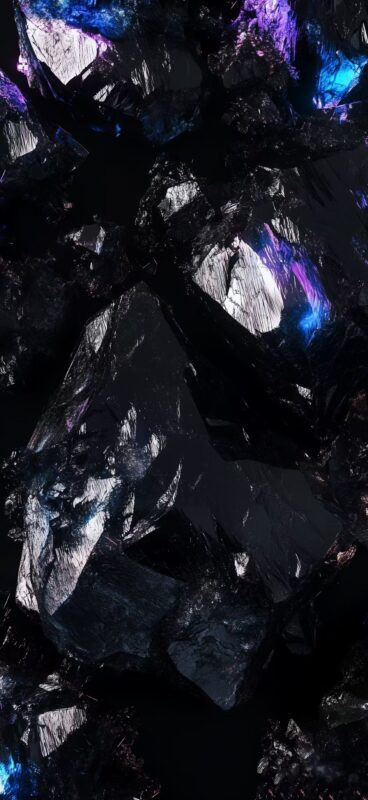
When basaltic lava erupts from a volcano and cools rapidly at the surface, the mineral particles don’t have enough time to form crystal structures. Instead, they solidify into glass. This rapid cooling can produce a thin shell or a thick mass, and obsidian is born from the fastest-cooling layer of that lava flow. Because of its glassy nature, obsidian has a smooth, reflective surface capable of catching and bending light, while its conchoidal fracture means it breaks with extraordinarily sharp edges — a property that defined its role in human civilization for thousands of years.
Chemically, obsidian is composed primarily of silicon dioxide (SiO₂) with a Mohs hardness of 5 to 5.5. While it ranks moderately hard, it is brittle and prone to chipping under impact. Its color is typically a deep, uniform black, but when light penetrates at certain angles, it can reveal brown, green, or iridescent hues. Among collectors, the most prized varieties are gold sheen obsidian and rainbow obsidian — stones that seem to hold trapped light within their dark depths.
A Stone That Crossed Civilizations
Obsidian is arguably the oldest worked stone in human history, and its significance spans continents and cultures that never knew each other existed.
Ancient China: Archaeological evidence shows that Chinese craftspeople were working with obsidian as early as the Shang and Zhou dynasties, using it for cutting implements and small ritual objects. In traditional Chinese belief, obsidian was understood to protect against harmful external energies — what the Chinese call xie qi (邪气) or “negative energy.” Fragments were often sewn into pillows, worn as amulets close to the body, or placed at the four corners of a home. This belief has persisted for thousands of years and remains part of folk practice in some regions today.
Native American Peoples: Across the American West, especially in Oregon’s High Lava Plains, prehistoric obsidian tools and weapon fragments are found in extraordinary abundance — not only for daily use but for ceremonial purposes. In Hopi and Navajo shamanic traditions, obsidian was crafted into protective amulets and ritual objects. Practitioners believed it could absorb darkness and connect the wearer to deep earthly energies.
Maya & Aztec Civilizations: In Mesoamerica, obsidian reached its most sacred expression. The Maya carved stunning sun masks from single pieces of polished obsidian — works so refined that modern archaeologists still marvel at their craftsmanship. These masks, depicting the sun god’s face, were central to sun worship ceremonies. The Aztec went further still, shaping obsidian into remarkably sharp surgical-like blades for ritual procedures. They believed that a cut made with obsidian carried a special spiritual cleanliness — a belief that speaks volumes about how deeply this dark stone was revered.
Japan: During the later Jōmō period, the people of the Japanese archipelago began using obsidian for arrowheads and ritual implements. In Shinto tradition, obsidian was understood to facilitate communication between heaven and earth, earning it a place in sacred ceremonies.
What is most striking is this: across all these civilizations — disconnected, unrelated, thousands of miles apart — the understanding of obsidian was remarkably consistent. It is a stone of protection, purification, dispelling negativity, and facing what is true.
Spiritual Properties & Energetic Qualities
When obsidian enters the modern crystal lexicon, these ancient associations find contemporary expression — framed as spiritual properties and energetic qualities rather than medical claims.
In contemporary energy work, obsidian is widely regarded as one of the most powerful grounding stones. It is believed to anchor scattered, anxious thoughts to the present moment — particularly useful for people who feel mentally adrift, unable to focus, or disconnected from their physical bodies. For those who are highly sensitive to other people’s moods and energies, obsidian is often described as a gentle “energetic shield,” helping the wearer maintain emotional equilibrium in public spaces: on commutes, in open offices, at crowded events.
Obsidian is also known as the “emotional detox stone.” It is believed to support the wearer in confronting feelings they have been avoiding — long-held anger, buried fear, recurring anxiety. The premise is framed as a spiritual practice: real change can only begin when we stop running from our inner truths. Obsidian, in this reading, offers the courage to sit with what’s real.
In today’s digitally saturated world, obsidian has found another role: as a symbolic counterweight to electromagnetic radiation from phones and computers. Whether or not there is a physical mechanism at work, many people find genuine comfort in the ritual of setting a piece of obsidian near their workspace — a small act of intention that helps create a psychological boundary between themselves and the constant digital hum.
Who Is Black Obsidian For
Obsidian may be a meaningful companion if you often feel drained after social interactions, as though you’ve absorbed other people’s moods and stress. If you are navigating a major life transition — a new job, a relationship shift, a move, a new chapter — obsidian may offer a sense of stabilizing presence. If you work in high-pressure environments or consume a lot of difficult information, obsidian is traditionally worn as a protective stone in these contexts. And if you are simply beginning your journey with crystals, black obsidian is widely considered one of the best starting stones — deep, ancient, and immediately engaging.
When to Wear
- When starting something new or entering unfamiliar situations — a new job, a new home, a new social circle.
- On overwhelming days when you need grounding support rather than reactive energy.
- During meditation or self-reflection practices when you want to go deeper.
- As an ideal first crystal for beginners who are just starting their journey.
Small pauses.Big shifts.Find your piece→
Care Guide
Though obsidian ranks around 5–5.5 on the Mohs scale, it is glass-like and can fracture or chip if struck against hard surfaces. Chemical exposure — perfume, cleaning products, cosmetics, even sweat — can dull its natural luster over time. After wearing, simply wiping it gently with a soft dry cloth is usually sufficient to maintain its shine.
Because of its glass structure, prolonged water exposure is not ideal. Remove your obsidian before showering, swimming, or exercising. If working with obsidian energetically is part of your practice, sage smudging or resting the stone on a clear quartz or amethyst cluster are commonly used methods — water immersion is generally discouraged.
Further Reading & References
1. The Crystal Bible — Judy Hall, Godsfield Press, 2003 (first edition); revised and expanded in subsequent editions.
One of the world’s best-selling crystal reference guides, covering over 200 crystals with detailed entries on properties, history, and uses.
2. The Encyclopedia of Crystals, Herbs, and New Age Items — Rosemary Gladstar, Storey Publishing, 2012.
A foundational reference in the contemporary crystal and holistic wellness community. The author is a widely recognized authority in American herbalism and natural healing traditions.
3. The Book of Stones — Robert Simmons & Naisha Ahsian, North Atlantic Books, multiple editions since 2005.
Widely regarded as one of the most authoritative references in the modern crystal field, with detailed entries on hundreds of stones including obsidian.
4. Smithsonian National Museum of Natural History — Minerals & Gems Collection — https://naturalhistory.si.edu/ (accessed 2026)
One of the world’s largest natural history museums, with extensive public-facing academic resources on obsidian and other gemstones available online at no cost.
5. Mesoamerican Obsidian Studies — Journal of Archaeological Science, published by Elsevier; multiple peer-reviewed studies published across the 1990s–2010s.
A respected peer-reviewed journal publishing original research on archaeological topics, including several landmark studies on obsidian sourcing, trade routes, and ritual significance in Maya and Aztec civilizations.