
Material
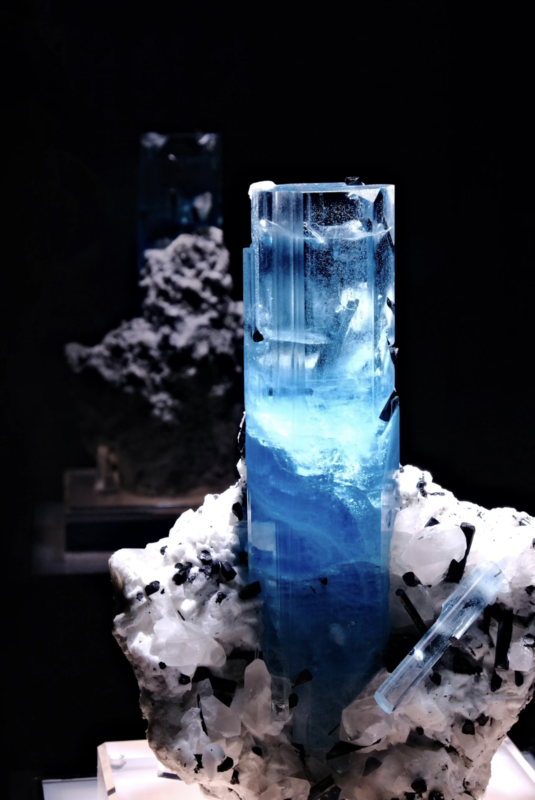
Aquamarine is a transparent to translucent variety of beryl, a beryllium aluminum silicate mineral with the chemical formula Be3Al2Si6O18. Its signature blue-to-sea-green color ranges from pale sky blue to deep ocean blue, caused by trace amounts of iron (Fe2+ and Fe3+) embedded in the crystal structure. The finest specimens display a pure, intense blue with no visible inclusions and exceptional clarity — a quality that makes faceted Aquamarine particularly brilliant under light. It ranks 7.5-8 on the Mohs hardness scale, making it durable for jewelry use while still requiring care to avoid sharp impacts. Aquamarine forms in pegmatite veins and miarolitic cavities, typically as hexagonal prismatic crystals that can grow to substantial sizes; large gem-quality crystals are relatively common compared to other beryl varieties, which is why significant Aquamarine specimens are more accessible on the market. Heat treatment is commonly used to enhance blue color, a widely accepted practice in the gem trade that produces a more stable, saturated blue.
Cultural Significance
Aquamarine’s luminous blue has inspired humanity’s relationship with the ocean for thousands of years, making it one of the most culturally rich gemstones in the beryl family.
Ancient Rome: Aquamarine was known as aqua marina — literally “sea water” in Latin. Roman sailors routinely carried the stone as a talisman for safe sea voyages, believing it offered protection from the dangers of the ocean and earned the favor of Neptune, god of the sea.
Medieval Europe: European healers and physicians used Aquamarine in elixirs and as an amulet, believing it had the power to calm seasickness and protect travelers on long journeys. It was also considered a stone of courage — a counterbalance to the fear induced by open water.
Ancient Egypt and Greece: Carved Aquamarine scarabs and intaglios have been found in Egyptian burial sites. In Greece, Aquamarine was associated with the goddess of the sea and was used in jewelry and decorative objects as a sign of status and connection to the divine.
Tibetan and Himalayan Buddhist Traditions: Aquamarine has long been considered a sacred stone in Tibetan Buddhist practice, associated with the throat chakra and the energy of truthful communication. It has been used in ritual objects and as a meditation stone.
Modern Maritime Tradition: Aquamarine remains associated with sailors and ocean travel to this day. It is traditionally given as a 19th wedding anniversary gift — a reference to its connection with the sea and lasting partnerships.
Across traditions, Aquamarine’s defining symbolism is the same: the ocean as a force both calming and powerful, beautiful and humbling. It is the stone of those who carry the sea within them — whether by profession, by temperament, or by longing.
Energetic Qualities
Aquamarine is regarded in crystal traditions as a stone of openness, clarity, and fluid courage — the kind of energy that helps one move through the world without unnecessary resistance. Its cool blue color evokes wide, open water, and with it comes a sense of expansiveness: a feeling of releasing what is tight and contracting, and allowing a broader, more inclusive perspective to emerge. Practitioners value Aquamarine for its association with honest, clear communication — the willingness to say what needs to be said without aggression or apology. It is considered a stone that supports those who must speak difficult truths or navigate complex interpersonal situations with composure and calm. Many who work with Aquamarine describe it as a stone of letting the breath come easy — an energy that loosens the grip of anxiety and creates space for a quieter, more settled mind. Its connection to the sea also brings themes of adaptability and flow: the recognition that change is constant and that flexibility is not weakness but intelligence. Aquamarine is traditionally associated with the throat chakra, where it is valued for supporting authentic expression and the courage to speak from a genuine place.
Who It Suits
Those who spend significant time near or on the ocean, or who feel deeply connected to the sea as a source of meaning and renewal
Individuals whose work or life requires clear, honest, and sometimes difficult communication — teachers, leaders, mediators, and advocates
People who tend toward anxiety or tension and who are drawn to cool, calming energies as a counterbalance to a racing or worried mind
Anyone navigating a period of transition or uncertainty who wants a reminder of the value of adaptability and open-hearted resilience
Those who are drawn to the beauty of blue gemstones and want a piece of jewelry that carries both elegance and deep symbolic meaning
When to Wear It
Public speaking and important conversations: Worn during presentations, difficult discussions, or any situation where clear and composed communication is essential
Travel and ocean journeys: An appropriate companion for sea voyages, coastal retreats, or any journey that takes one away from familiar ground
Creative and artistic work: Kept nearby during creative processes to support openness, flow, and the ability to express something true
Daily composure: A beautiful everyday piece that serves as a quiet anchor for maintaining calm clarity throughout the demands of the day
Small pauses.Big shifts.Find your piece→
Care Instructions
Clean with lukewarm soapy water and a soft brush; avoid harsh chemicals, steam, or ultrasonic cleaners, which may damage the stone or affect any heat treatment
Remove before activities that could cause impact or scratches — Aquamarine, while durable, can chip or fracture if struck sharply
Store separately from harder gemstones to prevent scratching; a soft pouch or lined jewelry box is ideal
Avoid prolonged exposure to strong direct sunlight, which may cause the blue color to fade over time, particularly in lighter specimens
Apply perfume, hairspray, and cosmetics before putting on Aquamarine jewelry to minimize exposure to chemicals
Further Reading
Simmons, Robert & Ahsian, Naisha. The Book of Stones: Who They Are and What They Teach. North Atlantic Books, 2007.
Hall, Judy. The Crystal Bible: A Definitive Guide to Crystals. Godsfield Press, 2003.
Schumann, Walter. Gemstones of the World. Sterling Publishing, 2013.
Gemological Institute of America (GIA) — Aquamarine Gem Guide: https://www.gia.edu/
Smithsonian National Museum of Natural History — Gem Collection: https://naturalhistory.si.edu/
FAQ
Aquamarine is a transparent to translucent variety of beryl, a beryllium aluminum silicate mineral. Its blue-to-sea-green color ranges from pale sky blue to deep ocean blue, caused by trace amounts of iron in the crystal structure. It ranks 7.5–8 on the Mohs hardness scale.
The name “aquamarine” literally means “sea water” in Latin. Ancient Roman sailors carried it as a talisman for safe voyages, believing it offered protection from ocean dangers. This maritime association has remained strong throughout history.
Ancient Romans used it as a sailors’ protective talisman. Medieval Europeans associated it with courage and calm during travel. Tibetan Buddhists valued it for truthful communication. Greeks used carved Aquamarine in jewelry as a sign of status and divine connection.
Clean with lukewarm soapy water and a soft brush. Avoid harsh chemicals, steam, or ultrasonic cleaners. Avoid prolonged direct sunlight, which may cause lighter specimens to fade. Apply perfume and hairspray before wearing.
Clean with lukewarm soapy water and a soft brush. Avoid harsh chemicals, steam, or ultrasonic cleaners. Avoid prolonged direct sunlight, which may cause lighter specimens to fade. Apply perfume and hairspray before wearing.
In crystal energy traditions, Aquamarine is associated with the throat chakra, valued for supporting authentic expression and the courage to speak from a genuine place. It is considered a stone that helps with clear, composed communication.