
The Stone That Fell from the Sky
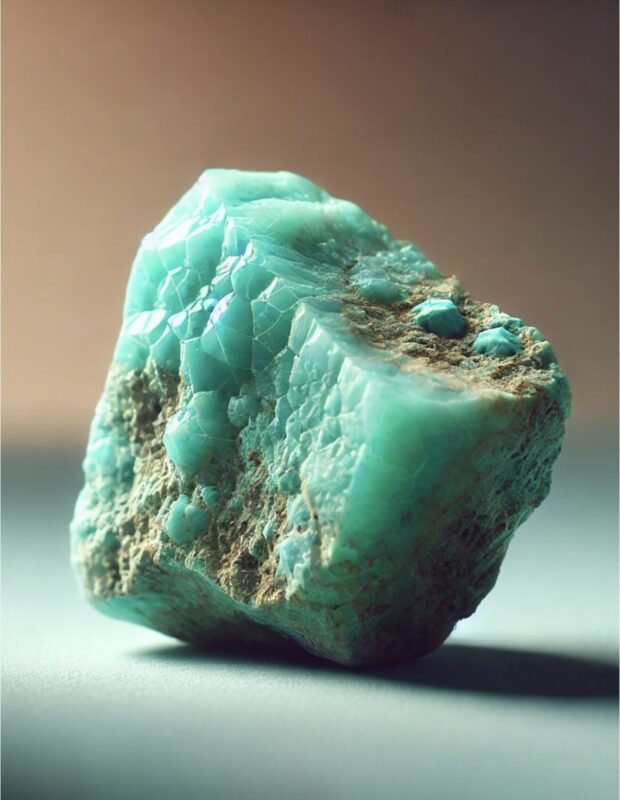
Turquoise is a phosphate mineral — copper aluminium phosphate, to be precise — formed when copper-rich water percolates through aluminium-rich host rock. The colour that makes it unmistakable, that specific blue-green that sits between sky and sea, comes from copper: the more copper present, the more vivid the blue; the more iron, the more the colour shifts toward green. No two specimens are the same, which is part of what has made turquoise among the most consistently valued materials in human civilization for over five thousand years.
The finest turquoise comes from the region that straddles the border between Iran and Afghanistan — Persian turquoise — characterised by an even, robin’s-egg blue with minimal matrix (the dark veining that runs through some specimens like a geological fingerprint). American turquoise, particularly from Arizona and Nevada, tends toward a more vivid blue-green with more pronounced matrix patterns: some specimens show black or brown veining that creates a landscape-like pattern across the stone, earning them names like “spiderweb turquoise.” Chinese turquoise is often more green and frequently treated or reconstructed. The quality range is wide, and the market reflects it: from inexpensive reconstituted material to rare, matrix-free Persian specimens commanding significant prices.
Turquoise rates 5 to 6 on the Mohs scale — making it relatively soft compared to most gemstones used in jewelry. It is also porous: it absorbs oils, chemicals, and moisture readily, which is why high-quality turquoise is often stabilisation-treated (infused with resin to fill the pores and strengthen the stone) before being set in jewelry. This treatment does not diminish the stone’s beauty or authenticity, but untreated, high-grade turquoise is considerably more vulnerable to colour change over time — exposure to skin oils, cosmetics, and air can gradually shift its blue toward green.
The Sky Stone Across Cultures
Turquoise has one of the longest continuous cultural histories of any material on earth. The oldest known turquoise jewellery — a turquoise-inlaid gold pectoral mask excavated from the tomb of the Egyptian Queen Zer in 5500 BCE — places the stone at the beginning of recorded human civilisation. From there, its history runs in a nearly unbroken line through the Indus Valley, Mesopotamia, the Persian Empire, pre-Columbian Central and South America, and the indigenous cultures of the American Southwest.
In ancient Persia, turquoise was associated with the sky and with the god of the sky — a stone that represented the space between the earthly and the divine. It was set into the turbans of Persian royalty as a protective amulet: not merely decorative, but functional, believed to protect the wearer from the Evil Eye and from untimely death. This association with protection from without — with shielding the wearer from external harm — is one of two dominant symbolic threads that runs through turquoise’s cultural history.
In pre-Columbian Mesoamerica and the American Southwest, turquoise was among the most sacred materials in the Aztec, Pueblo, and Navajo traditions. The most significant of these is its use by the Zuni and Hopi peoples, for whom turquoise represented the sky and was inseparable from the practice of shamanic protection and healing. The Zuni traditionally used turquoise in fetish carvings — small animal figures believed to house protective spirits — with the turquoise representing the sky element and the particular animal representing the spirit’s character. In Navajo tradition, turquoise is one of the four sacred stones used in the Blessingway ceremony — the ceremonial practice most central to Navajo spiritual life — and is worn or carried as a protection against misfortune and as an offering to the spiritual forces that govern health and wellbeing.
In Tibetan and broader Himalayan culture, turquoise is worn by horses and yaks as a protective talisman — a small turquoise stone hung at the mane or tail of an animal to protect it from harm and attract good fortune. This practice extends the stone’s protective association beyond the human realm into the animal and the natural world, and it is one of the most visually striking expressions of the stone’s cultural meaning.
Spiritual Properties & Energetic Qualities
In the modern crystal lexicon, turquoise occupies a position at the intersection of protection and communication — two qualities that might seem unrelated until one considers what they share: both require courage. Protection because it requires standing ground; communication because it requires speaking something true. Turquoise, in contemporary practice, is described as a stone that supports both.
The protection quality attributed to turquoise draws directly from its ancient cultural history: the Persian turban, the Egyptian amulet, the Navajo Blessingway. Contemporary practitioners describe turquoise as a stone that creates a kind of energetic buffer — not the absorption of obsidian or the deflecting quality of black tourmaline, but something closer to : a stone that is simply there, fully present, in a way that changes the quality of the space around it. People who describe themselves as energetically sensitive — who find large crowds or chaotic environments overwhelming — often find turquoise to be one of the most immediately effective supportive stones.
The communication quality attributed to turquoise is newer in its articulation but has ancient roots. The connection between turquoise and clear, honest speech is found in several crystal traditions simultaneously: in the Navajo tradition, turquoise set at the throat was believed to support clear speech and honest expression; in contemporary practice, turquoise is described as a stone that helps the wearer find the courage to say what they actually mean, rather than what is safest or most palatable. This is not the communication quality of blue lace agate — which is gentle and diplomatic. Turquoise’s communication quality is more direct, more elemental: the courage to say the true thing, regardless of whether it is comfortable.
Who Is Turquoise For
Turquoise is one of the more versatile stones in the crystal lexicon — appropriate across a wider range of contexts than some of the more emotionally specialised materials.
If you are someone who tends to absorb the energy of your environment — who finds large gatherings, loud spaces, or high-conflict situations difficult to navigate without coming away feeling depleted — turquoise is traditionally used as a supportive protective stone in exactly these situations. Not as a shield, but as a buffer: something that is simply too fully present to be destabilised by what is going on around it.
If you are preparing to have a difficult conversation — one that requires honesty rather than diplomacy, or that requires you to advocate clearly for yourself in a situation where you might otherwise defer — turquoise is described as a supportive companion for that moment. It is not a stone that makes the conversation easier; it is one that supports the courage to have it.
If you are drawn to the visual quality of turquoise — the colour that has no real equivalent in the mineral world, the particular blue-green that photographs and paintings can only gesture toward — that aesthetic connection is entirely valid. Turquoise is one of the few stones whose colour is more vivid in person than in image. Wearing it is its own kind of engagement with its energy.
When to Wear
- In large gatherings, crowded spaces, or high-density social environments — where its protective buffer quality is most useful
- Before difficult conversations, negotiations, or moments that require clear, honest self-advocacy
- During travel and transition — turquoise’s protective quality is traditionally valued during periods of movement and change
- In creative work that requires courage rather than comfort — when the quality of what you need to say or make is more important than whether it is immediately well received
- Everyday wear during periods when you need to feel more fully present — not performing or deflecting, but genuinely inhabiting your own space
Small pauses.Big shifts.Find your piece→
Care Guide
Turquoise is one of the more care-intensive materials in the crystal lexicon — beautiful and worth the attention it requires, but requiring a few specific habits to keep it at its best.
Apply perfume, hairspray, cosmetics, and sunscreen before putting on turquoise jewelry. Turquoise is porous and absorbs oils and chemicals readily — these can affect the colour over time, shifting the blue toward green. This is not a flaw in the stone; it is its nature. The预防 is in the application order: put the turquoise on last, after everything else is in place.
Clean turquoise with a soft, dry cloth only. Do not submerge in water, do not use chemical cleaners, and do not use ultrasonic or steam cleaners. If the stone needs more than a dry wipe, a briefly damp cloth followed immediately by a dry cloth is the safest approach.
Store turquoise separately from other jewelry — particularly metals and harder gemstones that can scratch its relatively soft surface. A soft pouch or individual compartment is ideal. Avoid storing turquoise in direct sunlight for extended periods, which can cause some specimens to fade.
Note on colour change: it is normal and expected for turquoise to gradually shift in colour with wear and exposure — bluer specimens tend toward green, and the overall colour deepens with skin oils and regular wear. This is not damage; it is the stone taking on its wearer’s history. Some collectors and wearers actively welcome this; others prefer to maintain the original colour as long as possible through careful care habits.
For energetic clearing of turquoise: sage smoke, sound healing with a singing bowl, or brief moonlight exposure are all gentle and effective methods. Because turquoise is sensitive to chemicals and prolonged moisture, avoid water-based clearing methods unless the turquoise has been stabilisation-treated and your care provider has confirmed it is safe to submerge.
Further Reading & References
1. The Book of Stones — Robert Simmons & Naisha Ahsian, North Atlantic Books, multiple editions since 2005. Widely regarded as one of the most authoritative references in the modern crystal field. The turquoise entry covers formation, varieties, and energetic properties.
2. The Crystal Bible — Judy Hall, Godsfield Press, 2003 (first edition); revised and expanded in subsequent editions. One of the world’s best-selling crystal reference guides.
3. Turquoise: The World’s Most Famous Gemstone — Glenn C. Wiles, ed., Blue Chart Company, 2018. A comprehensive reference on turquoise sourcing, varieties, treatment methods, and market standards.
4. GIA — Gemological Institute of America: Turquoise — https://www.gia.edu/turquoise/ (accessed 2026). The Gemological Institute of America’s official information on turquoise — formation, varieties, treatment, and care.
5. Turquoise Unearthed — Joe Dan Lowry, Jr., Living Desert Publications, 2002. An illustrated guide to American turquoise — sources, varieties, and the cultural history of turquoise in the American Southwest and Mexico.
FAQ
Turquoise is a phosphate mineral — copper aluminium phosphate — formed when copper-rich water percolates through aluminium-rich rock. Its characteristic blue-green colour comes from copper; more copper produces vivid blue, more iron shifts the colour toward green. Sources include Iran, Afghanistan, the American Southwest (Arizona, Nevada, New Mexico), China, and Mexico. Turquoise rates 5 to 6 on the Mohs scale — relatively soft and porous. High-quality turquoise is often stabilisation-treated to strengthen it for jewelry use.
Turquoise has one of the longest continuous cultural histories of any material on earth — over 5,000 years. In ancient Persia it was a protective amulet against the Evil Eye; in Navajo and Pueblo traditions it is one of the four sacred stones of the Blessingway ceremony. In modern crystal practice, turquoise is described as a stone of protection and clear communication: protective in the sense of creating an energetic buffer in overwhelming environments, and communicative in the sense of supporting the courage to say what is true rather than what is safe.
Turquoise is porous and sensitive to oils, chemicals, and moisture. Apply perfume, hairspray, and cosmetics before putting on turquoise jewelry. Clean with a soft dry cloth only — do not submerge in water or use chemical cleaners. Store separately from harder gemstones. Turquoise will gradually shift in colour with regular wear (blue tends toward green) as it absorbs skin oils — this is normal and expected, not damage.
Stabilisation is a treatment process where resin is infused into porous turquoise to fill the pores and strengthen the stone for jewelry use. Most commercial turquoise is stabilisation-treated. Untreated, high-grade turquoise is rarer and more expensive but considerably more vulnerable to colour change and damage. Both are genuine turquoise; the difference is in durability and maintenance requirements.
Turquoise is porous and absorbs the oils, cosmetics, and environmental substances it is exposed to over time. This absorption gradually shifts the colour — typically from blue toward green — and is considered a normal part of the stone’s life. Some wearers appreciate this as the stone taking on their personal history; others prefer to maintain the original colour through careful care habits.