
Overview
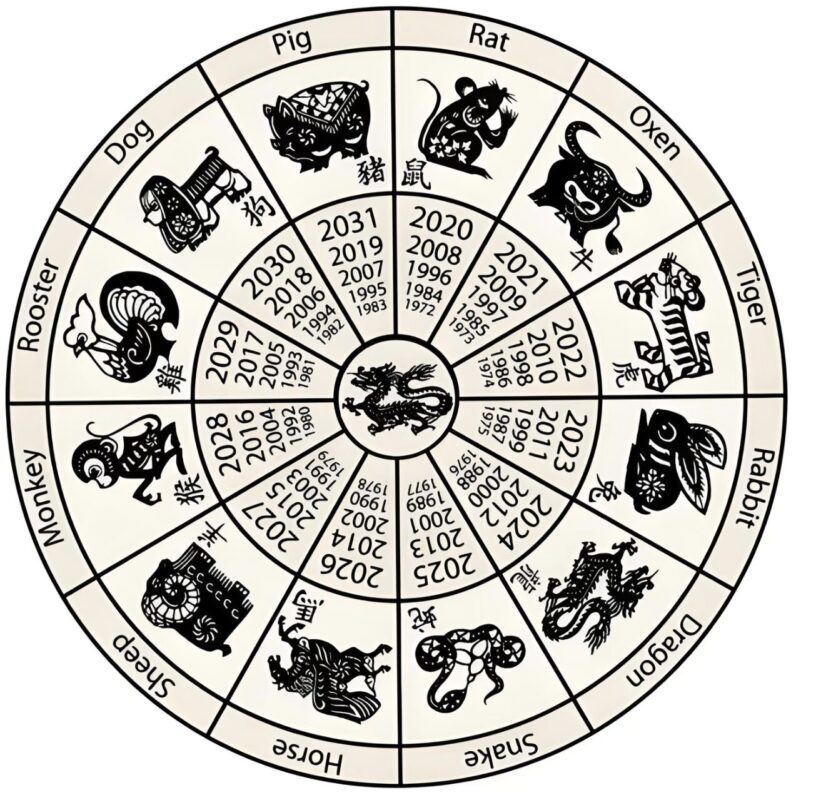
The Chinese zodiac, known as “Sheng Xiao” (生肖), is a cyclical system that pairs twelve animals with the ten heavenly stems and twelve earthly branches that make up the traditional Chinese calendar. Rat, Ox, Tiger, Rabbit, Dragon, Snake, Horse, Goat, Monkey, Rooster, Dog, and Pig — each repeating every twelve years, a system that has been in continuous use for over two millennia.
This is not merely a curiosity of the calendar. The zodiac permeates Chinese daily life: it shapes how people understand their personality, choose their partnerships, pick auspicious dates, and interpret the years ahead. For anyone engaging with Chinese culture — whether through commerce, design, or personal interest — the zodiac is one of the most foundational frameworks to understand.
Cultural Symbolism
Origins and History
The roots of the zodiac lie in the earlier sexagenary cycle (ganzhi), a sophisticated calendrical system developed during the Shang and Zhou dynasties. The pairing of specific animals to each earthly branch crystallized during the Eastern Han dynasty, likely through a combination of totemistic traditions, agricultural symbolism, and oral narrative.
The most enduring origin story tells of the Yellow Emperor selecting twelve animals as his guards, with the order of arrival determining their rank — which is why the Rat is first, having arrived by hitching a ride on the Ox. This narrative is legend, not history, but it is the story that most Chinese people grow up knowing, making it a powerful entry point into the system.
Symbolic Meanings of Each Animal
The Rat occupies an unusual cultural position: small and often seen as a pest, yet the Rat is celebrated in the zodiac for its cleverness and adaptability. In Chinese folklore, the Rat often outwits larger animals, a quality that translates in the zodiac to resourcefulness and sharp intuition. Rat years are associated with financial activity and commercial energy.
The Ox is the opposite of the Rat in temperament. Patient, reliable, and unstoppable once set to a task, the Ox represents the value of steady, quiet effort. In rural China, the Ox was the most valued working animal, and this translated into a zodiac sign associated with perseverance and building something lasting. Ox years are considered stable and productive.
The Tiger is the only truly wild animal in the zodiac, and its placement third — outranking even the Dragon in the sequence — speaks to how seriously the tiger was taken in Chinese culture. As the king of beasts, the Tiger symbolizes courage, personal power, and the ability to ward off evil. Tiger imagery is ubiquitous in protective symbolism: tiger slippers for children, tiger charms on cradles. A Tiger year carries a reputation for boldness and disruption.
The Rabbit is associated with the Moon in Chinese folklore — the legend of the Jade Rabbit pounding the elixir of immortality on the Moon is among the most beloved stories in Chinese culture. This association gives the Rabbit zodiac sign connotations of longevity, gentleness, and refined taste. Rabbit years are considered auspicious for growth and cultivation.
The Dragon is the most mythologically charged of all twelve animals, and in Chinese culture it is the supreme symbol of imperial power, divine authority, and exceptional fortune. Unlike Western dragons, the Chinese dragon is benevolent, rain-bringing, and associated with wisdom rather than destruction. Dragon years are coveted: it is widely believed that Dragon-year children are destined for exceptional lives. Dragon imagery appears throughout Chinese art, architecture, and ceremony — from the dragon robes of emperors to the dragon dances of Spring Festival.
The Snake, often called the “little dragon,” shares the Dragon’s connotations of wisdom and transformation. In Chinese cosmology, the snake is associated with the feminine principle, with deep intuition, and with the capacity to shed its skin — a powerful symbol of renewal. Snake years are associated with introspection and strategic repositioning.
The Horse is associated with forward motion, vitality, and freedom. In a predominantly agrarian society, the horse was the ultimate symbol of mobility and military power. The Horse’s zodiac position — seventh, at the peak of yang energy — reflects the cultural importance of the horse as an agent of action and conquest. 2026 is a Horse year (the year of the Wood Horse). Horse years are traditionally seen as years for bold moves, new beginnings, and personal breakthroughs.
The Goat (sometimes translated as Sheep or Ram) is associated with peace, harmony, and gentle strength. The character for Goat shares the same root as the character for “auspicious” (祥), giving the Goat zodiac direct symbolic access to the concept of good fortune. The imagery of three goats heralding a great thaw (三羊开泰) is one of the most beloved auspicious motifs in Chinese art. Goat years are considered gentle and favorable for diplomacy and creative work.
The Monkey is the zodiac’s trickster — smart, mischievous, and adaptable. The character for Monkey (猴) sounds like the character for “marquis” (侯), making the monkey a symbol of social climbing and ambition in traditional symbolism. Monkey years are associated with cleverness, innovation, and the ability to seize unexpected opportunities.
The Rooster is the zodiac’s timekeeper — punctual, hardworking, and unapologetically itself. Roosters were the most reliable alarm clocks in pre-industrial China, and this practicality gave the Rooster zodiac associations with discipline, reliability, and public recognition. Rooster years favor precision work and matters requiring attention to detail.
The Dog is universally understood as loyal, and in the Chinese zodiac this loyalty is elevated to a defining cosmic virtue. The Dog is the guardian — reliable, protective, and unwavering in its bonds. Dog years are associated with consolidation, loyalty, and the protection of what one has built.
The Pig completes the cycle with connotations of abundance, prosperity, and native good fortune. In an agricultural society, a fat pig represented wealth, and the phrase “a pig rooting at the door” (肥猪拱门) was a common blessing for commercial prosperity. Pig years are traditionally seen as years of good fortune and domestic happiness, often quieter and more introspective than others.
Ben Ming Nian (Birth Year) and the Red Cord Tradition
Every twelve years, the zodiac returns to your own animal. This year is called “Ben Ming Nian” (本命年) — literally “the year of one’s life origin.” Folk belief holds that this return is a vulnerable year, when personal energy is at a cyclical low and misfortune is more likely to find you. The traditional remedy is direct and tactile: wear red. Red cord around the wrist, red underwear, red belts — the specific object matters less than the color.
What is culturally significant is not the belief itself but what it reveals: Chinese time consciousness is deeply cyclical rather than purely linear. To be “in your year” is to be aware of yourself as part of a larger system, a larger rhythm. The red cord is the physical interface between individual life and cultural time. This is why even people who identify as entirely modern will often observe the Ben Ming Nian tradition when it arrives — it is participation in a story that connects them to family, ancestors, and the accumulated meaning of millions of similar choices across two thousand years.
Spiritual Properties
The zodiac’s “spiritual properties” are not claims about supernatural causation. They are cultural symbols — accumulated meanings that have been projected onto each animal over centuries of continuous use. When someone wears a zodiac charm or gives a zodiac-themed gift, they are drawing on this reservoir of shared meaning.
Think of it as a vocabulary rather than a diagnosis. Each zodiac sign offers a vocabulary for self-description, relationship dynamics, and intentional living — one that is deeply embedded in Chinese and pan-Asian culture, and increasingly understood worldwide.
Rat: Quick-witted adaptability and financial intuition
Ox: The power of steady, persistent effort without drama
Tiger: Courage to face what feels threatening and the strength to make boundaries real
Rabbit: Sensitivity as a form of intelligence; the wisdom of retreat when needed
Dragon: Ambition that is large enough to reshape the environment around it
Snake: Transformative intuition and the capacity to navigate darkness without being consumed by it
Horse: Uncontained vitality and the refusal to be confined by circumstance
Goat: Gentleness as a form of power; the ability to neutralize conflict through patience rather than force
Monkey: Intellectual agility and the confidence to solve problems in non-obvious ways
Rooster: Uncompromising integrity and the willingness to stand out by being exactly what you are
Dog: Absolute reliability and the emotional depth to maintain loyalty across difficulty
Pig: Innate contentment and the freedom that comes from not being disturbed by external noise
Who It Is For
Anyone seeking a framework for self-understanding rooted in Chinese cultural tradition. Whether or not you believe in the predictive aspects of zodiac analysis, the zodiac provides a rich vocabulary for describing personality, relationship dynamics, and life cycles that has been refined by billions of people over two thousand years.
Those observing Ben Ming Nian — whether from genuine belief or cultural participation. The act of wearing red or giving a zodiac-themed gift during your birth year is a form of cultural continuity: it connects you to family, to tradition, and to a story that has been told and lived by hundreds of millions of people before you.
Cross-cultural learners and enthusiasts. The Chinese zodiac is one of the most globally recognized Chinese cultural frameworks — it appears in art, literature, fashion, games, and daily language. Understanding its layers unlocks a correspondingly deep layer of Chinese cultural literacy.
Creative professionals and brand strategists working with Asian markets or Asian-influenced design. The zodiac is an inexhaustible source of culturally resonant design themes. Knowing what each animal actually symbolizes — beyond surface aesthetics — is what separates respectful cultural borrowing from cultural stereotyping.
When to Use
Lunar New Year and gifting season: The zodiac animal of the incoming year is the most culturally relevant gift theme for Chinese New Year, birthdays, and milestone celebrations. A zodiac-themed piece is the most targeted gift you can choose for someone whose birth-year animal you know.
Ben Ming Nian observances: Birth-year gifts carry particular cultural weight. For a person in their zodiac year, even a small zodiac-themed item is a gesture of acknowledgment and connection to something larger than the moment.
Personal milestones: Weddings, graduations, the birth of a child, a new career chapter — any moment when you want to mark time and meaning in a culturally resonant way. The zodiac provides the deepest available framework for marking time in Chinese-influenced cultures.
Design and product development: Twelve symbols, infinite applications. Zodiac imagery is used across jewelry, fashion, homeware, stationery, digital products, and more. A Dragon-year or Horse-year limited collection carries built-in cultural significance that requires no additional narrative to land.
Small pauses.Big shifts.Find your piece→
Care Instructions
Red cord pieces (lucky bracelets, braided cords): Remove before bathing, swimming, or applying perfumes and cosmetics. Store flat or loosely coiled in a dry pouch. Color fixation is achieved during cord production, but prolonged moisture exposure will compromise it over time.
Metal zodiac charms (silver, alloy, gold-plated): Wipe with a soft dry cloth after each wear to remove body oils and environmental residue. Avoid impact with hard surfaces that can dent, scratch, or deform the engraved surface. Silver charms respond well to a dedicated silver polishing cloth; avoid chemical jewelry cleaners.
Jade and stone carvings (used in zodiac pendants, beads, and display pieces): Clean with lukewarm water and a soft cloth only. Do not use ultrasonic cleaners or chemical solvents. Jade is sensitive to temperature shock and acidic substances. Store separately from metal pieces to prevent scratching.
General principle for all zodiac pieces: Wrap individually in soft cloth when storing. Keep away from sustained direct sunlight and high-humidity environments, which can affect both cord fibers and metal finishes over extended periods.
Further Reading
Kendall, Rebecca. “Chinese Zodiac: The Complete Guide to Understanding Your Chinese Horoscope.” Findhorn Press, 2017. — An accessible and well-organized introduction to the twelve zodiac animals, their personalities, and their interactions. Good starting point for English-language readers new to the topic.
Miller, Dorcas S. “The Chinese Zodiac: A Practical Guide to Its Energy and Symbolism.” Storedown Press, 2019. — Takes a symbolic and archetypal approach, situating each zodiac animal within a broader framework of cultural meaning and practical application in daily life.
Whitney, Catherine. “Chinese Astrology: Exploring the Eastern Zodiac.” Bantam Books, 2018. — Places the zodiac within the wider context of Chinese calendrical science, BaZi (Four Pillars), and feng shui. Useful for readers interested in the broader system beyond the twelve animals.
British Museum Online Collection — Search “Chinese zodiac” to access a curated selection of zodiac-related artifacts across dynasties, including mirrors, ceramics, jade carvings, and textiles. High-resolution imagery with scholarly object descriptions. Essential reference for verifying the historical authenticity of zodiac symbolism in material culture.
The Palace Museum (故宫博物院) Collection Database — The most authoritative online resource for imperial zodiac artifacts. Extensive high-resolution photography of bronze, jade, ceramic, and textile zodiac objects from the Ming and Qing dynasties, with academic commentary in Chinese and English.
Zhao, Guozhen. “The Origin of the Chinese Zodiac and Its Cultural Significance.” Journal of Chinese Cultural Studies, Vol. 14, 2020. — Academic analysis of the sexagenary cycle’s evolution into the animal zodiac system, with attention to archaeological evidence and textual sources. Recommended for readers who want to move beyond popular accounts into scholarly literature.
FAQ
The most widely told story describes the Yellow Emperor selecting twelve animals as palace guards, with their rank determined by the order in which they arrived. The Rat reached first by hitching a ride on the Ox — which is why the Rat is first and the Ox second. The remaining ten animals followed in order. While this is legend rather than documented history, it is the narrative most Chinese people grow up with, making it the most effective cultural framework for explaining the zodiac sequence.
Ben Ming Nian (本命年
) is the year when the zodiac returns to your birth-year animal — it happens every twelve years. Folk tradition holds that this is a year of heightened vulnerability, when personal energy is at a cyclical low and misfortune is more likely to find you. The traditional remedy is to wear red: a cord around the wrist, red underwear, a red belt. What matters culturally is not whether the belief has empirical support — it does not — but what wearing red expresses: a decision to participate in a cultural story that connects individual life to a larger rhythm. Even people who identify as entirely modern often observe Ben Ming Nian when it arrives. Participation is its own meaning.
Western astrology is based on the month of birth, with each zodiac sign occupying a segment of the ecliptic. The Chinese zodiac is based on the year of birth, cycling through twelve animals. Both provide personality frameworks, but they operate differently: astrology emphasizes WHERE you were born in the sky, the zodiac emphasizes WHEN you were born in the cultural calendar. Western astrology has deep roots in Hellenistic psychological typology; the Chinese zodiac is woven into daily life — it shapes decisions about marriage, business partnerships, house construction, and travel in ways that Western astrology rarely does in its home culture.
2026 is the year of the Horse (午年), the seventh animal in the zodiac cycle. The Horse is associated with forward motion, vitality, and freedom — in a predominantly agricultural society, the horse was the ultimate symbol of mobility and ambition. Horse years are traditionally seen as years for bold moves, new beginnings, and personal breakthroughs. For those born under the Horse sign, 2026 is their Ben Ming Nian (birth year), carrying all the traditional significance described in Q2 above. It is also a year when many Horse-sign people turn 36, a milestone called the “Ben Yun Nian” (本运年) in folk tradition, considered particularly significant.
The most direct principle: give something related to the recipient’s zodiac animal, or give something in their animal’s lucky colors, numbers, or directions. A red cord bracelet for someone in their Ben Ming Nian is the most culturally resonant zodiac gift available. Giving someone a gift featuring their own zodiac animal is another strong choice — it communicates attention and personal knowledge. Traditional folk belief also considers “clashing” animal signs (certain pairings are thought to create natural tension, such as Rat and Horse), so avoid gifts that feature a recipient’s clashing animal. But these are cultural preferences, not hard rules — the intention behind the gift matters more than the form.
Chinese zodiac compatibility is part of the broader ganzhi (Four Pillars / BaZi) divination system, based on the interacting relationships between earthly branches: mutual generation, mutual overcoming, harmony, conflict, punishment, and harm. For example, Horse, Tiger, and Goat are traditionally considered compatible groups; Rat and Horse, Rabbit and Rooster are considered traditionally challenging pairings. These are projections of a symbolic system, not statistical findings. In modern usage, zodiac compatibility works best as cultural conversation material — interesting, generative of discussion, and useful for thinking about relationship dynamics without being treated as a decision-making tool.
In traditional Chinese practice, the left hand is associated with receiving energy and the right hand with releasing it — described as “left in, right out.” Based on this principle: bracelets associated with abundance and receiving (such as Green Phantom Crystal, Citrine, or Wealth bracelets) are traditionally recommended for the left hand. Bracelets associated with protection and grounding (such as Black Obsidian or Gold Obsidian) are traditionally recommended for the right hand. If a bracelet combines multiple materials with different intentions, either hand works — choose based on your dominant need for the day. The most important principle is consistency: wearing your bracelet regularly matters more than which hand it is on.