
Violet Light in Quartz
Amethyst takes its name from the Greek amethystos — a word that means “not drunk.” The ancient Greeks believed that amethyst had the power to prevent intoxication, and they carved drinking vessels from it, believing that wine drunk from an amethyst cup would not make them drunk. The scientific explanation for amethyst’s distinctive violet color is more grounded but equally fascinating: iron impurities within the quartz crystal structure, combined with natural radiation from surrounding rocks, create the color centers that produce amethyst’s signature purple range — from pale lavender to deep royal violet.
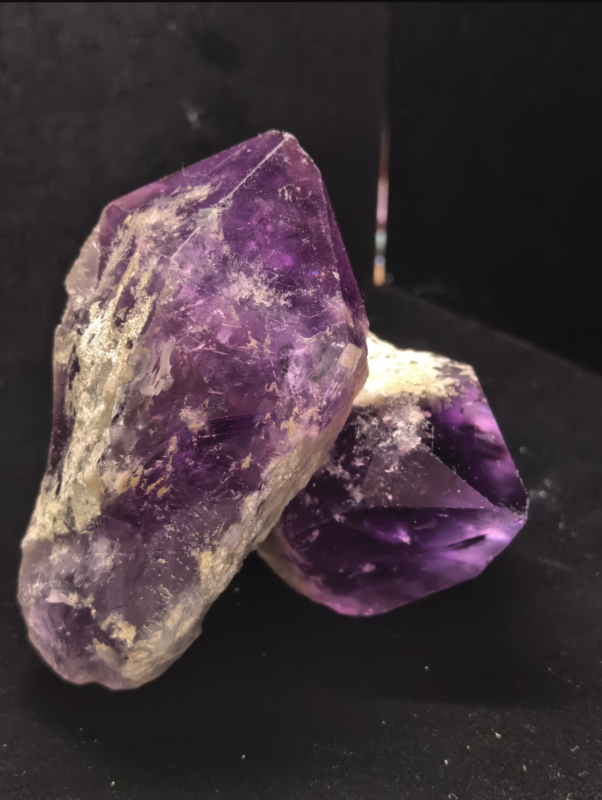
Amethyst belongs to the quartz family and grows in the same hexagonal crystal system as clear quartz and citrine — forming in long six-sided prisms with distinctive pyramid-like terminations. Unlike clear quartz, amethyst crystals often form in geodes and cavities, where they grow freely into beautiful pointed clusters. A well-formed amethyst cathedral geode, with its interior lined with purple crystal points, is one of the most dramatic mineral specimens in the world.
The color of amethyst ranges from near-colorless pale lavender to the deep, saturated violet of the finest Siberian amethyst. Heat can transform amethyst into citrine — a process that occurs naturally and is also done commercially, producing “heat-treated amethyst” sold as citrine. Amethyst rates 7 on the Mohs scale — hard enough for everyday wear in jewelry, making it both a collector’s stone and a practical choice for daily use.
A Stone That Moved Between Worlds
Amethyst’s purple color placed it in a unique position in ancient cultures — it sat between the earthly and the divine, between the material and the spiritual, and that liminal quality shaped its symbolism across civilizations.
Ancient Greece & Rome: The Greeks’ belief that amethyst prevented drunkenness was more than superstition — it reflected a deeper association between the stone’s purple color and qualities of moderation and clarity of mind. Wine was associated with both joy and excess, with Dionysus; amethyst, worn or drunk from, was believed to keep the wearer in a state of clear-minded moderation. Roman soldiers wore amethyst amulets for protection and mental steadiness in battle. Pliny the Elder described amethyst as one of the most highly valued stones of his time.
Ancient Egypt: Egyptian artisans worked amethyst into jewelry, scarab amulets, and inlaid decorative objects. The purple color was associated with royalty and divine authority, and amethyst jewelry from ancient Egypt shows evidence of sophisticated lapidary work — beads, pendants, and rings that demonstrate the Egyptians’ understanding of the stone’s properties and aesthetic qualities.
Christian & Medieval Europe: During the Middle Ages, amethyst became associated with the Christian church and its concept of piety. Its purple color linked it to Lent and the season of Advent, when clergy wore purple vestments. The church designated amethyst as the stone of bishops and High Church officials, and amethyst rings became a symbol of ecclesiastical authority. This association with spiritual clarity and devotional practice continued into the Renaissance, when amethyst appeared frequently in ecclesiastical jewelry and reliquaries throughout Europe.
China & East Asia: In Chinese tradition, amethyst — known as zi shuijing (紫水晶), or purple crystal — was associated with spiritual awareness and the crown chakra. While jade remained the supreme stone in Chinese culture, amethyst was valued for its calming purple energy and its association with mindfulness and inner peace. Feng shui practitioners describe amethyst as one of the best stones for meditation spaces, believed to support stillness and spiritual insight.
Across these varied traditions, amethyst’s consistent quality is its association with the middle path — not excess, not suppression, but clarity, moderation, and a kind of peaceful wisdom that comes from being neither too stimulated nor too dull. That quality, perhaps, is why it has been valued across cultures that had nothing else in common.
Spiritual Properties & Energetic Qualities
In the modern crystal lexicon, amethyst is described as the premier stone of calm, balance, and spiritual clarity — particularly valued for its ability to quiet without suppressing.
Contemporary energy practitioners describe amethyst as a stone that brings a particular quality of calm — not the sedation of a downer, but the clarity of someone who has thought their way through a problem and arrived at stillness. When your mind is racing, when anxiety makes everything feel urgent, or when you are stuck in repetitive overthinking, amethyst is traditionally described as a stone that quiets the noise without flattening the landscape — making space for clarity to emerge naturally.
Amethyst is also widely described as a stone that supports meditation and spiritual awareness. This is not a dramatic claim about the stone inducing mystical states; it is a description of how practitioners have used it — as a physical focal point for meditation, as a stone to hold during prayer or reflection, as a presence in a meditation space that helps establish a quiet, introspective atmosphere. Its purple color, associated with the crown chakra in the energy system described in many traditions, connects it to qualities of clarity, wisdom, and spiritual openness without prescribing any specific spiritual framework.
Finally, amethyst is described as a protective stone — particularly for the mind and the sleeping space. Placing amethyst near the bed, under the pillow, or in a bedroom is a common practice, described as supporting restful sleep and providing a gentle protective presence in the sleeping environment. This is framed not as a medical claim about sleep quality, but as a supportive energetic practice — a small ritual of creating a quiet, protected space for rest.
Who Is Amethyst For
Amethyst is one of the most versatile and approachable crystals. It suits people who tend toward anxiety or overthinking — providing a quality of calm clarity that feels supportive rather than suppressing.
If you meditate or practice mindfulness, amethyst is one of the most traditional crystals to work with in that practice — whether as a focal point, a presence in your meditation space, or a piece to hold during prayer or reflection.
If you struggle with racing thoughts at night or want to create a calmer energy in your sleeping space, amethyst is traditionally used as a supportive presence. And if you simply appreciate its color and beauty — the rich, sophisticated purple that works with almost everything — amethyst delivers aesthetically and energetically as a daily-wear stone.
When to Wear
- During meditation, prayer, or any mindfulness practice — as a physical anchor for a quiet mind.
- On days when anxiety, overthinking, or mental noise has taken hold — amethyst’s calm quality is especially supportive.
- In the evening or before sleep — to support a quiet, restful atmosphere in your space.
- As a daily companion for anyone drawn to its calming energy — or simply its beautiful, sophisticated purple color.
Small pauses.Big shifts.Find your piece→
Care Guide
Amethyst is a durable stone — 7 on the Mohs scale — but its beautiful color benefits from a few simple care habits.
Protect amethyst from prolonged direct sunlight. Like many purple gemstones, amethyst can fade with extended exposure to strong ultraviolet light. This is particularly relevant for geodes and large specimens displayed in sunny windows, and for jewelry worn at the beach or pool during summer. Storing amethyst away from direct sunlight when not in use will preserve its color over decades.
Clean amethyst with warm, soapy water and a soft brush. It is safe in water for regular cleaning. Avoid harsh chemicals and ultrasonic cleaners. Steam cleaning is not recommended, as the thermal shock can cause fractures in the crystal structure.
Store amethyst separately from harder gemstones to prevent scratching. A soft pouch or lined compartment is ideal. For energetic cleansing, smudging with sage, placing on a crystal cluster, or leaving it in moonlight are all gentle, effective methods. Amethyst is described as a stone that responds particularly well to moon energy — making it an ideal stone to cleanse and recharge in the light of a full moon.
Further Reading & References
1. The Crystal Bible — Judy Hall, Godsfield Press, 2003 (first edition); revised and expanded in subsequent editions.
One of the world’s best-selling crystal reference guides, with an extensive entry on amethyst as one of the most important crystals in the modern lexicon.
2. The Book of Stones — Robert Simmons & Naisha Ahsian, North Atlantic Books, multiple editions since 2005.
Widely regarded as one of the most authoritative references in the modern crystal field. The amethyst entry is among the most detailed and comprehensive in the book.
3. The Encyclopedia of Crystals, Herbs, and New Age Items — Rosemary Gladstar, Storey Publishing, 2012.
A foundational reference in the contemporary crystal and holistic wellness community.
4. GIA — Gemological Institute of America: Amethyst — https://www.gia.edu/amethyst/ (accessed 2026)
The Gemological Institute of America’s official gem information page covering amethyst’s formation, color sources, sources, and market quality.
5. Pliny the Elder — Natural History (English translation) — Pliny the Elder, translated by John Bostock and H.T. Riley, various modern editions. Original work circa 77–79 CE.
The ancient Roman naturalist’s encyclopedia describes amethyst as among the most highly valued stones of the ancient world, providing primary source documentation of its antiquity and value.
Amethyst is the purple variety of quartz, one of the most abundant minerals on Earth. Its distinctive violet color comes from iron impurities within the crystal structure combined with natural radiation. It has been valued as a gemstone for over 2,000 years across Greek, Roman, Egyptian, and Asian cultures.
Amethyst has been associated with calm clarity, moderation, and spiritual awareness across nearly every culture that valued it. The ancient Greeks named it “amethystos” — meaning “not drunk” — believing it prevented intoxication. Medieval Europeans associated it with piety and ecclesiastical authority. Today, practitioners describe it as a stone of calm, balance, and quiet wisdom.
Clean amethyst with warm soapy water and a soft cloth. Avoid prolonged exposure to direct sunlight, which can fade its color over time. Remove before swimming, exercising, or applying perfume and cosmetics. Store separately from harder gemstones to prevent scratching. For energetic cleansing, moonlight or sage smudging are gentle, effective methods.