
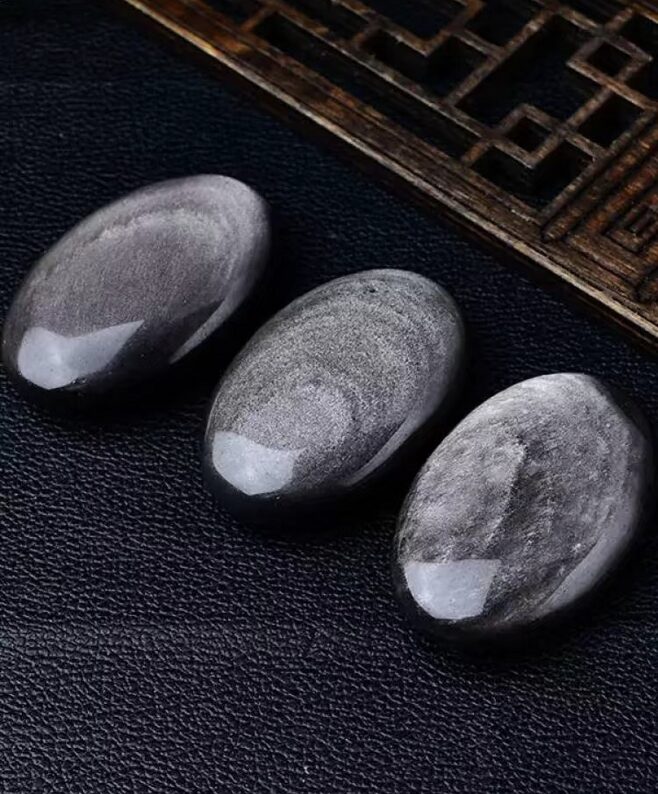
Volcanic glass forms when lava cools so rapidly that individual mineral crystals never have the chance to grow. Locked inside that dark, glassy mass are layers of gas and trace minerals — and in the case of Silver Obsidian, those layers contain nanoscale crystals of magnetite aligned in parallel bands. When light strikes these bands, it diffracts into a luminous silver-gray sheen that seems to drift across the surface, like moonlight caught in still water. The base stone is the same volcanic black glass as regular obsidian; it is the silver flash that sets this variety apart — and gives it a quieter, more introspective character.
Material & Properties
Silver Obsidian is a variety of natural volcanic glass in the obsidian family, composed primarily of silicon dioxide (SiO2). Its characteristic silver sheen is caused by nano-scale magnetite (Fe3O4) crystal inclusions arranged in parallel bands, which produce a metallic orient (Schiller) effect under reflected light.
Key physical properties:
- Mohs hardness: 5 – 5.5
- Structure: Amorphous (volcanic glass), no crystal lattice
- Luster: Vitreous with silver-gray orient effect
- Major sources: Oregon (USA), Mexico, Iceland, and other volcanic regions
Cultural Significance
Obsidian has been valued by human civilizations for millennia. Among the most extensively documented cultures are those of the Americas — the Aztec and Maya civilizations used black obsidian to craft blades, mirrors, and ceremonial objects, artifacts that continue to be unearthed in significant numbers across Mesoamerican archaeological sites. These objects suggest that obsidian served simultaneously as both practical tool and spiritual instrument in the societies that worked with it.
While specific cultural documentation for Silver Obsidian as a distinct material is more limited, this is consistent with the stone’s character: silver has long been associated with the moon, with inner clarity, and with the act of turning inward rather than projecting outward. Across cultures that worked with obsidian, a shared thread emerges — the stone was regarded as a guardian, a buffer between the wearer and the noise of the outside world, helping to anchor a person back to their own center.
Energetic Qualities
Silver Obsidian is often described as grounding and steadying — firm but not aggressive, less intense than its black cousin but more sustained in its support. Practitioners and wearers commonly associate it with the following properties:
- Emotional steadiness — believed to help maintain composure when circumstances feel chaotic or unpredictable
- Grounding — traditionally valued as a stone that anchors scattered energy and supports inner balance
- Mental clarity — the cool silver tones are frequently linked to calm thinking and clearer judgment under pressure
- Decisiveness — some find it helpful when they need to move past doubt and commit to a course of action
Who It Suits
- Those going through a significant life transition who want a stabilizing presence at their side
- Empaths and highly sensitive individuals who regularly pick up on the moods and energies around them
- Anyone in high-pressure or high-stakes decision-making roles who needs to stay clear-headed
- Those drawn to its aesthetic — the understated silver flash has a refined, contemplative quality that stands apart from more common black stones
Small pauses.Big shifts.Find your piece→
When to Wear
- During high-pressure workdays, important meetings, or negotiations — keep the stone close at the wrist or on a desk
- In crowded social settings or public spaces where external energy feels loud or dispersed
- During meditation or quiet reflection — its steady quality supports a still, inward-facing practice
- While traveling, especially in unfamiliar environments or when traveling alone
Care & Maintenance
- Silver Obsidian is glass-like and relatively durable, but it can chip or scratch if knocked against harder materials. Store it separately from other jewelry, ideally in a soft pouch or lined compartment.
- Clean with a soft, damp cloth. Avoid ultrasonic cleaners, steamers, and harsh chemicals — plain water is sufficient.
- It does not require regular cleansing or recharging. Brief exposure to indirect sunlight will not alter its structure or appearance.
- Remove before swimming, bathing, or engaging in physical activities where impact is possible.
Further Reading
The Crystal Bible, Judy Hall, Godsfield Press, 2003
- A comprehensive reference covering over 200 crystals and gemstones. Includes entries on multiple obsidian varieties with concise descriptions of their traditional properties and uses.
The Book of Stones, Robert Simmons & Naisha Ahsian, North Atlantic Books, 2007 (revised edition)
- Widely regarded as one of the most authoritative references in the field of crystal energetics. The authors combine mineralogical knowledge with decades of practical experience working with stones.
Smithsonian National Museum of Natural History — Mineral Sciences Collection: https://naturalhistory.si.edu/
- Online access to high-resolution specimens and scholarly descriptions from one of the world’s leading natural history institutions.
FAQ
Silver Obsidian and Black Obsidian are essentially the same material — both are natural volcanic glass formed when lava cools too quickly for crystals to develop, composed primarily of silicon dioxide (SiO2). The difference is visual: Black Obsidian is uniformly dark and glossy, while Silver Obsidian displays a characteristic silver-gray sheen across its surface. This effect, known as a Schiller or orient, is caused by nanoscale magnetite crystals arranged in parallel bands within the glass — when light hits these layers, it diffracts into a soft, metallic silver flash. In short: Silver Obsidian is black obsidian with a silver sheen.
Yes, Silver Obsidian is well suited for daily wear. With a Mohs hardness of 5–5.5, it resists everyday scratching. That said, as a glass-like material it does not handle impact as well as crystalline stones — a hard knock can cause chips or cracks. Most people find it perfectly durable for regular use; just take it off during sports, heavy lifting, or any situation where it might get struck.
No special cleansing routine is required. Unlike some crystalline stones that are described as absorbing or retaining energy, Silver Obsidian is chemically stable and does not need regular “clearing.” If you want to freshen it up, a quick wipe with a soft, damp cloth is all it needs.
Brief contact with plain water will not harm it. However, prolonged exposure to soaps, shampoos, and other cleaning agents will gradually dull the surface sheen over time. For that reason, it is best to remove it before bathing, swimming, or working with any harsh chemicals.
A few practical suggestions: protect it from hard impacts; store it separately from harder stones (diamond, sapphire, ruby) to avoid scratches; remove it before swimming, exercising, or doing rough work; and clean it with a soft cloth and plain water rather than ultrasonic or steam cleaners.