
The Stone Itself
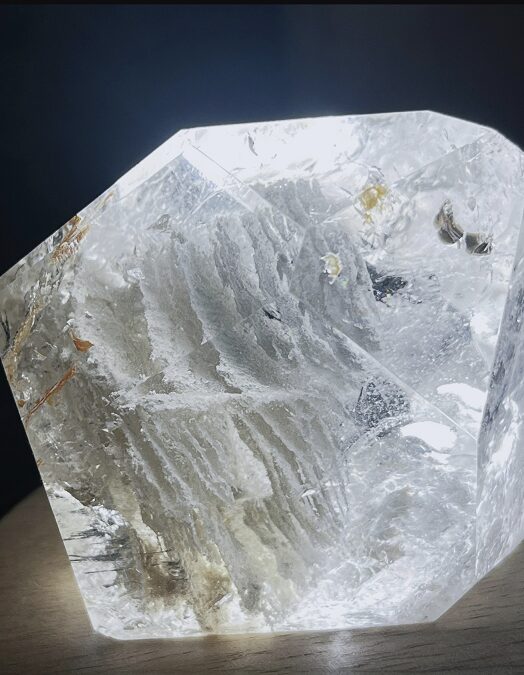
White Phantom Quartz — known in the Chinese market as Bai Youling (white ghost spirit) or Bai Youling Shuishui (white phantom crystal) — is a variety of clear quartz that has recorded one or more moments of interrupted and resumed growth within its structure, visible as white-to-pale-grey mineral outlines suspended inside the crystal. These ghost-like outlines are called phantoms, and they are the defining visual characteristic of this stone.
The mineral composition is silicon dioxide (SiO2) — identical to clear quartz, amethyst, and citrine. The phantom effect itself is created by a thin layer of mineral sediment — typically kaolin (a white clay), feldspar, or fine silicate particles — that settles onto a growing quartz crystal and is then covered by subsequent quartz growth. The sediment layer remains visible as a translucent white or pale grey outline, recording the exact shape of the crystal at the moment the pause occurred. When multiple sediment layers accumulate, each marking a distinct pause, the result is a series of phantom outlines stacked within the crystal — like a geological stratigraphy of frozen growth moments.
The phantom formations in White Phantom Quartz take several characteristic forms. A cloud-like or misty phantom (xuehua / snowflower) appears as a soft, diffuse white zone within the crystal, often flowing across its interior. A layered mountain phantom (qiancengshan) shows multiple horizontal or gently curved bands, resembling terraced hillsides. A pyramid phantom (jinzita) presents as a distinct pyramid or stepped triangle formation, often at the base of the crystal. A treasure-bowl phantom (juboguan) is a wide, basin-shaped formation, unique to certain specimens and particularly prized by collectors. All of these are natural; no two White Phantom Quartz specimens display the same formation.
In English-language markets, this material is universally referred to as White Phantom Quartz or simply Phantom Quartz when the white variety is implied. The word “phantom” is used because the internal outline resembles a ghost or shadow of a former crystal form — a crystalline memory suspended in clear quartz. It is the same formation mechanism as Green Phantom Quartz (associated with chlorite) or Red Phantom Quartz (associated with iron oxide), but white phantom formations are produced by lighter, more translucent mineral inclusions, giving them a quiet, ethereal quality that neither green nor red phantom varieties possess.
Cultural Significance
In East Asian Stone Culture
The Chinese name Bai Youling (“white ghost spirit”) carries a specific aesthetic resonance in Chinese-speaking markets — it references the quality of the stone internal white formations as something ethereal, transient, and gently mysterious rather than dark or unsettling. The ghost in this context is a benevolent presence — a record, a memory, a layering of time made visible. This fits naturally within a broader Chinese aesthetic tradition that values the appearance of depth and hidden time within stones, from the landscape-like inclusions of Garden Quartz to the layered formations within Scholar Stones (taihu).
In Japan, clear quartz with visible internal formations has long been appreciated for its wabi-sabi character — the beauty of impermanence and incompleteness. White Phantom Quartz, with its internal record of interrupted growth and resumed life, resonates with this sensibility: a stone that visibly contains its own history, imperfect and complete at once.
In Western and International Markets
Internationally, Phantom Quartz — white and otherwise — is most commonly discussed within the crystal healing and spiritual market. The phantom formation is interpreted as a symbol of recorded spiritual growth: each layer representing a stage of inner development, preserved within a matrix of clarity. This reading has made White Phantom Quartz popular in meditation practice and among those who work with crystals as part of a personal development framework. The stone pale, luminous quality reinforces this association with purity, clarity, and the luminous rather than the dramatic.
In the broader mineral collecting world, White Phantom Quartz specimens with well-defined formations — particularly pyramid and treasure-bowl phantoms — are valued for their rarity and visual drama. Fine specimens from Brazil, Madagascar, and the United States appear in mineral shows and specialist collector markets worldwide.
Energetic and Spiritual Properties
White Phantom Quartz is most commonly described in crystal practice as a stone of clarity, inner layering, and recorded growth. Unlike stones valued primarily for color or luminosity, White Phantom Quartz is appreciated for the quality of what is contained within its clarity: a visible record of time, pause, and return.
- Recorded growth and inner layering. The phantom formation is a natural record of interrupted growth — each white layer marking a moment when the crystal paused, was coated in sediment, and resumed. In crystal practice, this is symbolically associated with personal growth that is not erased by setbacks but incorporated into the next stage of development. The stone is described as supportive of a quality of inner accumulation: learning and experience that builds rather than disappears.
- Clarity within depth. Clear quartz is the most widely used amplifier and clarifying stone in crystal practice. White Phantom Quartz inherits this clarity while adding the dimension of visible depth. It is described as a stone that supports clear thinking that is not superficial — perspective that has been through something and carries that passage visibly.
- Quiet purification. The white mineral inclusions that form the phantom are themselves associated in crystal practice with purification and cleansing. White Phantom Quartz is described as a gentle purifier — not aggressive or dramatic, but consistent and cumulative. It is a stone chosen for long-term, quiet work rather than acute intervention.
- Transition and fresh starts. Because the phantom formation visually records a transition from pause back to growth, White Phantom Quartz is commonly associated with periods of change and new beginnings — a move, a new phase of work, a personal transition. It is understood as a stone that supports forward movement without demanding that the past be forgotten.
These descriptions reflect the philosophical and energetic framework of crystal practice. There is no scientific evidence that any gemstone or crystal has measurable effects on human health, emotional state, or spiritual experience. These characterizations are presented as the cultural context in which White Phantom Quartz is understood and valued.
Who It’s Suited For
- For those drawn to quiet, understated stones. White Phantom Quartz is visually subtle in ordinary lighting and most dramatic in strong direct light, where the internal phantom formations light up within the clear crystal. For buyers who prefer stones that reveal themselves gradually rather than demand attention, this is an ideal quality.
- For those in a period of transition. The phantom formation — a visible record of pause, interruption, and resumed growth — is a natural symbol for anyone navigating a life transition. White Phantom Quartz is often chosen as a supportive stone during times of change when forward movement is desired without erasure of the past.
- For collectors of included quartz. White Phantom Quartz occupies a specific niche in the included quartz market. Specimens with well-defined pyramid or treasure-bowl formations are rarer and more collectible than those with diffuse cloud-like phantoms. For collectors who appreciate the geological story a stone tells, White Phantom Quartz is particularly rewarding.
- For those who value depth in everyday objects. A piece of White Phantom Quartz held in good light rewards sustained attention in a way that most polished gemstones do not. Its internal landscape changes subtly with angle and light, offering something new with each viewing. It is a stone for people who like their objects to keep revealing themselves.
Suitable Occasions
- Everyday wear. White Phantom Quartz in bead or pendant form works well as a daily piece. Its clarity and subtle internal interest pair naturally with professional and casual clothing. The white phantom formations are best appreciated in direct light, making the stone particularly striking outdoors in sunlight or under bright artificial lighting.
- Desk and study display. A small polished White Phantom Quartz specimen on a desk or windowsill is a contemplative object that rewards sustained attention. The internal phantom formation invites looking and re-looking, and the stone pale clarity does not intrude on a workspace visually while providing something to glance at during moments of reflection.
- Meditation practice. White Phantom Quartz is commonly used in meditation for its quiet, grounding quality. Holding a specimen or placing it nearby during meditation supports a quality of sustained attention and inner accumulation rather than dramatic transformation.
- Gifting. White Phantom Quartz makes a thoughtful gift for someone who appreciates natural objects with depth, story, and visual interest. The stone’s visual subtlety and layered meaning make it feel considered and personal, particularly for recipients who value understated rather than flashy objects.
Small pauses.Big shifts.Find your piece→
Care Instructions
White Phantom Quartz ranks approximately 7 on the Mohs hardness scale — durable enough for daily wear in jewelry, though the internal phantom formation requires some additional care considerations.
- Cleaning. Use lukewarm water and a soft cloth or brush. Mild soap can be used for deeper cleaning. Avoid ultrasonic cleaners, steam cleaners, and harsh chemical cleaners. The mineral inclusions that form the phantom layer are natural and stable, but harsh cleaning can cloud the crystal or affect the clarity of the formations near the surface over time.
- Light and display. White Phantom Quartz performs best in direct or strong indirect light, which illuminates the internal phantom formations most dramatically. Unlike Kunzite, it is not photosensitive and does not fade in sunlight. It can be displayed in sunny positions without color degradation. Bright light is actually the best way to appreciate the phantom formations.
- Storage. Store separately from harder stones (diamonds, sapphires, topaz) which can scratch the quartz surface. A soft pouch or lined jewelry box compartment is ideal. Avoid impact: while the quartz matrix is durable, a hard blow near the phantom zone can cause the internal formation to fracture.
- Wearing. Remove before swimming, showering, applying perfumes or lotions, or engaging in physical activity where the stone could be struck. While White Phantom Quartz is durable, the internal phantom layer is a natural structural feature and is best protected from unnecessary stress.
Further Reading and References
- Schumann, Walter. Gemstones of the World. New York: Sterling Publishing, 2013.
- Hall, Judy. The Crystal Bible. Salisbury: Octopus Publishing, 2003.
- Pough, Frederick H. A Field Guide to Rocks and Minerals. Boston: Houghton Mifflin, 1996.
- Rundell, Rebecca. “Phantom Quartz: Formation and Varieties.” Mineral Digest, Vol. 8, 2019.
- Cibula, G. & McCourt, R. Quartz: Varieties, Formation, and Identification. Tucson: Geoscience Press, 2004.
FAQ
White Phantom Quartz is a variety of clear quartz that displays one or more internal crystalline outlines called phantoms — pale white or grey mineral formations suspended within the crystal body. These phantom outlines form when a growing quartz crystal is temporarily coated in mineral sediment — typically kaolin, feldspar, or fine silicate particles — and then resumes growing, preserving the sediment layer permanently within its structure. In the Chinese market it is called Bai Youling (white ghost spirit); internationally it is known as White Phantom Quartz or Phantom Quartz.
These are two entirely different stones. White Phantom Quartz displays internal phantom formations — pale white mineral outlines created by interrupted and resumed crystal growth. The visual effect is a ghostly internal scene visible within the crystal body. White Ase Quartz (Ase), by contrast, is clear quartz with internal fracture lines that produce rainbow flash optical effects under direct light. The key distinction is internal formations versus internal fractures; solid mineral inclusions versus refractive light effects. Both are varieties of quartz, but their optical character and formation mechanism are completely different.
Three factors primarily determine value: clarity of the host crystal, definition of the phantom formation, and rarity of the formation type. High-clarity host crystals — those that are transparent and glassy — allow the phantom formations to be seen most clearly and are more valued than milky or included host quartz. Well-defined, sharp phantom formations command higher prices than diffuse or barely visible ones. Formation type also matters: pyramid (jinzita) and treasure-bowl (juboguan) phantoms are rarer and more collectible than cloud-like (xuehua) or layered mountain (qiancengshan) formations. The overall visual drama of the specimen — how striking the phantom appears — is the overriding consideration for collectors.
White Phantom Quartz ranks 7 on the Mohs scale and is durable enough for daily wear. Clean it with lukewarm water and a soft cloth or brush. Unlike Kunzite, it is not photosensitive and can be displayed in direct sunlight without fading — in fact, bright light shows off the phantom formations best. Avoid ultrasonic cleaners, steam, and harsh chemicals. Store separately from harder stones (diamonds, sapphires) that can scratch the quartz surface, and avoid impact that could fracture the phantom zone. Remove before swimming, exercising, or applying lotions and perfumes.