
The Stone Itself
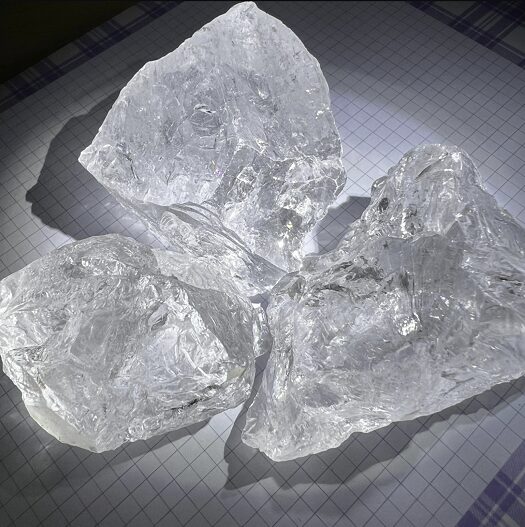
Azeztulite is a trade name for a distinctive variety of quartz distinguished not by its color but by an unusual internal fracture pattern that produces vivid flashes of spectral color — rainbow light that shifts and dances across the surface as the stone moves. The name Azeztulite was coined in the English-speaking crystal market, and in the trade it is also referred to as Ase Quartz, Aseachtulite, or Rainbow Flash Quartz. Among Chinese crystal buyers, the common shorthand is simply 阿赛 (Āsài), which has become a recognized label in that market as well.
At its mineral core, Azeztulite is silicon dioxide (SiO₂) — the same composition as clear quartz, amethyst, and citrine. What sets it apart is not a different chemical formula but a distinctive internal structure: fine fracture lines and microscopic stress cracks within the crystal, formed during rapid cooling or tectonic pressure deep in the earth. These fractures do not weaken the stone; in fact, they are what create its signature optical effect. When light passes through the fractured internal structure, it refracts and disperses into rainbow flashes — blues, greens, pinks, oranges, and golds — visible across the crystal’s surface or within its depth.
Unlike Garden Quartz, where visible mineral inclusions create a landscape-like scene, Azeztulite’s visual interest comes from light itself — the play of spectral color across an otherwise clear or milky surface. This makes it visually quiet in ordinary lighting and startling in direct light or sunshine, where the internal fractures ignite into color.
Color Varieties
While the word “Azeztulite” is most closely associated with white and clear quartz, the term has expanded in the market to encompass several color varieties, each with its own visual character. All share the same rainbow flash effect; the base color simply sets the mood.
White Azeztulite (Ase Blanc / 白阿赛) The most recognized variety. These specimens range from fully transparent to soft milky white, and they display the most vivid rainbow flashes — especially under direct sunlight or strong artificial light. White Azeztulite is what most buyers are referring to when they use the Ase name alone.
Yellow Azeztulite (黄阿赛) A rarer variety with a warm golden to honey-yellow base tone. The yellow color comes from trace iron deposits within the crystal matrix. Yellow Azeztulite tends to display a softer, more diffused rainbow flash, with gold and amber tones harmonizing with the base color. High-clarity yellow Ase specimens are especially sought after, as the transparency allows the internal fractures to catch light from every angle.
Pink Azeztulite (粉阿赛) A soft, delicate variety in which the quartz carries a blush-pink hue, typically from trace manganese or selenite inclusions. The pink base gives rainbow flashes a warm, rosy character, and the overall effect is gentle and jewel-like. Pink Ase is less common than white and tends to appear in smaller beads or polished pendants.
Tea Azeztulite (茶色阿赛 / Smoky Ase) A smoky brown to warm taupe variety, sometimes called Smoky Azeztulite in the English trade. Tea Ase combines the grounding quality of smoky quartz with the internal fracture pattern, producing a subdued, sophisticated look — warm browns lit from within by subtle rainbow flashes. This variety is particularly prized for its understated elegance and its appeal to buyers who want something quieter than the bright flashes of white Ase.
Cultural Significance
In the International Crystal Market
Azeztulite was introduced to the Western crystal market through the American crystal healing community, where it was positioned as a high-vibration stone associated with clarity of consciousness and spiritual awakening. The name itself carries this intent — it was chosen to evoke the quality of awakening (the root “aze” has been associated by crystal practitioners with an ancient, unnamed origin). In the United States, Azeztulite from certain sources — particularly the Appalachian region — has been linked to metaphysical circles and is sometimes offered with provenance certification from healing crystal distributors.
In China, the term 阿赛 became established in the crystal trade as a descriptor for any clear or white quartz displaying visible rainbow flash effects from internal fractures. The market distinguishes between higher-grade natural Ase (typically from Pakistan or Himalayan sources, with clean crystals and pronounced rainbow effects) and more common material where the flash effect is subtle or absent in ordinary lighting. Among serious collectors and energy practitioners, natural Ase with pronounced rainbow flash from genuine fracture lines — rather than surface coatings or artificial treatment — commands significantly higher value.
The appeal of Azeztulite across markets is substantially visual: a well-lit Ase specimen creates an immediate, striking impression that is difficult to photograph faithfully and even harder to forget in person. This quality — described by some as an almost “ethereal” inner light — is the primary reason it commands attention in both the jewelry trade and the collector market.
Energetic and Spiritual Properties
In crystal practice, Azeztulite is most commonly characterized as a stone of inner light, clarity, and perspective. Unlike stones valued primarily for their color or pattern, Azeztulite is appreciated for the quality of light it appears to generate from within.
- Inner clarity and discernment. Crystal practitioners describe Azeztulite as a stone that supports clear seeing — the ability to perceive a situation as it is, without emotional distortion or familiar bias. The visual metaphor is direct: just as the fractures within the stone reveal hidden color when lit correctly, the stone is said to help the user find what is already present but not yet visible.
- Light and elevation. Azeztulite’s natural luminosity is symbolically associated with lightness of being — not as escapism but as the capacity to rise above a stuck or heavy emotional state without denying it. Practitioners often describe it as a stone that helps reframe difficulty by shifting perspective, rather than removing the difficulty itself.
- Amplification of intention. Like clear quartz more broadly, Azeztulite is used in crystal practice as an amplifier — a stone that supports the clarity and stability of a held intention. It is commonly placed alongside other stones during meditation or worn during moments of focused purpose.
- Aesthetic contemplation. Perhaps the most understated quality of Azeztulite is its purely visual beauty. The way rainbow light moves through a fractured quartz crystal is itself a form of natural art — and for many owners, this is not a minor point. Contemplating beautiful objects has long been understood as a practice in itself, and Azeztulite offers this in a small, wearable, everyday form.
These characterizations reflect the philosophical and energetic framework of crystal practice. There is no scientific evidence that any gemstone or crystal has measurable effects on human health, emotional state, or spiritual experience. These descriptions are presented as the cultural context in which Azeztulite is understood and valued.
Who It’s Suited For
- For those drawn to light and luminosity. Azeztulite’s defining appeal is the way it holds and plays with light. People who are visually oriented — who notice the way light moves through a space or object — often find Azeztulite deeply compelling in a way that goes beyond ordinary gemstone appreciation.
- For those who prefer subtlety over spectacle. Unlike strongly colored stones, Azeztulite is understated in ordinary lighting and stunning in the right light. For buyers who want something beautiful that does not demand attention, white or tea Azeztulite is an ideal choice.
- For those navigating a moment of transition. Azeztulite is commonly described as a stone of awakening — not dramatic transformation but the quiet recognition that a shift has already occurred. For people at a threshold — a new phase of work, a relationship shift, a personal realization — it is often chosen as a supportive companion.
- For collectors of optical phenomena. Gem and crystal collectors who focus on optical effects — labradorescence, asterism, adularescence — often appreciate Azeztulite for its fracture-induced rainbow flash, which is entirely natural and unique to each specimen.
Small pauses.Big shifts.Find your piece→
Suitable Occasions
- Everyday wear. Azeztulite in bead bracelets, pendants, or simple rings works well as a daily piece. Its visual subtlety means it pairs naturally with professional or casual clothing. The white variety is especially versatile; the yellow and pink varieties add a soft warmth without being statement pieces.
- Meditation and contemplative practice. A polished Azeztulite palm stone or pendant is a common choice for meditation. Its internal light is felt to support a quality of focused stillness. Many practitioners place it in a windowsill or near a lamp between sessions, where it catches and holds available light.
- Gift-giving. Azeztulite makes an elegant and unusual gift — visually distinctive, naturally formed, and with enough individual character that the gift feels considered. It works well as a birthday stone, a milestone gift, or a meaningful token without being overly occasional or ritual-specific.
- Collecting and display. Fine Azeztulite specimens — raw or polished — are valued by collectors for the unrepeatable quality of their internal light. A well-lit display case or a position near a window where the stone can catch afternoon light will showcase its effect best.
Care Instructions
Azeztulite ranks approximately 7 on the Mohs hardness scale, placing it in the same durability range as clear quartz and amethyst. It is suitable for daily wear in jewelry with reasonable care.
- Cleaning. Use lukewarm water and a soft cloth or very soft brush. Mild soap can be used for deeper cleaning. Avoid ultrasonic cleaners, steam cleaners, and chemical cleaners — the internal fracture structure that gives Azeztulite its rainbow flash can be sensitive to harsh treatment or sudden temperature changes.
- Sunlight and light exposure. Azeztulite’s rainbow flash is at its most dramatic in direct light, and the stone can be displayed in sunlight for short periods to activate this effect. However, prolonged direct UV exposure may affect the clarity of the base crystal over time. Rotate display positions rather than leaving the stone in continuous direct sunlight.
- Storage. Store separately from harder stones (diamonds, sapphires, topaz) which can scratch the quartz surface. A soft pouch or individual compartment in a jewelry box is recommended. Avoid dropping Azeztulite onto hard surfaces — while the quartz itself is durable, the internal fracture network can propagate under impact.
- Wearing. Remove before swimming, showering, applying perfumes or lotions, or any activity that involves impact or chemical exposure. The fracture lines within the stone, while stable, are natural structural features and are best protected from unnecessary stress.
Further Reading and References
- Schumann, Walter. Gemstones of the World. New York: Sterling Publishing, 2013.
- Hall, Judy. The Crystal Bible. Salisbury: Octopus Publishing, 2003.
- H低级er, Michael. The Encyclopedia of Crystals, Herbs, and New Age Elements. Adams Media, 2014.
- Crystalis. “Azeztulite: Healing Properties, Meaning & Uses.” crystalis.com.
- Sacred Gems Australia. “Satyaloka Azeztulite Meaning.” sacredgems.com.au.
FAQ
Azeztulite is a trade name for clear or milky white quartz that displays a distinctive rainbow flash effect produced by internal fracture lines and stress patterns within the crystal. Unlike regular clear quartz, which is valued for its transparency and purity, Azeztulite is valued for what happens when light enters it: the fracture network causes light to refract and disperse into spectral color — blue, green, gold, pink — visible across the stone’s surface or within its depth. The base mineral composition is the same (silicon dioxide), but the internal structure creates an entirely different visual experience.
The rainbow flash is caused by fine internal fractures — stress cracks formed within the crystal during rapid cooling or tectonic pressure deep in the earth. These fractures do not represent damage or instability in the stone; they are a natural structural feature. When light passes through the fractured quartz, it refracts at multiple angles, producing the spectral color flashes. The effect is strongest in direct sunlight or strong artificial light, and is less visible in dim or diffuse lighting. Each specimen’s fracture pattern is unique, meaning no two Azeztulite stones display the same flash pattern.
Azeztulite ranks approximately 7 on the Mohs scale. Clean it with lukewarm water and a soft cloth or very soft brush. Avoid ultrasonic or steam cleaners and harsh chemicals. The stone can be placed in direct sunlight for short periods to activate the flash effect, but long-term continuous UV exposure may gradually affect the clarity of the base crystal — rotate display positions rather than leaving it in one spot of direct sun indefinitely. Store separately from harder stones and avoid impact, as hard blows can propagate existing fractures.
“Rainbow quartz” is a broad, informal term that has been applied to various quartz varieties showing rainbow effects. Azeztulite specifically refers to quartz where the effect is produced by internal fracture patterns — it is a physically distinct optical phenomenon rather than a surface coating or treatment. In the crystal trade, high-grade Azeztulite specimens are distinguished by the clarity of the base quartz, the visibility of the flash in ordinary lighting, and the natural origin of the fracture network. Buyers interested in the genuine article often ask about the specimen’s light performance in direct sun as a quality indicator.