
The Stone Itself
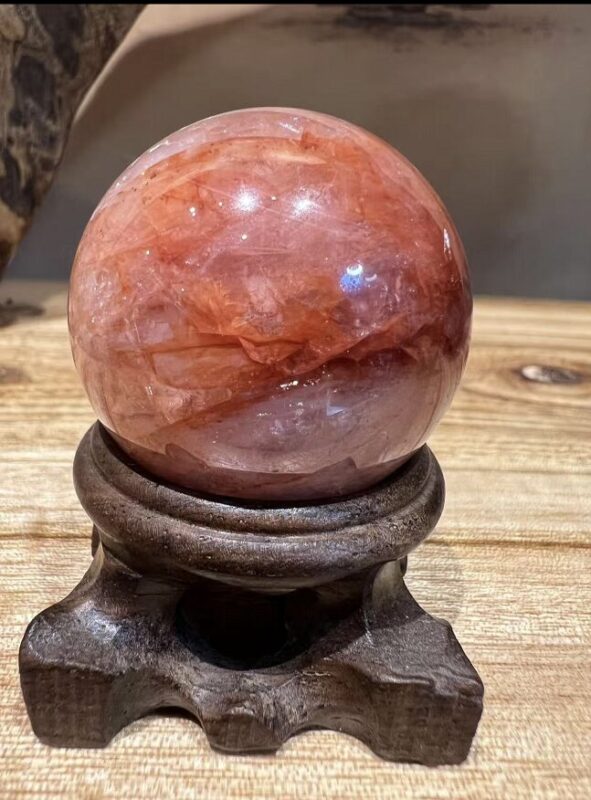
Garden Quartz is a variety of clear quartz that has captured other minerals within its structure during formation. The result is one of the most visually dramatic stones in the quartz family — translucent crystal interwoven with scenes of green chlorite, rust-red iron oxides, cream feldspar, and amber deposits, creating patterns that resemble miniature gardens, mountain vistas, underwater forests, or frozen landscapes. No two specimens look alike. Each one holds its own world.
Its mineral composition is silicon dioxide (SiO₂) at its core, interwoven with inclusions of chlorite, hematite, goethite, feldspar, and other trace minerals that became trapped inside the quartz as it grew over millions of years. The inclusions arrange themselves in organic, unpredictable formations — some like moss on a forest floor, others like clouds drifting over ridgelines. The stone’s transparency acts as a window into these buried scenes, which is precisely how it earned its poetic name.
In the crystal trade, Garden Quartz is known by several names. Lodolite — from the Portuguese lodo, meaning mud — refers to the way certain inclusions appear suspended like sediment. Scenic Quartz and Landscape Quartz describe its visual character. Shamanic Dream Stone is a label that emerged from South American spiritual traditions. In China, the trade name 股花 (jiao hua, literally “rubber flower”) references the way the mineral patterns sit within the crystal’s cracks, like pressed flowers sealed in resin. All of these names point to the same remarkable material: quartz that has quite literally grown a landscape within itself.
Cultural Significance
In East Asian Tradition
Quartz has held a significant place in Chinese and broader East Asian stone culture for centuries, often grouped with jade and other ornamental minerals in the category of scholar’s stones and collectible curiosities. Clear quartz was associated with purity and clarity of thought, while included varieties were admired for the landscapes they appeared to contain — miniature worlds that could be contemplated during meditation or placed in a study as a reflective object. The taihu (Scholar’s Rock) tradition emphasized stones that evoked natural scenery, and Garden Quartz, with its internal landscapes, fits naturally within this aesthetic philosophy. It was not merely decorative; it was understood as a condensation of the natural world into a held form.
In Japan, clear quartz was traditionally associated with Shinto purification concepts and was used in ritual contexts. Garden Quartz, as a variety that contains the earth within a transparent medium, carries a symbolic weight of hidden depth made visible — a theme that resonates with Japanese sensibilities around makoto (truthfulness) and the acknowledgment of what lies beneath the surface.
In Western and Brazilian Folk Tradition
The most commonly cited origin stories for Garden Quartz’s spiritual associations come from Brazil, particularly the Minas Gerais region, where some of the finest specimens have been found. Among crystal practitioners in Brazil and subsequently in North American and European markets, Garden Quartz became known as a stone of nature contact — a material that literally contains the living earth within a transparent matrix. This led to its reputation as a stone that facilitates connection to the natural world, to ancestral wisdom, and to what practitioners describe as the “devic realm” of plant and earth energies.
These are energetic and philosophical associations rather than documented historical ritual use, and they reflect the crystal spirituality movement rather than ancient unbroken tradition. Nonetheless, they form the dominant cultural narrative around Garden Quartz in the contemporary English-speaking crystal market, and they shape what buyers and collectors expect from the stone.
In Ancient Mediterranean and Near Eastern Context
Clear quartz was valued in ancient Greek, Roman, and Mesopotamian cultures, though the specific included variety we call Garden Quartz was not explicitly documented in classical sources. Ancient lapidaries described quartz as a form of ice that never melted, a concept that reflects the stone’s clarity and cool appearance. The Greeks used clear quartz for carving seals and intaglios; the Romans used it for jewelry and traded it across the Mediterranean. What we now understand as Garden Quartz would likely have been appreciated in these cultures for its unusual internal patterns, though no specific textual references survive.
Energetic and Spiritual Properties
Garden Quartz is most commonly described in crystal practice as a stone of nature connection, emotional resonance, and amplified intention.
The presence of mineral inclusions suspended within clear quartz is understood by crystal practitioners to create a unique energetic quality — the clarifying and amplifying properties of clear quartz interwoven with the grounding and earthy qualities of minerals like chlorite and iron oxide. This combination is said to support emotional balance, a sense of perspective, and the capacity to see patterns and connections in one’s own life with greater clarity.
Garden Quartz is particularly associated with the following qualities:
- Grounding without heaviness. Unlike stones that ground primarily through density or darkness, Garden Quartz is described as offering a gentle grounding quality — one that connects the user to the energy of the living earth without inducing lethargy or heaviness. The visual metaphor is often invoked: just as the inclusions within the stone are anchored within the quartz matrix, the stone itself is said to anchor scattered or anxious energy.
- Connection to the natural world. Because each piece contains what appears to be a miniature ecosystem or landscape, Garden Quartz is associated with nature attunement. Practitioners often describe it as a stone that carries the energetic memory of the natural world — forests, rivers, mountains, soil — compressed into a wearable form.
- Perspective and overview. The internal scenes within Garden Quartz — which often look like vast landscapes seen from above — are symbolically associated with the capacity to step back and see the larger picture. It is a stone that crystal practitioners recommend for moments when one feels overwhelmed, stuck in granular detail, or disconnected from the bigger picture.
- Amplification of personal intentions. Clear quartz is historically the most widely used amplifier in crystal practice, and Garden Quartz inherits this reputation in its included form. It is commonly used alongside other stones during meditation or ritual to amplify their qualities, or used on its own as a supportive stone for setting and reinforcing personal intentions.
It should be noted that these descriptions reflect the philosophical and energetic framework of crystal practice, and there is no scientific evidence that any crystal or gemstone has measurable effects on human health or emotional state. These characterizations are presented here as the cultural and philosophical context in which Garden Quartz is understood and valued by those who incorporate it into their practice.
Who It’s Suited For
Garden Quartz is a versatile stone, but it tends to appeal most to certain types of people or certain moments in life.
- For those drawn to nature and outdoor experience. The internal landscapes in Garden Quartz make it a natural companion for people who find peace, clarity, or inspiration in the natural world. It is a stone that holds visual interest indefinitely — no two viewing angles are alike, and the play of light through the inclusions creates a different scene with every shift in position.
- For those in creative or conceptual work. Garden Quartz’s unique and unrepeatable patterns can serve as a source of visual inspiration. Designers, writers, photographers, and other creative practitioners often keep a piece on their desk as a contemplative object that sparks associative thinking.
- For those navigating periods of transition or overwhelm. The symbolic quality of Garden Quartz — a world contained within clarity — makes it a stone that many practitioners recommend during times of change, uncertainty, or emotional complexity. It is not a stone of escape; rather, it is understood as a stone that supports clear seeing during difficult moments.
- For collectors of unusual and individual specimens. Because every piece of Garden Quartz is visually unique, it is particularly suited for people who value individuality in their objects. It does not come in grades that are identical to one another — each piece is a one-of-a-kind find.
Small pauses.Big shifts.Find your piece→
Suitable Occasions
- Everyday wear. Garden Quartz in jewelry — whether set as a pendant, ring, or bead in a bracelet — transitions well between casual and intentional. Its earthy tones and natural patterns pair naturally with neutral clothing, linen, cotton, and natural fibers. The stone’s internal interest means it holds its own even in simple settings.
- Meditation and contemplative practice. Garden Quartz is well suited to a meditation or yoga practice, where its grounding quality and symbolic depth provide something to focus on or around. A small polished piece held in the hand or placed nearby during practice is a common use.
- Home display. A rough or polished specimen placed on a shelf, desk, or windowsill serves as an ongoing visual point of interest. The stone’s relationship to light means its internal scenes shift throughout the day as sunlight moves across its surface.
- Gifting. Garden Quartz makes a meaningful gift for someone who appreciates nature, unique objects, or stones with individual character. Because no two pieces are alike, it carries a built-in message of individuality and care in the selection.
Care Instructions
Garden Quartz ranks approximately 7 on the Mohs hardness scale, making it durable enough for daily wear in jewelry but not immune to damage from impact or harsh treatment.
- Cleaning. Use lukewarm water and a soft brush or cloth. Mild soap can be used for deeper cleaning. Avoid ultrasonic cleaners, steam cleaners, and harsh chemicals, as the inclusions within the stone may be sensitive to abrupt temperature changes or corrosive substances.
- Storage. Store separately from harder stones such as diamonds or sapphires, which can scratch the quartz surface. A soft pouch or lined jewelry box compartment is ideal. Avoid leaving Garden Quartz in direct sunlight for extended periods, as prolonged UV exposure may cause some included minerals — particularly chlorite — to fade over time.
- Wearing. Remove before swimming, showering in chlorinated water, applying perfumes or lotions, or engaging in physical activity where the stone could be struck. While the quartz itself is durable, the included minerals within can be more sensitive to chemical exposure.
Further Reading and References
- Schumann, Walter. Gemstones of the World. New York: Sterling Publishing, 2013.
- Hall, Judy. The Crystal Bible. Salisbury: Octopus Publishing, 2003.
- Ribeiro, D.S. “Aspectos Mineralógicos e Genéticos do Quartz Litinizado de Minas Gerais.” Revista Brasileira de Geociências, Vol. 42, No. 2, 2012.
- Moebenus, Hermann. Quartz: The Many Varieties of a Familiar Stone. Tucson: Geoscience Press, 1995.
FAQ
Garden Quartz is a variety of clear quartz that contains natural mineral inclusions — chlorite, hematite, goethite, feldspar, and other trace minerals — trapped within its crystal structure during formation. These inclusions create patterns that resemble miniature landscapes, underwater forests, or frozen gardens, visible through the transparent quartz body. It is also known as Lodolite, Scenic Quartz, and Shamanic Dream Stone in the international crystal trade.
The color of the inclusions depends on the minerals present. Green chlorite produces mossy, botanical-looking patterns. Iron oxides — hematite and goethite — create reds, rusts, and amber tones. Feldspar can add cream, pink, or peach hues. These minerals entered the quartz through fractures and cavities as it grew, and the arrangement is entirely random: no two Garden Quartz specimens form the same internal scene. This natural unpredictability is precisely what makes each piece unique.
Garden Quartz ranks approximately 7 on the Mohs hardness scale. Clean it with lukewarm water and a soft cloth or brush. Avoid ultrasonic cleaners, steam, and harsh chemicals — the included minerals inside can be sensitive to sudden temperature changes or corrosive substances. Store separately from harder stones like diamonds or sapphires, which can scratch the quartz surface. Prolonged direct sunlight may cause chlorite inclusions to fade over time, so display pieces ideally should not sit in continuous direct sun.
Yes. Garden Quartz is 100% natural. The inclusions are formed over millions of years as mineral-bearing solutions penetrate quartz crystals during their growth in igneous and metamorphic rock environments. The characteristic internal landscape scenes are a product of this natural process. High-clarity Garden Quartz with well-defined, dramatic scenes commands higher value in the collector market, but the stone itself is a product of natural geology, not human treatment or composite construction.