
The Stone Itself
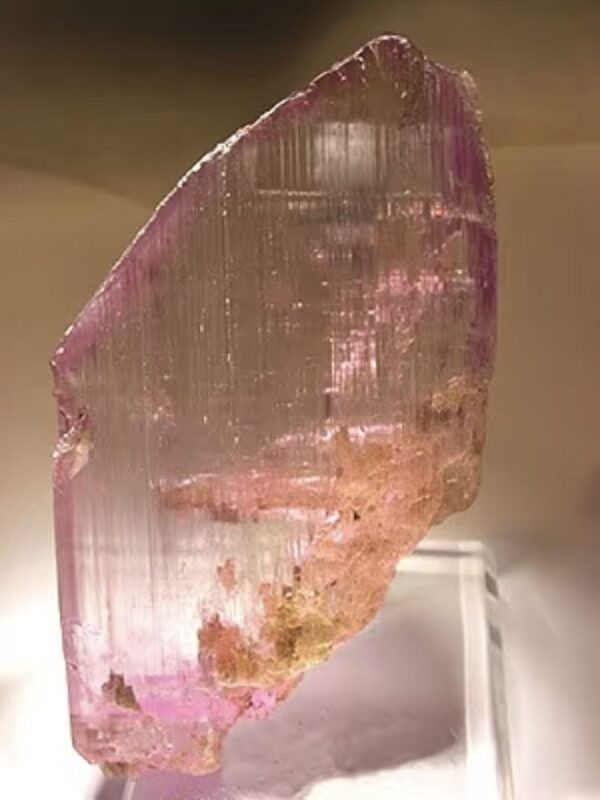
Kunzite is the pink to violet variety of the mineral spodumene, a lithium aluminum silicate with the chemical formula LiAl(Si₂O₆)¹. It takes its color from trace amounts of manganese within the crystal structure, which produces a soft violet to lilac tone that ranges from pale lavender pink to deep violet-purple. The finest specimens display a delicate pink flush within a predominantly violet body — described in the trade as having a “blush” or “inner glow” quality — and this warmth within the purple is what commands the highest prices in the collector market.
Spodumene is best known as the primary source of lithium, an element essential to modern battery technology. The mineral forms in lithium-rich pegmatite veins, where molten rock cools slowly enough to allow large, well-formed crystals to develop. Kunzite crystals are typically large, prismatic, and elongated, often with deeply striated surfaces. The mineral has two directions of perfect cleavage — a structural characteristic that requires careful handling during cutting and setting, as the stone can split along these planes if struck at the right angle.
One of Kunzite’s most remarkable physical properties is its strong pleochroism: when viewed from different angles, the stone displays different colors — typically pale pink from one direction, deeper violet from another, and near-colorless from a third. This means that the same stone can look significantly different depending on how it is held or set, and skilled lapidaries orient the cut to maximize the most desirable color. This pleochroic character is one of the features that distinguishes genuine Kunzite from imitations.
The stone was first identified and described in 1902 by the American mineralogist and gemologist George Frederick Kunz, who served as chief gemologist for Tiffany & Co. Kunz recognized it as a new variety of spodumene and advocated for its use in jewelry. The discovery was made in the Pala region of Southern California, one of several significant sources for this mineral. Today, major sources include Afghanistan, Pakistan, Brazil, and Madagascar. In the Chinese market, Kunzite is known as 紫锂辉石 (purple lithium spodumene), and its gentle violet-pink character has earned it the colloquial nickname 暖夜精灵 (evening精灵) — the evening spirit — in reference to the way its color seems most alive in soft, low light rather than direct sun.
Cultural Significance
A Stone of the Modern Era
Unlike quartz, jade, or turquoise — minerals with thousands of years of documented use across multiple civilizations — Kunzite is among the youngest of the world’s recognized gemstones. Its formal identification dates to 1902, and it did not enter the jewelry trade in any meaningful way until the mid-twentieth century. This makes Kunzite distinctive: it is a stone without ancient mythology, without medieval lapidary texts, and without the accumulated lore of centuries. Its cultural associations are contemporary by design.
What Kunzite has instead is a direct connection to the Art Nouveau and early Art Deco movements, which were at their height when the stone first appeared on the gem market. George Kunz himself was a central figure in both movements, and he championed Kunzite for jewelry precisely because its color — soft, evening, indeterminate between pink and violet — suited the aesthetic mood of the period. The stone appeared in several important pieces from Tiffany’s workshops in the early 1900s, establishing it as a stone of refinement and modernity.
In the crystal healing and metaphysical market that emerged in the 1970s and expanded significantly from the 1990s onward, Kunzite became associated with the heart and the emotional realm — a pairing that owes as much to its color as to any specific tradition. Pink-to-violet stones naturally evoke the combination of warmth and transcendence that the color itself communicates, and this symbolic reading has become the dominant lens through which contemporary buyers encounter Kunzite in the market.
In East Asian Markets
In the Chinese market, Kunzite arrived relatively late but has gained steady recognition for its visual uniqueness. Its purple-violet color occupies a niche distinct from amethyst — softer, more pink-toned, and with a luminous quality that amethyst does not always possess. The nickname 暖夜精灵 (evening spirit) is particularly evocative and has helped establish Kunzite as a stone associated with evening occasions, intimate settings, and contemplative wear. It has become a popular choice for pieces meant to be worn in low-light environments — candlelit dinners, evening events, intimate settings — where its color comes into its own.
Energetic and Spiritual Properties
In crystal practice, Kunzite is most commonly described as a stone of emotional openness, gentle clarity, and the softening of hardened states — emotional, relational, or circumstantial.
- Emotional openness. Kunzite’s color — hovering at the border between pink and violet — is often described by crystal practitioners as a bridge between the heart and a higher perspective. It is associated with the capacity to remain open and tender without losing clarity of intention. This is distinct from the aggressive brightness of some stones; Kunzite is understood to support a quiet, steady form of emotional receptivity.
- Gentle clarity. The transparency of Kunzite — its glass-like clarity and clean color — is metaphorically associated with clarity of thought and communication. Practitioners describe it as a stone that supports honest self-expression without harshness — saying difficult things gently, clearly, and without defensive posturing.
- Evening quality and rest. The market nickname “evening stone” reflects an energetic association with the liminal quality of evening light: neither day nor night, neither bright nor dark. Kunzite is often described in crystal practice as supportive of transitions — periods of unwinding, of releasing the intensity of the day, of moving from doing to being.
- Light and elevation without force. Kunzite does not assert itself. Its color is soft; its energy, as described by practitioners, is equally so. This makes it distinctive in a market where many stones are associated with force, strength, or dramatic transformation. Kunzite is associated with quiet elevation — a slow, natural rising rather than a dramatic breakthrough.
These descriptions reflect the philosophical and energetic framework of crystal practice. There is no scientific evidence that any gemstone or crystal has measurable effects on human health, emotional state, or spiritual experience. These characterizations are presented as the cultural context in which Kunzite is understood and valued.
Who It’s Suited For
- For those who are drawn to violet and pink tones. Kunzite occupies a unique color space between amethyst’s deep violet and rose quartz’s pale pink, with a luminous quality that is entirely its own. For buyers who want something that reads as purple but carries warmth — or as pink but carries depth — Kunzite is the natural answer.
- For those who prefer understated elegance. Kunzite is not a stone that announces itself. In ordinary lighting it can appear almost pale; in the right light — evening light, candlelight, soft lamp light — it comes alive. For people who appreciate objects that reveal themselves gradually rather than all at once, this is an ideal quality.
- For those navigating emotional transitions. Kunzite is commonly chosen as a supportive stone during periods of emotional change — a new relationship, the end of one, a period of vulnerability or opening. It is not a stone of dramatic action but of gentle, sustained presence during times when tenderness feels risky.
- For collectors of rare and unusual gemstones. Kunzite’s pleochroism, its lithium-based chemistry, its relatively recent discovery, and its sensitivity to light and heat make it a distinctive acquisition for collectors interested in minerals with unusual properties and a short recorded history.
Suitable Occasions
- Evening wear. Kunzite is at its most striking in low, warm light. Evening events, intimate dinners, candlelit settings — these are the environments where its color reveals itself most fully. A Kunzite pendant or earrings worn in the evening will display a depth of color that is not apparent in daylight.
- Everyday wear with care. Kunzite ranks 6.5 to 7 on the Mohs scale, making it softer than quartz and more susceptible to scratching and impact. It is suitable for daily wear in low-exposure situations — pendants, earrings, brooches — but less ideal for rings or bracelets that encounter daily abrasion. Always remove before physical activity or exposure to chemicals.
- Meditation and contemplative practice. Kunzite’s gentle energy character and its visual quality of stillness make it a common choice for meditation and emotional reflection practices. A piece held during meditation or placed nearby during journaling or quiet conversation serves as a supportive object.
- Gifting. Kunzite makes an unusual and considered gift — distinctive enough to stand out from more common stones, beautiful in an understated way, and with a story (the Tiffany connection, the evening character, the pleochroism) that makes it interesting to recipients who appreciate mineral lore.
Small pauses.Big shifts.Find your piece→
Care Instructions
Kunzite ranks 6.5 to 7 on the Mohs hardness scale — softer than quartz, sapphire, and topaz, and requiring more careful handling than most common jewelry stones. Its sensitivity to sunlight and temperature change requires particular attention.
- Sunlight — the most critical care point. Kunzite’s color is photosensitive and can fade with prolonged exposure to direct sunlight or strong UV light. Never leave Kunzite in direct sun for extended periods. This is not a temporary effect — the fading is permanent. Store Kunzite away from windows and bright light when not being worn. Display cases with UV-filtering glass or low-wattage lighting are ideal for specimens.
- Cleaning. Use only lukewarm water and a very soft cloth. No ultrasonic cleaners, steam cleaners, or harsh chemicals. Kunzite’s cleavage planes can be activated by thermal shock — sudden temperature changes can cause the stone to fracture or cleave along its structural planes. Even warm-to-hot water should be approached with caution.
- Storage. Store separately from all harder stones. Even a sapphire or diamond brusing against Kunzite in a jewelry box can scratch it. Individual soft pouches or a lined compartment are essential. Avoid storing Kunzite in direct light.
- Wearing. Remove Kunzite jewelry before swimming, showering, exercising, applying lotions or perfumes, or doing anything that involves impact or chemical exposure. The stone’s cleavage planes make it structurally vulnerable to sharp blows from certain angles. Kunzite is best reserved for low-contact, intentional wear rather than everyday rough handling.
Further Reading and References
- Schumann, Walter. Gemstones of the World. New York: Sterling Publishing, 2013.
- Kunz, George Frederick. The Curious Lore of Precious Stones. Philadelphia: Lippincott, 1913.
- GIA. “Kunzite Quality Factors.” gia.edu.
- Mayer, Thomas. “Kunzite: The Evening Stone.” Mineral Digest, Vol. 14, 2020.
- Arkadia Mineralogy. “Kunzite: Properties and Occurrence.” arlandia.cc.
FAQ
Kunzite is the pink to violet variety of the mineral spodumene, with the chemical formula LiAl(Si₂O₆). Its color comes from trace amounts of manganese within the crystal structure. The finest specimens display a delicate pink flush within a predominantly violet body — often described as a blush or inner glow — and this warmth within the purple is what commands the highest prices. Kunzite has strong pleochroism: viewed from different angles, the same stone shows pale pink, deep violet, and near-colorless tones. This is a key identifying feature of genuine Kunzite.
Kunzite’s color appears most vivid and alive in soft, low light — candlelight, evening sun, warm lamp light — rather than in direct sunlight, which can actually cause its color to fade over time. This quality has earned it the nickname 暖夜精灵(evening spirit) in Chinese markets. In its optimal setting — an evening occasion, a candlelit table — Kunzite reveals a depth and warmth that is not apparent in everyday lighting. This evening quality is part of what makes it distinctive in the violet gemstone market.
The most important care rule for Kunzite is: keep it away from direct sunlight. Kunzite is photosensitive and its color will fade permanently with prolonged UV exposure. Never leave it in direct sun. For cleaning, use only lukewarm water and a soft cloth — no ultrasonic or steam cleaners, and no harsh chemicals. Kunzite also has two directions of perfect prismatic cleavage, meaning it can split along these planes if struck at the right angle; avoid impact. Store in a soft pouch or lined compartment, separate from all harder stones.
Kunzite ranks 6.5 to 7 on the Mohs hardness scale — softer than quartz, amethyst, and most common jewelry stones — and its cleavage planes make it vulnerable to impact from certain angles. It is best suited for pendants, earrings, and brooches where it encounters less abrasion and impact. For rings and bracelets, wear with care and remove during physical activity, exercise, or any situation where the stone might be struck. If you wear Kunzite daily, inspect it regularly for any signs of chipping along the cleavage edges.