
Every natural crystal that has ever formed under the earth is a one-time event. Millions of years of heat, pressure, mineral-rich fluids, and gradual cooling — and what emerged was shaped by conditions that will never repeat in exactly the same way. That is precisely why natural crystals are so compelling: their beauty is inseparable from their history.
When you compare a natural crystal to a lab-grown or mass-manufactured stone, the difference is immediately apparent. Factory-produced stones are engineered to be identical — flawless, predictable, optimized for visual uniformity. A natural crystal carries the signature of its own formation: the route it took through the earth’s crust, the other minerals it grew alongside, the small stresses it endured as the surrounding rock shifted and settled. The result is a stone that is irreducibly itself.
What many people call “imperfections” are actually inclusions — materials that became trapped inside the crystal as it grew, or structural variations that occurred during its formation. These are not flaws in the conventional sense. They are the crystal’s autobiography, written in stone.
Understanding Crystal Inclusions & Variations
Below is a plain-language guide to the most commonly encountered features in natural crystal jewelry. Each one is a normal, expected characteristic of the natural material — not something to be concerned about, but something to understand and appreciate.
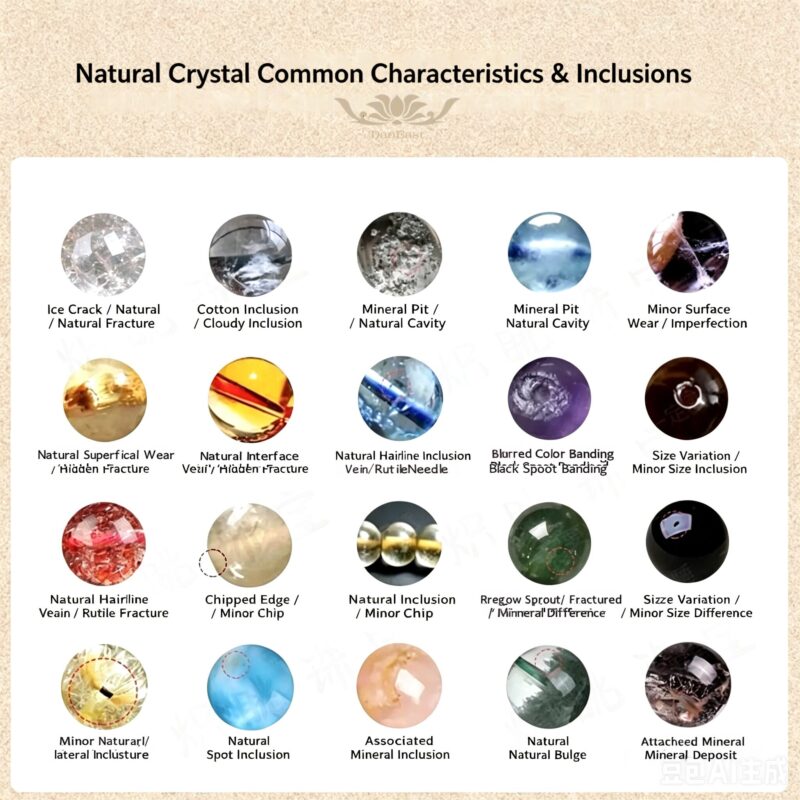
Ice Cracks / Fractures
These are fine, hairline cracks inside the crystal — sometimes described as looking like frozen cracks in ice. They occur when the crystal undergoes stress during or after formation, such as from tectonic pressure changes. They are internal and do not compromise the stone’s structure in normal use.
Cloudiness / Milky Zones
Areas within a crystal that appear hazy, milky, or less transparent than the rest of the stone. These zones form when tiny liquid or gas pockets become trapped during crystallization, or when fine mineral particles scatter light inside the stone. Cloudiness is especially common in rose quartz and milky quartz varieties.
Color Zoning / Color Bands
Natural crystals often grow in layers over extended periods, and the chemistry of the surrounding fluid can shift during that time. The result is color that is not perfectly uniform — bands, stripes, or gradient zones of lighter and darker color within the same stone. This is especially visible in amethyst, citrine, and tourmalinated quartz.
Inclusions (Other Minerals Trapped Inside)
As a crystal grows, it sometimes encases minerals that were present in its environment. These inclusions can take many forms: needles, flakes, clouds, crystals, or irregular masses. Common host minerals include rutile (golden needles), tourmaline (black or green needles), chlorite (green flakes), and calcite. Each gives the host crystal its own distinctive character.
Black Spots / Dark Inclusions
Dark inclusions — black spots, dark specks, or irregular dark patches — are simply other minerals trapped inside the crystal. Black tourmaline, magnetite, and carbonaceous material are common culprits. These dark spots are entirely natural and are often the defining visual feature of stones like black tourmalinated quartz.
Mineral Deposits / Attached Minerals
Some crystals grow alongside or attached to other minerals — for example, quartz crystals that grew on a feldspar matrix, or crystals with small clusters of other minerals visible on their surface. In jewelry settings, these may appear as crystalline crusts or mineral attachments on the back or sides of a stone.
Exposed Mineral Points / Termination Points
The natural pointed end of a crystal — its “termination” — is where crystal growth stopped. Sometimes, a termination point can be slightly worn, broken, or missing, especially in tumbled stones or beads where the raw crystal surface has been polished. This is described as an “exposed termination” or, in bead form, a “natural point.”
Uneven Bead Sizes / Off-Round Beads
When beads are cut from natural rough crystal — rather than molded — their size and shape will vary slightly from piece to piece. A strand of natural crystal beads will almost never be perfectly uniform in diameter. Slight off-round or barrel-shaped beads are a hallmark of genuinely natural material.
Minor Chips or Surface Wear
Small chips on the edges of faceted stones, or light surface scuffs on polished beads, can occur during the cutting, polishing, or stringing process, or from ordinary wear. Minor surface wear is normal in jewelry that has been worn and enjoyed over time, and even newly finished pieces can show tiny contact marks under close inspection.
Mica Sheets / Flaky Inclusions
Mica is a sheet-silicate mineral that crystallizes in flat, flexible, flaky plates. When trapped inside quartz or other crystals, it appears as shimmering, reflective patches that catch the light at different angles. Mica inclusions are harmless and are considered a beautiful, distinctive feature in stones like aventurine and tourmalinated quartz.
Fractures / Cracks That Do Not Go Through
Sometimes called “internal fractures” or “concealed cracks,” these are fractures within the crystal that do not reach the surface. They are visible under certain lighting conditions but do not affect the structural integrity of the stone. A fracture that does not break the surface is considered stable and safe for jewelry use.
Co-Infused Minerals / Mineral Intergrowths
Some crystals grow in intimate intergrowth with another mineral species — the two form together as a composite stone. A common example is quartz intergrown with feldspar, which creates a two-toned or multi-mineral appearance. These intergrowths are not contaminations; they are the natural product of a shared geological environment.
Bumps or Raised Areas on the Surface
Natural crystal surfaces are rarely perfectly smooth. Small bumps, ridges, or raised areas can occur where mineral growth was interrupted or where a secondary mineral crystallized on the surface. In polished stones, these are usually sanded down to a smooth finish, but very slight raised areas may remain in hand-polished pieces and are entirely normal.
Why These Are Not Defects
The most important thing to understand is this: in the world of gemology and mineralogy, inclusions are how we know a stone is natural. A perfectly flawless, chemically uniform stone is, statistically, more likely to be synthetic. Inclusions are not evidence of poor quality — they are evidence of geological authenticity.
There is also a deeper point here, one that connects science to philosophy. When you hold a natural crystal, you are holding something that took millions of years to form and has existed unchanged since long before humans existed. Its inclusions are not errors in that process — they are the process. The golden needle inside your quartz was formed in the same moment as the crystal around it. They are coeval. They are, in the most literal sense, inseparable.
This is precisely why natural crystal jewelry carries a resonance that manufactured stones cannot replicate. The variations you see are not obstacles to beauty — they are the source of it. A crystal with a visible inclusion is a crystal with a story. A perfectly uniform stone, however brilliant, is a stone without a past.
How to Check If Your Piece Is Normal
When you receive your natural crystal jewelry, here is a quick and simple checklist to confirm that what you are seeing is within the expected range for natural material. This is not a grading exercise — it is a way to familiarize yourself with what natural crystals look like up close.
- Does the stone show visible inclusions, color variation, or zoning when you hold it to the light? — This is normal and expected.
- Are the beads or facets slightly irregular in size or shape? — Natural material is rarely perfectly uniform.
- Is there cloudiness, a milky zone, or an internal fracture visible under close inspection? — These are characteristic of natural quartz family stones.
- Are there dark spots, mineral specks, or needle-like inclusions inside the stone? — This is a clear indicator of genuine natural origin.
- Is the stone free from cracks that reach the surface and compromise its stability? — Surface-breaking cracks are rare in properly finished jewelry and should not be present in new pieces.
- Is the setting secure, with no loose stones or damaged metalwork? — This is the one area where quality control matters and where you should expect precision.
Found one or more of these characteristics in your piece? Don’t worry — these are all normal expressions of what a natural crystal can be. If you have concerns about the sixth item — the setting — please reach out to us directly.
Caring for Your Natural Crystal Jewelry
Natural crystals, particularly those in their raw or semi-raw form, can be more delicate than the treated, filled, or lab-enhanced stones sometimes sold alongside them. Here are a few practical notes to help your pieces last a lifetime.
- Remove jewelry before exposure to harsh chemicals, chlorine pools, saltwater, or abrasive cleaning products.
- Clean with a soft, lint-free cloth dampened with lukewarm water. Avoid ultrasonic cleaners, steam cleaners, and chemical jewelry dips.
- Store each piece separately — preferably in a soft pouch or lined box — to prevent harder gems or metal settings from scratching the crystal surface.
- Be mindful of impact: a hard knock on a faceted edge can chip even a hard stone like quartz (Mohs 7). Treat your crystal jewelry with the same care you would a fine watch.
- If your piece contains softer or more sensitive inclusions (such as mica sheets or feldspar intergrowths), extra care around water and chemicals is especially worthwhile.
Further Reading & References
If you are interested in learning more about the mineralogy and gemological properties of natural crystals, the following resources are excellent starting points:
- CIBJO (The World Jewellery Confederation). The Pearl, Gemstone and Coral Blue Books, current edition. — The authoritative international standard for gem nomenclature.
- Schumann, W. Gemstones of the World. Sterling Publishing, 5th edition, 2016. — A comprehensive and well-illustrated reference for collectors and enthusiasts.
- Read, P.G. Gemmology. Butterworth-Heinemann, 3rd edition, 2005. — The standard introductory textbook for professional gemology.
- Nassau, K. Gemstone Enhancement: History, Science and State of the Art. Butterworth-Heinemann, 2nd edition, 1994. — Essential reading for understanding how natural stones differ from treated and synthetic equivalents.
- Kunz, G.F. The Curious Lore of Precious Stones. Dover Publications (reprint), 1971. — A fascinating historical survey of how crystals and gemstones have been understood across cultures.
FAQ
Inclusions are materials that became trapped inside a crystal as it grew — other minerals, liquids, gases, or structural variations that formed at the same time as the crystal itself. They are not things that got “added later.” They are the geological record of how and where the crystal formed. Many people call them “imperfections,” but in reality they are one of the primary ways we identify a stone as genuinely natural.
No. In the world of gemology and mineralogy, inclusions are how we identify a stone as natural. A perfectly flawless, chemically uniform stone is, statistically, more likely to be synthetic or lab-grown. Because every crystal forms under unique conditions, every crystal has a different inclusion profile — and that is precisely why no two natural crystals are ever identical.
This is precisely what makes natural crystal jewelry different from mass-produced jewelry. Every crystal’s inclusions, color depth, and transparency vary slightly. For stones with prominent inclusions or color zoning, photography cannot fully capture every detail of the unique specimen you’ll receive. Minor differences between the photo and your piece are a normal and expected feature of buying natural material.
The most fundamental difference is time and origin. Natural crystals formed deep in the earth over millions of years, under high heat and pressure, with no human intervention. Lab-grown crystals are created in controlled laboratory conditions over days or weeks, resulting in stones that are chemically similar but practically identical in appearance. Visually, lab-grown stones tend to look too clean and too perfect — natural stones always carry some trace of their organic history.
It depends on the type of crack. Surface-breaking cracks — those that extend from the outside in — can potentially affect structural integrity. These are rare in properly finished jewelry and should not be present in new pieces. Internal fractures (cracks that do not reach the surface) typically do not affect durability and require no special handling.
Because natural crystal beads are cut from rough stone rather than molded in factories. Each rough specimen has a different shape and size, which means the beads cut from it vary accordingly. When stringing, we select beads of similar size, but perfect uniformity is the hallmark of manufactured stones — not natural ones. Minor size variation is normal and expected.
If your piece has a craftsmanship issue — a loose setting, damaged metalwork, or a loose bead — please contact us within 48 hours of receiving it and we will make it right. Natural crystal inclusions, color variations, and minor surface characteristics are normal properties of natural stone and are not grounds for quality returns. We encourage you to review the Learn More section before ordering to ensure you are comfortable with the unique character of natural material.
Overall, no — treat them much like any fine gemstone jewelry. A few practical notes: avoid harsh chemicals and chlorine; skip ultrasonic and steam cleaners; store each piece separately to prevent scratching from harder stones; and be mindful of impact, as a hard knock on a faceted edge can chip even a hard stone like quartz. With reasonable care, natural crystal jewelry is durable enough for everyday wear.