
I grew up at my grandmother’s house. There was a clump of bamboo in the courtyard.
It wasn’t tall, just slender, swaying whenever the wind blew. It grew in the corner near an old well, next to a neat stack of chopped firewood. Back then, I didn’t understand bamboo at all. I only found it annoying — the leaves fell endlessly and the sweeping never stopped. My grandmother never complained. In autumn, she raked the leaves into a basket and said: bamboo leaves feed the soil and strengthen the roots.
It took me many years to realize: she never once explained bamboo to me. But she lived her entire life beneath that same clump, in her own way, without ever needing to say a word about it.
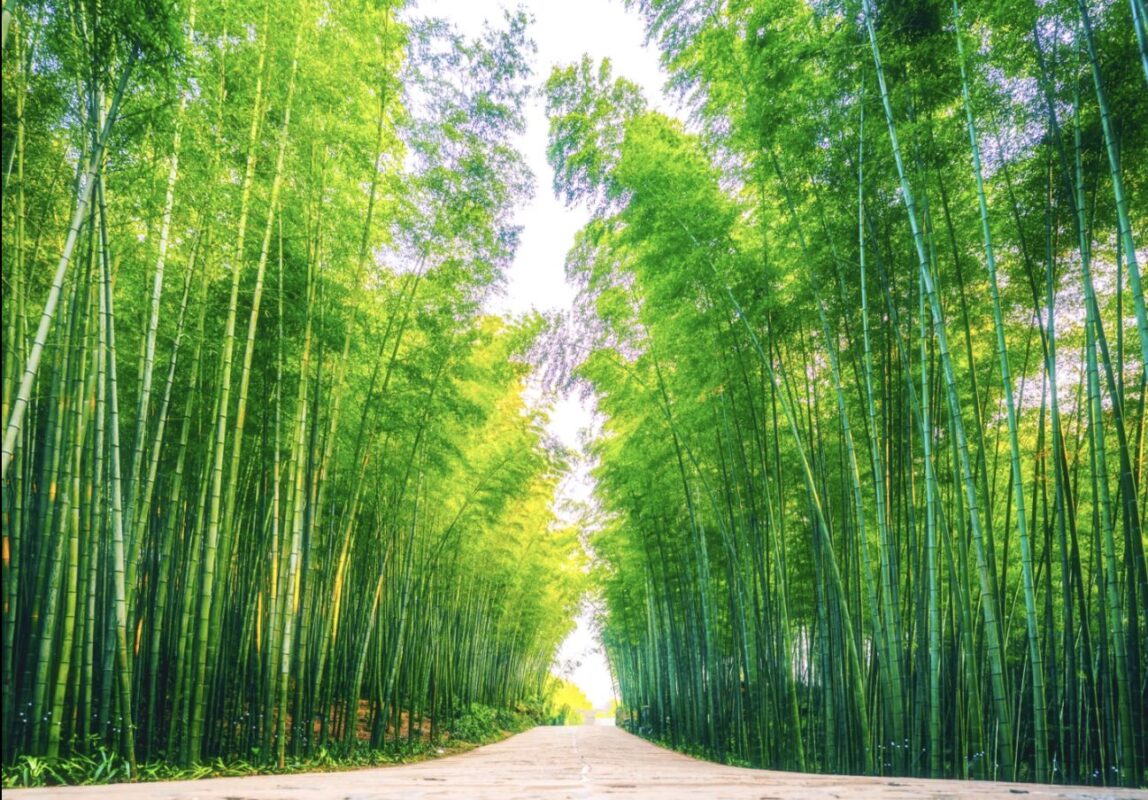
Why Chinese People Love Bamboo
If you ask a Chinese person why they love bamboo, they’ll probably pause, then say: “Because I’ve seen it all my life.”
That answer sounds like a cop-out. But it’s actually the most honest thing they could say.
Bamboo is everywhere in China. On country lanes, in ancestral courtyards, outside scholars’ studios, at the entrance of temples — bamboo is the kind of presence that doesn’t need to be sought. It simply appears in some corner of your life without being invited. It isn’t grand like a pine or cypress, demanding your reverence. It isn’t aloof like plum blossoms, withholding bloom until the depths of winter. Bamboo is approachable, worldly, woven into the texture of everyday Chinese life.
And it is precisely this “everydayness” that allowed bamboo to sink so deeply into Chinese culture.
The Years Beneath the Soil: What Bamboo Teaches Us About Patience
The most remarkable thing about bamboo actually happens where you can’t see it.
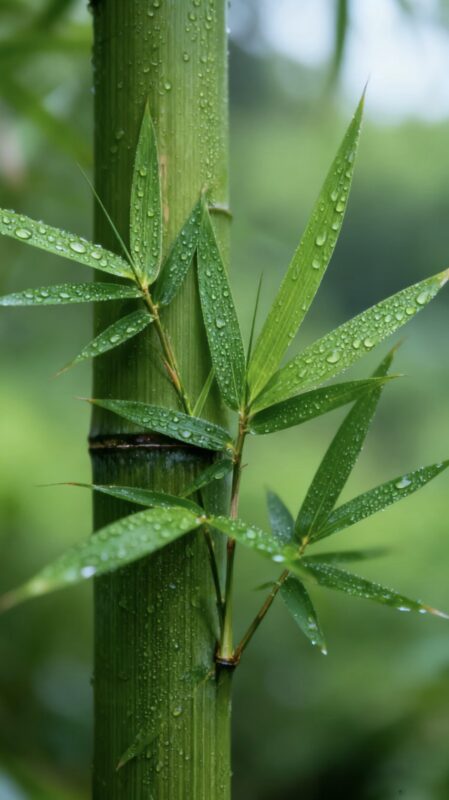
A single bamboo plant may look like a small clump above ground, but its root system spreads far and wide beneath the surface. Here is the part that always gets me: a bamboo shoot can grow from a freshly emerged sprout to a full-height stalk in under two months. But before that happens, it has been quietly developing underground for three to five years — sometimes longer.
For those first three to five years, the shoot extends its roots slowly in the darkness, reaching outward in every direction, drawing nutrients, building strength. On the surface, there is nothing. No sign. No movement. Just soil and silence. Nobody knows anything is happening down there. But the bamboo knows. It is waiting — for the right moment, for roots deep enough, for reserves thick enough. Then, after a single rainfall, it bursts through the earth and shoots upward at a rate of dozens of centimeters per day, completing in weeks what other trees take decades to achieve.
In Chinese there is a phrase for this: 厚积薄发— to store up quietly and then let it all come out at once. Grow slowly, grow steadily, and when the time is right, let it show. This isn’t an abstract philosophy. It is something Chinese people observed directly from watching bamboo. You think it bursts forth suddenly. But it spent five years getting ready.
Bamboo Has Never Belonged Only to Scholars
Many people assume bamboo is exclusively a literati symbol. Su Dongpo, the great Song Dynasty poet, put it plainly:
Better to go without meat than to live where bamboo does not grow.
Without meat a man grows thin —
without bamboo, he grows vulgar.
(宁可食无肉,不可居无竹:无肉令人瘦,无竹令人俗。— Better to go without meat than to live without bamboo; without meat you merely grow thin, but without bamboo you grow vulgar.)
In Su Dongpo’s view, vulgarity was the worse fate. Thinness could be fixed; loss of taste could not. This is how seriously Chinese literati took bamboo — as a marker of who you are at the level of your character.
But step just slightly outside that world, and you find bamboo was never only a scholar’s companion.
At my grandmother’s house, the bamboo sieve, the steamer, the cool mat, the palm-leaf fan — all bamboo. Lying on the bamboo mat in summer, your shirt sticking to your back, there was always a faint, clean scent in the air. Not strong, not showy, just reassuring. Like soil and sunlight mixed together and aged into something you could trust.
In southern Fujian and Chaoshan, when a new house is built, an important ceremony called “Tying Bamboo Leaves” takes place during the beam-raising. Two fresh bamboo leaves are tied to the main beam, symbolizing “Bamboo Reports Peace” — the “report” meaning to notify the heavens and the spirits that a family now dwells here. The bamboo leaf becomes a short letter, written by bamboo, to the sky.
In Hakka tradition, during the Dragon Boat Festival, households hang mugwort and calamus on the door, and some add a bamboo branch to ward off harm. The bamboo stalk, hollow and segmented, rising section by section, was understood as a pathway to heaven — negative energy, the folk believed, would simply travel up through the hollow and dissipate.
None of these beliefs can be verified by modern science. But they survived across generations not because they were “true” in an empirical sense, but because they once carried something real: the human need for safety, for a way to cope with uncertainty, for treating ordinary life with a little more seriousness.
If Bamboo Had a Personality
Sometimes I wonder: if bamboo had a personality, it would be the kind of friend who doesn’t say much, but is always there.
It won’t astonish you. But sit beneath it for a while, and something loosens. It doesn’t lecture you on how to live. But its presence says something anyway: slow down, make room, the wind will pass.
This is what feels so subtle about the Chinese relationship with bamboo. It’s not entirely about the noble qualities of “humility and integrity” either. Sometimes it’s simpler: it is there, and that steadies you.
When someone today places a bamboo plant in their home or wears a piece of bamboo-shaped jewelry, they may not know the full depth of the tradition behind it. But the choice itself has a lineage. It connects to a courtyard, to an elder, to a summer evening when a bamboo mat was the cool side of the pillow.
That is real. And real things stay with you.
One Clump of Bamboo
Later, I went to the Bamboo Sea of southern Sichuan, in the Yibin region. The forest stretched in every direction, and when the wind came through, the whole mountain spoke. The sound was unlike any other — not howling, but a soft, continuous rustle, as if thousands of bamboo stalks were conversing at once, or as if the mountain itself had fallen into a deep, meaningful silence.
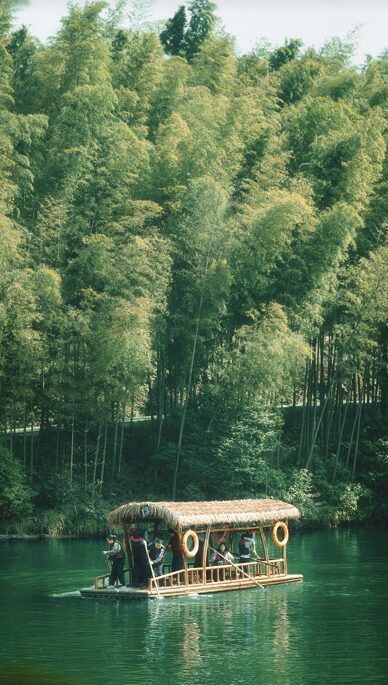
Standing inside it, I understood something old Chinese scholars used to say about bamboo: that its hollowness is not emptiness, but space — room made for other things to enter. Bamboo is empty inside. But empty isn’t the same as nothing.
Now, whenever I pass a grove of bamboo, I still stop and stand there for a while.
I don’t do anything. I just listen. A soft rustling, like words being spoken and nothing being said at the same time. If my grandmother were still alive, she would laugh at me and say: child, what are you standing there spaced out for?
That’s the one thing she gave me that I actually kept.
And now, doing this work — making things, writing about them — I find bamboo slipping into the pieces and the words without me putting it there. It stayed. In the end, that’s what it does.
Small pauses.Big shifts.Find your piece→