
Material
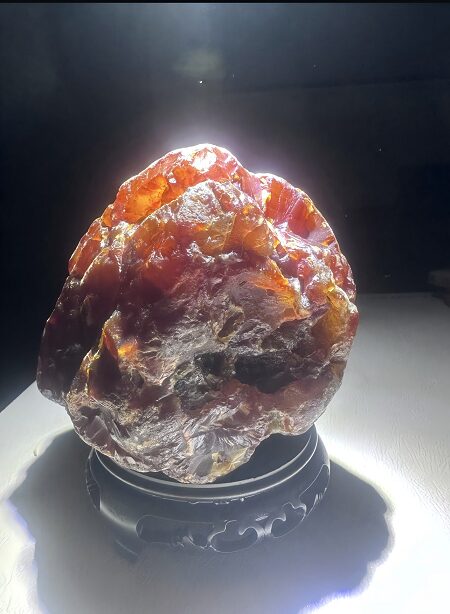
Agate is a variety of chalcedony — a microcrystalline form of quartz (silicon dioxide, SiO₂) — characterized by its distinctive banded texture: alternating layers in different colors, stacked like the rings of a tree. Carnelian (red agate) is the red variety of agate, its warm orange-red to deep brick-red color derived from trace amounts of iron oxide (Fe₂O₃). Carnelian has been one of the most consistently valued varieties of agate across civilizations — hard enough for daily wear (Mohs hardness 6.5 to 7), taking a beautiful polish, with an understated richness that has attracted jewelers and carvers for millennia.
A note on terminology: Carnelian (红玛瑙 / 红玉髓) is sometimes grouped with the broader “jade” (玉) family in casual Chinese usage, but they are mineralogically distinct. Similarly, carnelian must not be confused with cinnabar (朱砂, HgS, mercury sulfide) — a common point of confusion. Cinnabar has a Mohs hardness of only 2 to 2.5; carnelian is 6.5 to 7. They are entirely different minerals with different care requirements and cultural associations.
Cultural Significance
Ancient Egypt: Carnelian was one of the most prized materials in ancient Egypt for seals, amulets, and high-status jewelry. Egyptian beliefs held that carnelian possessed protective and restorative powers; it was commonly placed over the heart area of mummies as a talisman for the soul in the afterlife.
Ancient Rome: The Romans developed the extraordinary art of cameo carving — using agate’s natural color banding to carve a light-colored figure in relief against a darker background. Roman signet rings — personal seals worn to authenticate documents — were most commonly carved from carnelian and agate, passed down through families as marks of identity and authority.
Ancient Persia: Persian records show carnelian was a major trade good along the Silk Road, prized for its beauty and reputed power to confer strength and courage upon warriors. Persian soldiers wore carnelian talismans into battle.
Native American Cultures: Indigenous peoples of North America used carnelian extensively for tools and ceremonial objects, associating it with earth energies and physical endurance.
China and East Asia: In Chinese culture, red agate is most commonly encountered in Buddhist contexts — it is among the most traditional materials for prayer beads (佛珠, fo zhu). Red agate is also associated with stability and family harmony in Chinese folk tradition, making it a common material for heirloom jewelry passed from mothers to daughters across generations.
Energetic Qualities
Emotional Stability and Focus: Agate is traditionally regarded as one of the most grounding stones available — a stone that helps the wearer remain centered, steady, and emotionally settled during turbulent or distracting periods. Its characteristic banding — layers upon layers, stable and unchanging — is the visual metaphor for this quality.
Gentle Courage: Agate’s courage is not the loud, assertive kind. It is the quiet, persistent courage of someone who simply does not give up. In the contemporary crystal lexicon, this is described as supporting perseverance and inner strength during long-term challenges.
Protective Presence: Across ancient Egypt, Rome, Persia, and Mesoamerica, agate was worn as a protective talisman — not only against physical danger but against emotional disruption and anxiety. In contemporary practice, this is expressed as a stone that helps establish a sense of safe, contained personal space.
Family and Lineage Harmony: In the Chinese tradition, red agate is associated with the stability and continuity of family life. A well-worn strand of red agate beads, passed from mother to daughter, is understood not merely as jewelry but as a material symbol of family memory and continuity across time.
Who It Suits
Those who feel easily scattered, emotionally unsteady, or mentally adrift — agate’s quality of patient, persistent stability is its most defining energetic characteristic.
People in professions or life phases that require sustained attention and long-term focus.
Those who travel frequently or live in conditions of ongoing change — agate’s traditional association with stability and grounding makes it a meaningful companion.
Meditation practitioners and those engaged in contemplative practices — red agate is described as a supportive stone for seated practice.
Those who value heirloom-quality jewelry with genuine cultural depth and potential for intergenerational transmission.
When to Wear It
As a daily grounding companion — agate’s hardness (6.5–7) makes it one of the most practical stones for everyday wear.
During periods of transition or uncertainty — moving to a new home, starting a new chapter professionally.
During focused work or study — red agate worn as a pendant or bracelet is traditionally used as a tactile anchor for sustained concentration.
During travel — the stone’s ancient reputation as a traveler’s protective talisman makes it a natural companion.
As meditative support — holding a smooth piece of red agate during seated practice, or placing it on a meditation altar.
Small pauses.Big shifts.Find your piece→
Care Instructions
Avoid pairing with harder stones: Store separately from diamond, sapphire, and ruby, which can scratch agate’s polished surface.
Clean with lukewarm water and a soft cloth — mild soap is fine. Avoid harsh chemicals and ultrasonic cleaners, which can stress any micro-fissures within the stone.
Avoid prolonged heat and sudden temperature changes — thermal shock can cause internal stress fractures.
Remove before swimming in chlorinated pools or using hot tubs — chlorine can dull the surface polish over time.
Agate develops its luster naturally with regular wear — natural skin oils gently polish the stone over time, which is why old, well-worn agate beads are often more beautiful than newly polished pieces.
Further Reading & References
The Book of Stones Robert Simmons & Naisha Ahsian, North Atlantic Books, multiple editions since 2005. — The authoritative modern reference in the crystal field, with detailed entries on agate varieties including carnelian and fire agate.
The Crystal Bible Judy Hall, Godsfield Press, 2003. — One of the world’s best-selling crystal reference guides, with extensive entries on agate varieties and their historical applications.
Liu Guanghui — Chinese Ancient Bead Appreciation 刘光辉。《中国古珠鉴赏》。上海古籍出版社,2018. — A comprehensive guide to ancient Chinese beads — including carnelian and agate beads — with historical and cultural context.
GIA — Gemological Institute of America: Chalcedony Information https://www.gia.edu/ — The GIA’s official chalcedony and agate information page, covering formation, varieties, and market quality factors.
Smithsonian National Museum of Natural History — Minerals & Gems Collection https://naturalhistory.si.edu/ — The Smithsonian’s public-facing minerals collection, with information on agate formation and global sources.
FAQ
Chalcedony is the broader category: a micro-crystalline form of quartz (SiO₂). Agate is chalcedony that displays distinctive banding or parallel color layers. Carnelian (also called red agate) is simply the red variety of agate — chalcedony colored by iron oxide to produce warm orange-red to deep brick-red tones. In Chinese usage, “红玉髓
” (hong yusui, literally “red jade crystal”) is another name for carnelian — all three terms describe essentially the same material with slightly different naming conventions.
Carnelian (红玛瑙/红玉髓) and cinnabar (朱砂, zhu sha) are entirely different minerals. Carnelian is a variety of chalcedony — silicon dioxide (SiO₂) — with a Mohs hardness of 6.5 to 7. Cinnabar is mercury sulfide (HgS) with a Mohs hardness of only 2 to 2.5. They look somewhat similar in color but have different compositions, hardness levels, and care requirements. Cinnabar should never be worn in direct skin contact for prolonged periods, while carnelian is safe for everyday wear.
Agate banding forms as silica-rich groundwater slowly deposits layers of chalcedony inside rock cavities and vesicles — each band represents a distinct period of geological deposition, with color variations reflecting differences in the trace element composition (primarily iron and manganese) of the water at different times. This process takes millions of years.
Yes — agate rates 6.5 to 7 on the Mohs scale, making it hard enough for daily jewelry wear. It is more resistant to scratching than softer stones. That said, it should not be stored alongside diamond, sapphire, or ruby, which are harder and can scratch agate’s polished surface. Strong impacts should also be avoided, as agate can chip or crack under sufficient force.
Agate is particularly suitable for: those who feel emotionally scattered or easily distracted and seek a grounding, stabilizing energy companion; frequent travelers and people navigating periods of change; meditation and yoga practitioners who want a quiet, steady stone for contemplative practice; those who value heirloom-quality jewelry with genuine cultural depth; and anyone who appreciates warm, understated beauty that rewards close attention.
Clean with lukewarm water and a soft cloth — mild soap is fine. Avoid harsh chemicals, ultrasonic cleaners, and steam cleaners, which can stress micro-fissures within the stone.
Store separately from harder gemstones (especially diamond, sapphire, and ruby) to prevent scratching.
Remove before swimming in chlorinated pools, using hot tubs, or engaging in activities involving strong chemicals.
Avoid prolonged exposure to strong heat or rapid temperature changes.
Agate develops its natural luster with regular wear — natural skin oils gently polish the surface over time, which is why well-worn agate beads often look more beautiful than newly polished pieces.